
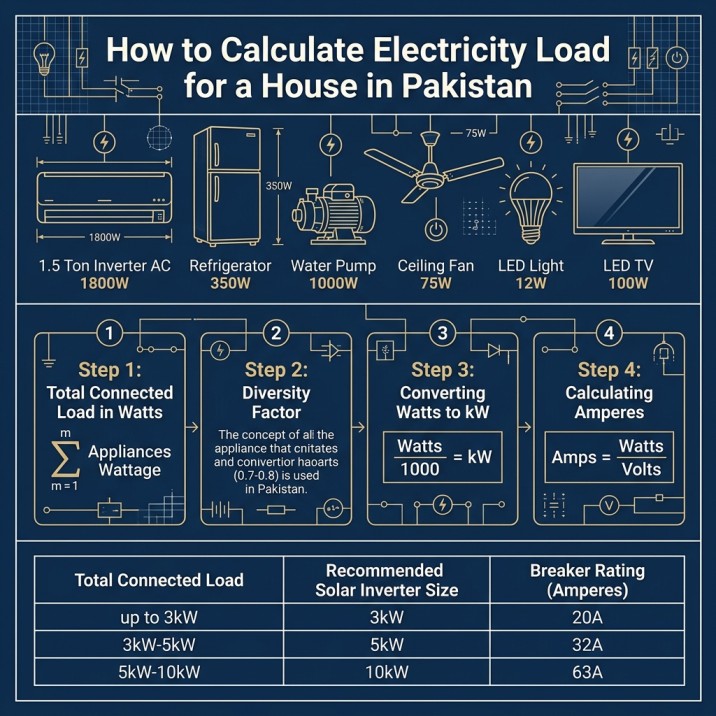
Calculating the electricity load of a house is one of the most important steps before installing a new electrical connection, upgrading a distribution board, selecting a generator or inverter, or planning a solar system.
Many homeowners in Pakistan simply add the wattage written on their appliances and assume that the final number is their actual electricity requirement. While this is a useful starting point, it does not tell the complete story.
For example, a house may have an air conditioner rated at 1,500 watts, a refrigerator using around 200 watts while running, several fans, lights, a water pump, a washing machine, a microwave and other appliances. But not all of these appliances necessarily operate at the same time.
This is why there is an important difference between connected load and the actual maximum demand of a house.
In this guide, we will explain how to calculate electricity load for a house in Pakistan in 2026, how to calculate appliance wattage, how to convert watts into kilowatts, how to estimate maximum demand, how to calculate current in amperes, and how the result can help you choose electrical protection, generators, UPS systems and solar systems.
Pakistan’s electricity billing and tariff structure also uses concepts such as sanctioned load, and NEPRA’s current 2026 residential tariff documents distinguish residential consumers according to sanctioned load, including a threshold of 5 kW for certain tariff treatment.
What Is Electrical Load?
Electrical load is the amount of electrical power that appliances and equipment require when they are operating.
It is commonly expressed in:
- Watts (W)
- Kilowatts (kW)
- Volt-amperes (VA)
- Kilovolt-amperes (kVA)
For most household load calculations, watts and kilowatts are the easiest units to understand.
Basic conversion
1 kilowatt (kW) = 1,000 watts (W)
So:
- 500 W = 0.5 kW
- 1,000 W = 1 kW
- 2,000 W = 2 kW
- 3,500 W = 3.5 kW
- 5,000 W = 5 kW
- 10,000 W = 10 kW
If the total electrical demand of a house is 4,000 watts:
4,000 ÷ 1,000 = 4 kW
Therefore, the estimated load is 4 kW.
Why Should You Calculate Your House Electricity Load?
Knowing your home’s electrical load helps with several important decisions.
1. Selecting the right electricity connection
Your calculated requirement can help determine whether your home’s electrical setup is suitable for the expected demand.
2. Choosing the correct main breaker
The main protective device should be selected according to the electrical design, cable capacity, current and fault conditions.
3. Selecting a generator
If you want backup power during load-shedding, you need to know how much load the generator may have to support.
4. Selecting an inverter
The inverter must have sufficient output capacity for the appliances you intend to operate simultaneously.
5. Designing a solar system
Solar system sizing starts with understanding energy consumption and load requirements.
6. Avoiding overload
An electrical system that is consistently overloaded can result in nuisance breaker trips, voltage problems, overheating and equipment damage.
Connected Load vs Actual Load
This is one of the most important concepts in electricity load calculation.
Suppose your house contains:
- 6 fans
- 15 LED lights
- 1 refrigerator
- 2 air conditioners
- 1 washing machine
- 1 water pump
- 1 television
- 1 microwave
- 1 iron
- 1 electric kettle
If you add the rated power of every appliance, you may get a large number.
That number represents approximately the connected load if all listed equipment is considered available to operate.
But it does not necessarily mean that every appliance will run at full power simultaneously.
For example, you may not use:
- The iron
- Electric kettle
- Microwave
- Washing machine
- Both air conditioners
all at exactly the same moment.
The power system therefore needs to be considered based on maximum expected demand, not merely the sum of every appliance’s nameplate rating.
What Is Connected Load?
Connected load is the total rated capacity of the electrical appliances or equipment connected to an electrical installation.
Example
Suppose a house has:
| Appliance | Quantity | Approx. Rating | Total |
|---|---|---|---|
| LED lights | 10 | 12 W | 120 W |
| Ceiling fans | 5 | 80 W | 400 W |
| Refrigerator | 1 | 250 W | 250 W |
| TV | 1 | 120 W | 120 W |
| AC | 2 | 1,500 W | 3,000 W |
| Water pump | 1 | 750 W | 750 W |
| Washing machine | 1 | 500 W | 500 W |
| Microwave | 1 | 1,200 W | 1,200 W |
| Iron | 1 | 1,000 W | 1,000 W |
Total:
7,340 watts
or:
7.34 kW
This is an example of connected load based on the assumed appliance ratings.
Actual ratings vary by appliance model, operating mode and manufacturer, so the nameplate/manual should be used for an accurate calculation.
Step-by-Step: How to Calculate Electricity Load for a House
The easiest method is to make an appliance list.
Step 1: List Every Major Appliance
Start by writing down everything that consumes electricity.
For example:
- Lights
- Fans
- Refrigerator
- Deep freezer
- Television
- Washing machine
- Water pump
- Air conditioner
- Microwave
- Electric oven
- Electric kettle
- Iron
- Computer
- Laptop
- Water heater
- Room heater
- Exhaust fans
- Kitchen appliances
Do not forget smaller appliances if you want a more complete estimate.
Step 2: Find the Wattage of Each Appliance
Look for the rating label on the appliance.
You may find specifications such as:
Power: 100 W
or:
Rated Power: 1,200 W
or:
Input: 220–240 V, 50 Hz, 6 A
If the appliance gives voltage and current instead of watts, you can estimate power using:
Power (W) = Voltage (V) × Current (A)
For a simple resistive appliance, this can provide a reasonable basic calculation.
For motors, compressors and other equipment, the relationship can be more complicated because of power factor and starting characteristics.
Step 3: Multiply Wattage by Quantity
If you have five fans and each fan is rated at 80 W:
80 × 5 = 400 W
If you have 10 lights rated at 12 W:
12 × 10 = 120 W
Do this for every appliance category.
Step 4: Add the Wattage
Now add all appliance totals.
For example:
- Lights = 120 W
- Fans = 400 W
- Refrigerator = 250 W
- TV = 120 W
- ACs = 3,000 W
- Pump = 750 W
Total:
120 + 400 + 250 + 120 + 3,000 + 750 = 4,640 W
Therefore:
4,640 W ÷ 1,000 = 4.64 kW
The connected load in this example is approximately 4.64 kW.
Step 5: Estimate Simultaneous Load
Now ask an important question:
Which appliances are likely to run at the same time?
This gives you a more practical estimate of maximum demand.
For example, during a hot summer afternoon, your house might simultaneously use:
- 2 ACs
- 5 fans
- Refrigerator
- Lights
- TV
- Water pump
But the washing machine, iron, microwave and electric kettle may not be running simultaneously.
Your actual peak load might therefore be lower than the total connected load.
Example: Electricity Load Calculation for a Pakistani House
Let’s take a realistic example.
Suppose a house has:
Lighting
10 LED bulbs × 12 W:
120 W
Fans
5 fans × 80 W:
400 W
Refrigerator
1 × 250 W:
250 W
Television
1 × 120 W:
120 W
Two inverter ACs
2 × 1,500 W assumed running input:
3,000 W
Water pump
1 × 750 W:
750 W
Washing machine
1 × 500 W:
500 W
Microwave
1 × 1,200 W:
1,200 W
Iron
1 × 1,000 W:
1,000 W
Electric kettle
1 × 1,500 W:
1,500 W
Now add everything:
120 + 400 + 250 + 120 + 3,000 + 750 + 500 + 1,200 + 1,000 + 1,500
= 8,840 W
or:
8.84 kW
This is the approximate connected load based on the assumed ratings.
However, it would be unrealistic to assume that the kettle, iron, microwave, washing machine and both ACs will always operate together.
Therefore, the maximum demand may be lower.
What Is Maximum Demand?
Maximum demand is the highest amount of electrical power that your house is expected to require at a particular time.
This is more useful for many system-design decisions than simply adding every appliance.
For example:
Connected load
8.84 kW
Expected simultaneous load
Suppose the following operate together:
- 2 ACs = 3,000 W
- 5 fans = 400 W
- Refrigerator = 250 W
- Lights = 120 W
- TV = 120 W
- Pump = 750 W
Total:
4,640 W
So the expected simultaneous load in this example is around:
4.64 kW
This does not mean that the house should automatically be assigned a 4.64 kW electrical connection. Actual electrical design and the utility’s requirements need to be considered.
What Is Demand Factor?
Demand factor helps explain why the connected load can be greater than the actual maximum demand.
A simple formula is:
Demand Factor = Maximum Demand ÷ Connected Load
Suppose:
Connected load = 8.84 kW
Maximum demand = 4.64 kW
Then:
Demand Factor = 4.64 ÷ 8.84
≈ 0.52
This means the assumed maximum demand is approximately 52% of the connected load.
Demand factor is not a number that should simply be guessed for every house. Actual usage patterns and electrical design determine the appropriate assumptions.
How to Calculate Electricity Load in Amps
Sometimes you need to know the current rather than just the power.
For a basic single-phase calculation:
Current (A) = Power (W) ÷ Voltage (V)
Pakistan’s residential supply is commonly based around approximately 230 V nominal single-phase supply, but actual voltage can vary.
For a simple example, if the load is:
4,600 W
and the assumed voltage is:
230 V
Then:
4,600 ÷ 230 = 20 A
So the approximate current is:
20 amps
For real-world AC installations, especially with motors and electronic equipment, power factor and other factors can affect the actual current.
Single-Phase vs Three-Phase Load
This is another important consideration for larger houses.
Single-phase connection
A normal residential house may operate on a single-phase supply.
A simplified current calculation is:
I = P ÷ V
where:
- I = current
- P = power
- V = voltage
Three-phase connection
For a balanced three-phase system, a simplified relationship is:
P = √3 × V × I × Power Factor
Therefore:
I = P ÷ (√3 × V × Power Factor)
Three-phase calculations are more appropriate for larger electrical installations and should be designed by a qualified professional.
NEPRA’s current tariff documents distinguish residential treatment according to sanctioned load, including separate provisions for residential consumers at 5 kW and above.
What Is Sanctioned Load in Pakistan?
You may see the term sanctioned load on electricity-related documents and bills.
Sanctioned load is the load approved for the consumer connection by the relevant distribution company.
It is important to understand that:
Sanctioned load is not exactly the same thing as your monthly electricity consumption.
For example:
A house may have a sanctioned load of 5 kW but consume 400 units in one month.
The two measurements describe different things.
NEPRA’s current 2026 tariff schedule explicitly uses sanctioned load as a category in residential tariff treatment. For example, it separates residential consumers with sanctioned load below 5 kW from those with 5 kW and above.
NEPRA’s regulatory forms also use fields such as Sanctioned Load (kW) and Applied Load (kW), showing that these are distinct electrical-connection concepts.
Load vs Electricity Consumption – What Is the Difference?
This is one of the most common sources of confusion.
Load
Load tells you how much power appliances require at a given moment.
Measured in:
W or kW
Consumption
Consumption tells you how much electrical energy you use over time.
Measured in:
kWh or units
In Pakistan, when people say:
“Mere ghar mein 500 units bijli use hui.”
they are talking about energy consumption.
One electricity unit is commonly equivalent to:
1 kWh
How to Calculate Electricity Consumption
The basic formula is:
Energy Consumption (kWh) = Power (kW) × Operating Time (hours)
For example, a 1 kW appliance operating for 5 hours:
1 × 5 = 5 kWh
Therefore, it uses approximately:
5 units
Example
Suppose a 1,500 W appliance runs for 4 hours.
Convert:
1,500 W = 1.5 kW
Then:
1.5 × 4 = 6 kWh
So it consumes approximately:
6 units
Load Calculation Example for a 5 kW House
Suppose your estimated simultaneous load is around 5 kW.
Your appliances may include:
- 2 ACs
- 5 fans
- Refrigerator
- Lights
- TV
- Water pump
- Kitchen appliances
A 5 kW load does not mean that your house will consume 5 units every hour throughout the month.
If the house actually draws 5 kW continuously for one hour:
5 kW × 1 hour = 5 kWh
But if the average load is only 2 kW for five hours:
2 × 5 = 10 kWh
This distinction is extremely important when calculating electricity bills and solar requirements.
How to Calculate Load for Solar System Sizing
If you are planning solar for your home, load calculation becomes even more important.
However, solar sizing should not be based only on maximum load.
You should consider both:
1. Power requirement
How much power do you need at one time?
Measured in:
kW
2. Daily energy consumption
How much energy do you use during the day?
Measured in:
kWh/day
For example:
A home might have a maximum simultaneous load of:
5 kW
but average daily consumption of:
15–20 kWh
The solar system should be designed according to the home’s energy profile, daytime consumption, battery requirements, inverter capacity and other site-specific factors.
This is why a 5 kW load does not automatically mean you need exactly a 5 kW solar panel system.
Load Calculation for a Solar Inverter
Inverter selection is especially important for homes using solar and batteries.
Suppose the appliances you want to operate simultaneously require:
- Fans = 400 W
- Lights = 120 W
- Refrigerator = 250 W
- TV = 120 W
- AC = 1,500 W
- Pump = 750 W
Total:
3,140 W
or approximately:
3.14 kW
The inverter must be selected based on the actual required load, surge characteristics, operating conditions and manufacturer specifications.
Motors and compressors can have starting/inrush requirements that are different from their normal running power.
Therefore, simply adding nameplate wattages may not always be enough.
Load Calculation for a Generator
The same principle applies when selecting a generator.
Suppose you want backup power for:
- Refrigerator
- Fans
- Lights
- TV
- Internet equipment
- One AC
First calculate the expected simultaneous load.
Then consider:
- Starting current
- Motor loads
- Generator power factor
- Generator kW/kVA rating
- Desired reserve capacity
Generators are commonly marketed in kVA, so it is important to understand that kVA and kW are not always numerically identical.
A qualified installer should select the generator based on the actual load characteristics.
How to Calculate Appliance Load From Current
Sometimes an appliance does not clearly show wattage but gives voltage and current.
For a simple load:
Power = Voltage × Current
Example:
Voltage = 230 V
Current = 5 A
Therefore:
230 × 5 = 1,150 W
So the approximate apparent/simple power calculation is 1,150 VA, while the actual real power can differ depending on power factor.
For motors, refrigerators, pumps, air conditioners and other inductive/electronic loads, do not blindly use this simplified formula as an exact real-power measurement.
Common Household Appliance Wattage Examples
The following figures are only illustrative estimates. Actual consumption varies significantly by model, capacity, efficiency, operating mode and environmental conditions.
| Appliance | Example Approx. Power |
|---|---|
| LED bulb | 7–15 W |
| Ceiling fan | 50–100 W |
| LED TV | 60–150 W |
| Refrigerator | 100–400 W while operating |
| Laptop | 40–100 W |
| Desktop PC | 150–500+ W |
| Washing machine | 400–1,000 W |
| Water pump | 500–1,500+ W |
| Microwave | 1,000–1,500 W |
| Electric iron | 800–2,000 W |
| Electric kettle | 1,000–2,500 W |
| Room heater | 1,000–2,500 W |
| Air conditioner | Highly variable |
| Electric oven | 1,500–3,500+ W |
Always check the appliance’s actual nameplate or manufacturer’s specification before using the number for a serious electrical design.
Why Air Conditioner Load Is Difficult to Calculate
Air conditioners are among the most important loads in Pakistani homes.
A common mistake is to assume:
“My AC is 1.5 ton, so it always consumes exactly X watts.”
That is not necessarily true.
Power consumption depends on:
- AC technology
- Inverter vs non-inverter
- Cooling capacity
- Outdoor temperature
- Room size
- Insulation
- Thermostat setting
- Compressor speed
- Indoor temperature
- Outdoor unit condition
- Manufacturer and model
An inverter AC may vary its compressor speed rather than continuously consuming the same amount of power.
Therefore, for an accurate calculation, check the actual input-power specification of your particular AC.
Why Refrigerator Load Is Also Variable
A refrigerator does not necessarily consume its maximum rated power continuously.
The compressor cycles on and off depending on:
- Internal temperature
- Ambient temperature
- Door opening
- Refrigerator size
- Efficiency
- Thermostat setting
Therefore, its nameplate wattage should not automatically be multiplied by 24 hours to estimate actual daily consumption.
For a more accurate energy estimate, use the manufacturer’s energy information or measure the appliance with an appropriate energy meter.
A Simple House Load Calculation Template
You can create a table like this:
| Appliance | Quantity | Watts Each | Total Watts | Expected Operating Together? |
|---|---|---|---|---|
| LED Lights | 10 | 12 | 120 | Yes |
| Fans | 5 | 80 | 400 | Yes |
| Refrigerator | 1 | 250 | 250 | Yes |
| TV | 1 | 120 | 120 | Yes |
| AC | 2 | 1,500 | 3,000 | Maybe |
| Pump | 1 | 750 | 750 | Maybe |
| Washing Machine | 1 | 500 | 500 | No/Occasional |
| Iron | 1 | 1,000 | 1,000 | No |
| Microwave | 1 | 1,200 | 1,200 | No |
Then calculate:
Total Connected Load
Add all the total watts.
Maximum Expected Load
Add the appliances likely to run simultaneously.
Daily Energy Consumption
Estimate how many hours each appliance operates.
This gives you three different but useful numbers.
Three Numbers Every Homeowner Should Know
Before buying a solar system, generator or backup inverter, try to determine:
1. Connected Load
The total rated appliance capacity.
Example:
8.8 kW
2. Maximum Demand
The highest expected simultaneous load.
Example:
4.6 kW
3. Daily Energy Consumption
Total electricity used during the day.
Example:
18 kWh/day
These three numbers answer different questions.
Common Electricity Load Calculation Mistakes
Mistake 1: Adding everything and assuming it runs simultaneously
This can dramatically overestimate your actual demand.
Mistake 2: Ignoring appliance starting current
Pumps, compressors and motors can have starting requirements above their normal operating power.
Mistake 3: Confusing kW with kWh
kW is power.
kWh is energy consumed over time.
Mistake 4: Assuming every appliance has a fixed wattage
Inverter ACs, refrigerators and many electronic devices can vary their power consumption.
Mistake 5: Choosing a breaker based only on total watts
Cable size, installation conditions, fault current and protection requirements also matter.
Mistake 6: Choosing solar panels based only on connected load
Solar system sizing also requires energy consumption, sunlight availability, inverter capacity and usage pattern.
Mistake 7: Ignoring future appliances
If you are building a new house, consider future additions such as:
- More ACs
- Electric water heater
- Electric oven
- EV charger
- Water pump
- Solar battery
- Additional rooms
How to Reduce Your House Electricity Load
Calculating load is not only about increasing electrical capacity.
It can also show you where energy savings are possible.
Use efficient LED lighting
Replacing inefficient lighting can reduce lighting demand.
Choose inverter ACs
Efficient inverter ACs can reduce energy consumption depending on usage conditions.
Improve insulation
Better insulation can reduce cooling requirements.
Maintain AC filters
Dirty filters can reduce cooling performance and increase energy use.
Avoid unnecessary standby loads
Chargers, electronics and appliances can consume energy even when not actively being used.
Use efficient fans
Modern energy-efficient fans can reduce continuous household load.
Use solar during daytime
Running suitable daytime loads from solar can reduce grid electricity consumption.
How Many kW Does a Normal House Need?
There is no single answer because houses vary significantly.
A small house with basic lighting, fans, refrigerator, TV and limited appliances may have a relatively low peak demand.
A larger house with:
- Multiple ACs
- Electric kitchen appliances
- Pumps
- Water heaters
- Washing machines
- Computers
- Other high-power equipment
can have a much higher demand.
Instead of asking:
“How many kW does a house need?”
ask:
“What appliances do I have, how much power do they require, and which ones operate simultaneously?”
That gives you a much more useful answer.
What Load Is Suitable for a 5 kW Connection?
A 5 kW figure should not be treated as a universal recommendation.
A home’s required sanctioned load depends on its electrical design and expected demand.
For tariff purposes, NEPRA’s 2026 residential schedule distinguishes consumers with sanctioned load below 5 kW from those at 5 kW and above.
If your calculated demand is approaching or exceeding your sanctioned load, consult your relevant electricity distribution company and a qualified electrician about the appropriate connection and electrical infrastructure.
Can I Calculate My Home Load From My Electricity Bill?
An electricity bill can help you understand energy consumption, but it does not necessarily tell you your exact real-time maximum load.
For example, your bill may show:
500 units
That means approximately:
500 kWh
for the billing period.
It does not mean:
500 kW load
These are completely different measurements.
For more accurate load information, use appliance nameplate data, an energy meter or appropriate electrical measuring equipment.
Best Way to Calculate Your Home Electricity Load in 2026
For a basic household estimate, follow this process:
Step 1
List all appliances.
Step 2
Record the actual wattage of each appliance.
Step 3
Multiply watts by quantity.
Step 4
Add all appliance ratings to calculate connected load.
Step 5
Identify appliances that are likely to operate simultaneously.
Step 6
Calculate expected maximum demand.
Step 7
Calculate daily energy consumption separately.
Step 8
Consider starting current for motors and compressors.
Step 9
Consider future electrical loads.
Step 10
Ask a qualified electrician or electrical engineer to verify the final design before installing breakers, cables, generators, inverters or major electrical equipment.
Final Conclusion
Learning how to calculate electricity load for a house in Pakistan is essential if you are planning a new electrical connection, upgrading your home wiring, installing a generator, buying an inverter or designing a solar system.
The basic calculation is simple:
Load (W) = Appliance Wattage × Quantity
Then:
Total Load (kW) = Total Watts ÷ 1,000
But a professional electrical design requires more than simply adding appliance wattages.
You should distinguish between connected load, maximum demand and energy consumption.
For example, a house may have a connected load of 8 kW while its actual maximum simultaneous demand is only around 5 kW. At the same time, its monthly electricity consumption may be several hundred kWh.
These numbers are different and should be used for different decisions.
For homeowners in Pakistan, load calculation is becoming increasingly important because many households are adding air conditioners, water pumps, electric appliances, solar systems, batteries, inverters and electric vehicles to their homes.
NEPRA’s current 2026 tariff framework also makes sanctioned load an important consideration in residential electricity arrangements, including different treatment around the 5 kW threshold.
The best approach is therefore to calculate your household’s electrical requirements carefully rather than choosing a breaker, generator, inverter or solar system based on guesswork.
And remember:
The goal is not simply to calculate the biggest possible load. The goal is to understand how much power your home actually needs, when it needs it, and how the electrical system can safely handle that demand.
Frequently Asked Questions
How do I calculate the electrical load of my house?
List all appliances, find their wattage, multiply wattage by quantity and add the results. Then estimate which appliances will operate simultaneously to determine maximum expected demand.
What is the formula for calculating electrical load?
For basic household calculations:
Total Load (W) = Wattage × Quantity
and:
Load (kW) = Total Watts ÷ 1,000
What is the difference between load and units?
Load is the amount of power being used at a particular time and is measured in W or kW. Electricity consumption is energy used over time and is measured in kWh, commonly called units.
How many watts is 1 kW?
1 kW = 1,000 watts.
How do I calculate amps from watts?
For a simple single-phase calculation:
Current = Power ÷ Voltage
For real installations, power factor and other electrical characteristics may need to be considered.
Is 5 kW enough for a house?
It depends on the appliances and how many operate simultaneously. A house with multiple ACs and high-power appliances may require more capacity than a smaller house.
Is sanctioned load the same as electricity consumption?
No. Sanctioned load refers to the approved electrical load of the connection, while consumption refers to the energy used over time, normally measured in kWh or units.
Can load calculation help me choose a solar system?
Yes. Load calculation helps determine inverter capacity and peak power requirements, while daily energy consumption helps determine the appropriate solar generation and battery strategy.