
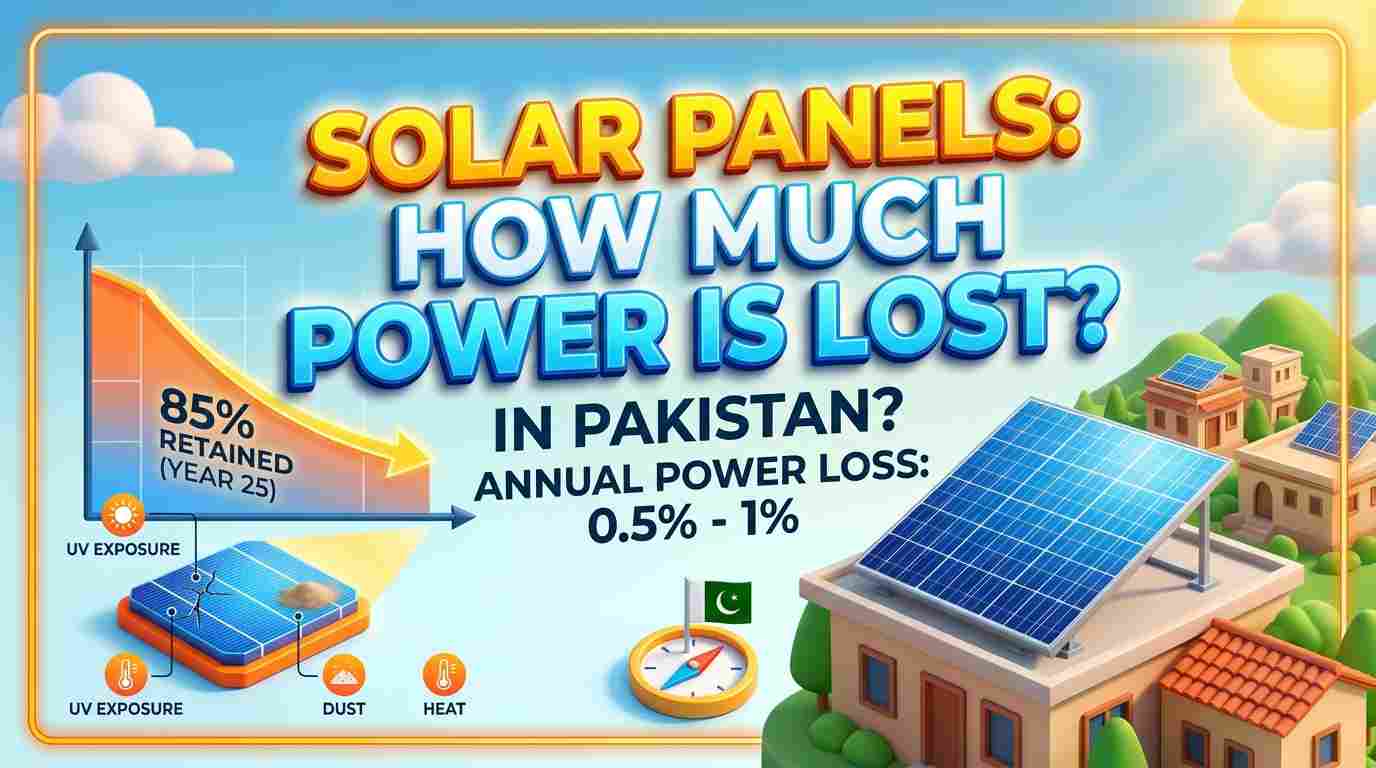
Solar panels are designed to produce electricity for decades, but they do not maintain exactly the same output forever. Like most outdoor equipment, photovoltaic (PV) modules gradually lose a small amount of their original power as they age.
For homeowners and businesses in Pakistan, an important question is:
How much power does a solar panel actually lose every year?
The short answer is that a good-quality modern solar panel may typically have a long-term degradation rate around 0.3% to 0.5% per year, depending on the technology and manufacturer’s warranty. Broader field research has found a median PV degradation rate of around 0.5% per year, while some system-level studies report higher figures because they include factors beyond module aging.
However, there is an important point for Pakistani solar users:
A panel losing 0.5% of its rated power because of aging is not the same thing as a panel producing less electricity because of dust, high temperature, shading, dirt, wiring problems or inverter issues.
These temporary or system-level losses can sometimes be much larger than the panel’s actual annual degradation.
This guide explains how solar panel degradation works, how much output you can expect after 5, 10, 20 and 25 years, how Pakistan’s climate affects solar performance, and what you can do to keep your system producing efficiently.
What Is Solar Panel Degradation?
Solar panel degradation means the gradual reduction in a solar module’s ability to produce electricity as it gets older.
A new panel may have a rated power of, for example, 585 watts.
After many years of exposure to sunlight and outdoor conditions, its maximum electrical output may be somewhat lower than when it was new.
This does not mean that a 585W panel suddenly becomes useless after a few years.
The reduction normally happens gradually.
For example, if a panel has a warranted degradation rate of 0.5% per year, its output after several years can still remain very high compared with its original rated capacity.
This is one reason reputable solar manufacturers provide long performance warranties.
Some modern manufacturers offer annual degradation warranties below 0.5%. For example, REC lists 0.5% annual degradation for some modules, while certain REC products specify 0.25%. First Solar’s Series 7 modules advertise a 0.3% warranted annual degradation rate.
The exact figure therefore depends on the panel technology and model.
How Much Does a Solar Panel Lose Per Year?
There is no single degradation rate for every solar panel.
A useful general range for modern quality panels is:
| Annual degradation | General interpretation |
|---|---|
| 0.2%–0.3% | Very low degradation |
| 0.3%–0.5% | Excellent modern performance |
| Around 0.5% | Common benchmark |
| 0.5%–0.8% | Higher but possible |
| 0.8%–1%+ | Should be investigated if unexpected |
A major NREL review of historical PV field data found a median degradation rate of approximately 0.5% per year. NREL also notes that reported degradation rates can vary considerably depending on technology, system, climate and measurement method.
Therefore, if someone says:
“Solar panels lose 10% power every year.”
That is generally not correct for a normal modern quality panel.
Likewise, saying:
“Every solar panel loses exactly 0.5% every year.”
is also incorrect.
The actual rate depends on the panel.
What Happens to a 585W Solar Panel Over Time?
Let’s use a 585W solar panel as a simple example.
Assume an illustrative degradation rate of 0.5% per year.
The calculation is approximately:
Remaining output = Original power × (1 − degradation rate)^years
Using 0.5% annual degradation:
| Age of panel | Approx. remaining rated output |
|---|---|
| New | 585W |
| 5 years | ~570W |
| 10 years | ~556W |
| 15 years | ~543W |
| 20 years | ~529W |
| 25 years | ~516W |
These figures are illustrative calculations based on a constant 0.5% annual degradation rate. Actual warranty calculations can use different methods and guaranteed minimum power values.
Notice something important:
After 25 years, the panel has not lost 50% of its power.
At a 0.5% annual rate compounded over 25 years, it would retain roughly 86% of its original output.
This is consistent with the type of 25-year performance warranty offered by some manufacturers. For example, REC states that a module with a 0.5% warranted annual degradation rate will retain at least 86% of nameplate power in its 25th year.
Does the Panel Lose 0.5% Immediately Every Year?
Not necessarily.
Solar panel degradation is not always perfectly linear in the real world.
Some modules can experience a larger initial reduction associated with early-life effects and then settle into a slower long-term degradation rate.
Modern module technologies are designed to reduce several of these effects.
This is why customers should look at the manufacturer’s performance warranty, rather than relying only on a general “0.5% per year” statement.
When buying solar panels, check:
- Product warranty
- Performance warranty
- Guaranteed power after 10 years
- Guaranteed power after 25 years
- Annual degradation rate
- Panel technology
- Temperature coefficient
- Manufacturer reputation
Pakistan’s Climate Makes the Situation More Complicated
Pakistan receives strong sunlight, making it an excellent country for solar energy.
But the same environment that provides abundant sunlight can also create operating challenges.
Solar panels installed in Pakistan may experience:
- High summer temperatures
- Dust
- Sand
- Air pollution
- Bird droppings
- Humidity in some areas
- Rain
- Strong sunlight
- Thermal cycling
- Occasional hail or severe weather
- Poor-quality installation
- Incorrect mounting
- Shading
- Poor ventilation
These factors should not automatically be called “panel degradation.”
That distinction is extremely important.
Permanent Degradation vs Temporary Power Loss
Consider a 585W panel.
Suppose after several years its long-term degradation has reduced its potential output by 3%.
That does not mean it will produce only 97% of the expected electricity every day.
If the panel is covered with dust, its actual production could temporarily fall much further.
Similarly, if the panel becomes extremely hot, its instantaneous output can decrease because PV modules generally perform less efficiently at higher cell temperatures.
If an inverter is operating inefficiently, the system can also produce less electricity.
So solar performance should be considered in two categories:
1. Module degradation
This is the gradual, long-term aging of the panel.
2. Operating losses
These can result from:
- Dust
- Shade
- High temperature
- Bird droppings
- Poor orientation
- Wiring losses
- Loose connections
- Inverter problems
- Mismatched strings
- Dirt or obstructions
Operating losses can sometimes be much more significant than the panel’s annual degradation.
Why Dust Is Especially Important in Pakistan
Dust is one of the biggest practical issues for solar installations in dusty and dry environments.
A dirty panel receives less usable sunlight because dust and other deposits interfere with the sunlight reaching the photovoltaic cells.
This is called soiling loss.
It is different from permanent degradation.
For example:
A panel can be physically capable of producing 585W under its test conditions, but a layer of dust can reduce its actual production.
Once the panel is properly cleaned, some or much of that lost production may return.
Research involving Pakistan has demonstrated the importance of soiling. One study examining dust accumulation in Islamabad and Bahawalpur reported substantial reductions in PV output, with the Bahawalpur test conditions showing around 25% power reduction after six weeks of exposure.
That figure should not be interpreted as “solar panels in Bahawalpur permanently degrade by 25%.”
It was a study of dust-related performance loss.
This is exactly why customers should understand the difference between degradation and soiling.
Bahawalpur and Other Dusty Areas Need Regular Cleaning
For solar users in areas such as:
- Bahawalpur
- Multan
- Rahim Yar Khan
- Dera Ghazi Khan
- Southern Punjab
- Parts of Sindh
- Other dry and dusty regions
soiling management can be particularly important.
The correct cleaning frequency depends on:
- Local dust conditions
- Panel tilt angle
- Rainfall
- Nearby roads
- Construction activity
- Agricultural activity
- Birds
- Roof conditions
There is no universal rule that every solar panel must be cleaned on exactly the same schedule.
Instead, monitor your system and inspect the panels regularly.
Does Rain Clean Solar Panels?
Rain can help remove some dust, but it should not automatically be considered a complete cleaning solution.
Light rain may actually leave dirt or mineral deposits behind when the water evaporates.
Heavy rain can provide better natural cleaning, but results depend on the type of dust and the condition of the panel surface.
Therefore, if production remains lower after rainfall, the panels may still need inspection or cleaning.
Does Extreme Heat Permanently Damage Solar Panels?
High temperature is another important issue in Pakistan.
Solar panels need sunlight to generate electricity, but their electrical performance generally decreases as cell temperature rises.
This creates an interesting situation:
More sunlight does not necessarily mean maximum panel output at the hottest moment of the day.
A panel may produce excellent energy throughout the day while its instantaneous efficiency is lower during very high temperatures.
However, temporary temperature-related output reduction should not be confused with permanent annual degradation.
A good-quality module is designed for outdoor operation, and its datasheet includes temperature specifications.
When comparing panels, check the temperature coefficient of Pmax.
A less negative temperature coefficient generally means the panel loses less power as its temperature rises, all else being equal.
How Much Does a Solar Panel Lose After 10 Years?
Let’s compare different hypothetical degradation rates.
Assuming constant annual degradation:
At 0.3% per year
After 10 years:
~97.0% output remains
At 0.5% per year
After 10 years:
~95.1% remains
At 0.8% per year
After 10 years:
~92.3% remains
At 1% per year
After 10 years:
~90.4% remains
This demonstrates why the manufacturer’s degradation warranty matters.
A difference of a few tenths of a percentage point per year may appear small, but over 20–30 years it becomes meaningful.
How Much Power Does a Solar Panel Lose After 25 Years?
Using the same simplified compound calculation:
| Annual degradation | Approx. output remaining after 25 years |
|---|---|
| 0.25% | ~93.9% |
| 0.30% | ~92.8% |
| 0.50% | ~88.2% |
| 0.80% | ~81.8% |
| 1.00% | ~77.8% |
These are mathematical illustrations, not guarantees for specific products.
Actual manufacturer warranties should always take priority.
For example, some modern products are warranted at 0.3% annual degradation, while others use 0.5% or even lower figures.
Why a 25-Year Solar Warranty Is Important
A solar panel warranty generally has two different parts.
Product Warranty
This covers manufacturing or material defects for the specified warranty period.
Depending on the manufacturer, this can be 10, 12, 15, 20 or more years.
Performance Warranty
This addresses how much power the panel is expected to retain over time.
For example, a manufacturer may specify a certain minimum power output after 25 or 30 years.
These are not the same warranty.
A panel can have a long product warranty but a separate performance warranty.
Before buying, always read both.
What Causes Solar Panels to Degrade?
Several mechanisms can contribute to long-term degradation.
1. UV Exposure
Panels spend their entire operating life exposed to sunlight.
Long-term ultraviolet exposure can contribute to aging of materials.
2. Thermal Cycling
Panels heat up during the day and cool down at night.
Repeated expansion and contraction can place mechanical stress on materials and electrical connections.
3. Moisture
Moisture can contribute to certain forms of material and electrical degradation if module protection is compromised.
4. Potential-Induced Degradation
Potential-induced degradation, commonly called PID, can affect some PV modules under certain environmental and system conditions.
Modern panel designs and manufacturing processes have introduced technologies to reduce this risk.
For example, REC highlights PID-related performance features on certain current modules.
5. Microcracks and Cell Damage
Mechanical stress, transportation damage, installation problems or environmental conditions can contribute to cell damage.
Not every microcrack immediately creates a noticeable system failure, but serious cell damage can reduce output.
6. Delamination and Material Aging
In some modules, degradation of encapsulation or other materials can affect long-term performance.
This is another reason manufacturer quality matters.
Does a More Expensive Solar Panel Degrade More Slowly?
Not necessarily.
Price alone does not determine degradation.
A customer should compare the actual technical specifications.
Look for:
- Annual degradation rate
- Long-term performance warranty
- Product warranty
- Temperature coefficient
- Module technology
- Manufacturer track record
- Testing and certification
- Local availability of warranty support
- Installer quality
A slightly more expensive panel may provide better long-term value if it offers stronger performance and reliability.
But customers should avoid paying extra simply because a seller calls a panel “premium.”
Always ask for the datasheet and warranty documentation.
How to Choose Solar Panels That Perform Well for 25 Years
If you are installing a solar system in Pakistan in 2026, consider these factors.
1. Buy from a reliable supplier
Avoid panels with unclear manufacturer information or suspiciously low prices.
2. Check the exact model number
Two panels from the same manufacturer can have different specifications.
3. Check the degradation warranty
Do not only ask:
“How many watts is this panel?”
Also ask:
“What is its annual degradation rate and 25-year guaranteed output?”
4. Check the temperature coefficient
Pakistan’s summers make temperature performance important.
5. Check the warranty terms
Understand who handles warranty claims and whether the product is properly documented.
6. Consider installation quality
A high-quality panel installed incorrectly can still result in poor system performance.
Does Panel Cleaning Stop Degradation?
No.
Cleaning does not stop the natural aging process of the photovoltaic cells.
Instead, cleaning helps prevent temporary soiling losses.
Think of it this way:
Degradation = aging
Soiling = dirt
Cleaning removes dirt.
It does not make an old panel new again.
However, regular inspection and appropriate cleaning can help the system operate closer to its available potential.
How Often Should Solar Panels Be Cleaned in Pakistan?
There is no single schedule for every location.
A reasonable starting point for many residential systems is to inspect the panels regularly and clean them when visible dirt is affecting performance.
Dusty areas may require more frequent cleaning.
Consider cleaning after:
- Extended dry periods
- Construction work nearby
- Dust storms
- Heavy bird activity
- Noticeable dirt accumulation
- Unexpected reduction in generation
Do not walk on solar panels.
Do not use abrasive materials.
Do not use harsh chemicals unless specifically recommended by the manufacturer.
For rooftop systems, safety should come first.
How Can You Tell If Your Solar Panels Are Losing Too Much Power?
Do not judge panel degradation from one cloudy day or one low-production afternoon.
Instead, monitor long-term trends.
Check:
- Daily generation
- Monthly generation
- Inverter statistics
- String-level performance if available
- Similar weather periods
- Panel cleanliness
- Shading
- Inverter alarms
If your system suddenly loses a significant amount of production, degradation is usually not the first thing to assume.
A sudden drop can indicate:
- Dirty panels
- New shading
- Inverter fault
- Loose connection
- Damaged cable
- Failed panel
- String problem
- Monitoring problem
Gradual degradation is expected.
A sudden large drop deserves investigation.
Example: 5kW Solar System
Suppose a home has a solar system with approximately 5kW of installed panel capacity.
If the modules have a hypothetical 0.5% annual degradation rate, the panel capacity equivalent after 10 years would be approximately:
5,000W × (0.995)^10 ≈ 4,756W
This does not mean the homeowner will always see exactly 4.756kW on the inverter.
Real-world solar production depends on:
- Sunlight
- Temperature
- Panel orientation
- Shading
- Dust
- Inverter efficiency
- Wiring
- Grid conditions
- Weather
The calculation simply demonstrates the effect of long-term module degradation.
Is Solar Panel Degradation a Reason Not to Buy Solar?
No.
In fact, gradual degradation is one of the normal characteristics already considered when manufacturers design long-term performance warranties.
A good solar system can continue producing useful electricity for decades.
The important thing is to buy quality equipment and install it correctly.
A panel that gradually loses a small percentage of its potential output can still provide substantial electricity after 20 or 25 years.
The bigger practical mistake is often ignoring maintenance and assuming every reduction in generation is caused by panel aging.
Solar Panel Degradation vs Battery Aging
It is also important not to confuse solar panels with batteries.
Solar panels generally have long operating lifetimes and gradual degradation.
Batteries have different aging mechanisms and their usable capacity can decline depending on:
- Chemistry
- Charge/discharge cycles
- Temperature
- Depth of discharge
- Operating conditions
- Battery management
Therefore, if you have a hybrid solar system, the solar panels and battery should be evaluated separately.
Common Mistakes Pakistani Solar Buyers Should Avoid
Mistake 1: Choosing only by wattage
A 585W panel is not automatically better than every 575W or 580W panel.
Look at efficiency, dimensions, warranty and long-term performance.
Mistake 2: Ignoring the temperature coefficient
Pakistan experiences very hot summers.
Temperature performance matters.
Mistake 3: Assuming dust is degradation
A dirty panel can temporarily lose substantial production without being permanently damaged.
Mistake 4: Buying without warranty documentation
Always understand the actual warranty terms.
Mistake 5: Installing panels without considering shade
A small amount of shade can affect production considerably depending on system design.
Mistake 6: Ignoring inverter performance
The panel is only one part of the complete solar system.
Mistake 7: Using poor-quality installation materials
Cables, connectors, protection devices and mounting structures all matter.
Mistake 8: Waiting for a major production failure
Regular monitoring makes it easier to identify problems early.
How to Extend the Useful Life of Your Solar System
You cannot completely stop natural panel degradation, but you can protect the system from unnecessary performance losses.
Keep panels reasonably clean
Remove excessive dust and dirt using safe cleaning practices.
Inspect the system
Look for damaged cables, connectors, mounting components and visible panel damage.
Monitor inverter performance
Keep an eye on unusual alarms or unexplained generation drops.
Control shading
Trees and nearby structures can create new shading as they change over time.
Use proper electrical protection
Appropriate DC and AC protection, earthing and surge protection can help protect the overall installation.
Use a qualified installer
Correct design and installation are critical to long-term reliability.
Keep warranty documents
Record panel model numbers, serial numbers, invoices and warranty information.
What Should You Ask a Solar Company Before Buying Panels?
Before purchasing a solar system, ask these questions:
- What is the exact panel model?
- What is the manufacturer’s annual degradation rate?
- What is the performance warranty?
- What power output is guaranteed after 25 years?
- What is the product warranty?
- What is the panel’s temperature coefficient?
- Is the panel suitable for Pakistan’s climate?
- Who handles warranty claims?
- Is the panel genuine and traceable?
- What inverter will be installed?
- What protection devices are included?
- How will the system be monitored?
- What maintenance is recommended?
A professional solar company should be able to explain these points clearly instead of only focusing on the panel’s wattage.
Frequently Asked Questions
Do solar panels lose power every year?
Yes. Solar panels naturally experience gradual degradation over their operating life. A commonly cited benchmark is around 0.5% per year, although modern products can have lower warranted degradation rates.
How much does a solar panel lose after 10 years?
At a constant 0.5% annual degradation rate, approximately 95% of the original output remains after 10 years. The actual guaranteed figure depends on the manufacturer’s warranty.
How much power will a solar panel have after 25 years?
It depends on its degradation rate. At 0.5% annual degradation, a simplified calculation gives roughly 88% remaining output after 25 years. Some modern panels have warranties based on lower annual degradation rates.
Does Pakistan’s heat make solar panels degrade faster?
Heat can affect PV performance and is an important design consideration, but temporary high-temperature power reduction should not automatically be treated as permanent degradation. Long-term degradation depends on the module, materials, operating environment and other factors.
Does dust permanently damage solar panels?
Normal dust accumulation mainly causes soiling-related performance loss rather than automatically causing permanent panel degradation. Cleaning can recover some of the lost production.
Are solar panels worth buying if they lose power every year?
Yes. The annual degradation of a quality panel is relatively gradual, and modern modules are designed to produce electricity for decades.
Can cleaning increase solar panel output?
Yes. If dirt and dust are reducing sunlight reaching the cells, proper cleaning can recover some of the lost production. Research in Pakistan has demonstrated that soiling can cause substantial output reductions under certain conditions.
What is more important: panel wattage or degradation rate?
Both matter. Wattage determines the panel’s rated output, while degradation indicates how that output is expected to decline over time. Temperature performance, efficiency, warranty and installation quality also matter.
Should I replace solar panels after 10 years?
Usually, not simply because they are 10 years old. A properly functioning panel may still have many productive years remaining. Replacement should be considered based on actual performance, physical condition, warranty status and the economics of upgrading.
Do all solar panels degrade at the same rate?
No. Degradation varies by technology, manufacturer, model, environment and operating conditions. Always check the exact product’s performance warranty.
Final Verdict: How Much Power Do Solar Panels Lose Each Year in Pakistan?
For a good-quality modern solar panel, around 0.3% to 0.5% annual degradation is a useful general benchmark, although individual products can have lower or higher warranted rates. Research reviewed by NREL found a median historical degradation rate of about 0.5% per year, while current products from some manufacturers advertise warranty rates around 0.25%–0.3%.
But Pakistani solar users should remember one very important point:
Annual panel degradation is not the same as annual electricity-production loss.
Dust, dirt, extreme temperatures, shading, inverter problems, poor wiring and other system issues can reduce actual generation much more than the natural aging of the panel.
For example, research involving Bahawalpur has shown that dust accumulation can create significant short-term power losses under certain conditions.
That means the best strategy is not simply to buy the highest-wattage panel.
Instead, choose a quality module with a strong long-term performance warranty, suitable temperature characteristics, reliable installation, proper electrical protection and regular monitoring.
A well-designed solar system should not be judged only by how much electricity it produces during its first year. The real value comes from how reliably it continues producing electricity over 10, 20 and 25 years.
For homeowners and businesses in Pakistan, especially in dusty and hot regions, proper system design, quality equipment and regular maintenance can make a significant difference to lifetime solar performance.