
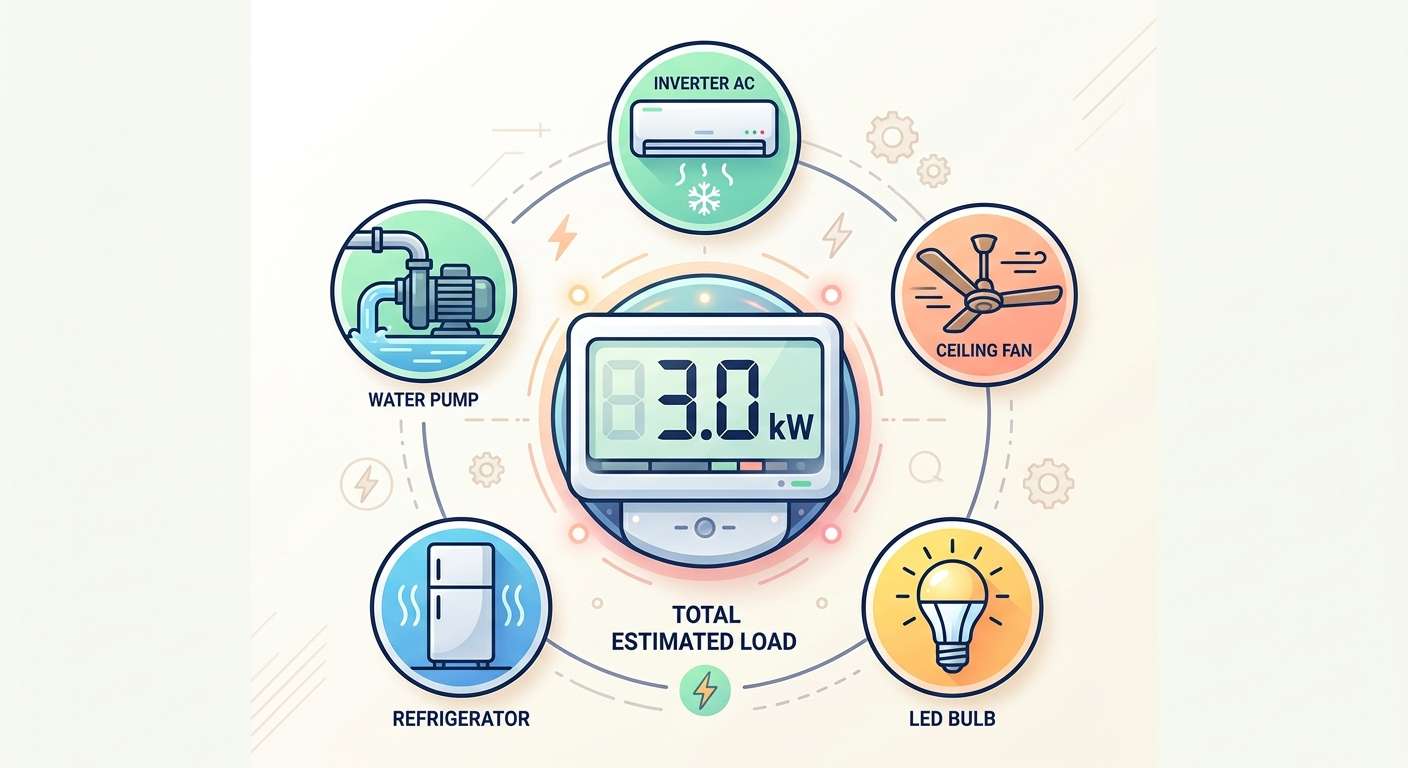
When planning a new house, installing an inverter, upgrading electrical wiring, or deciding how much solar capacity a home needs, one question comes up again and again:
How much electricity does a house actually need?
Many people simply add up appliance wattages and make a rough estimate. That can give a basic idea, but proper electrical load calculation requires a little more understanding. Different appliances operate for different amounts of time, some appliances have starting currents, and not every appliance runs at the same time.
In Pakistan, where electricity costs, load shedding, voltage issues and solar adoption have become important considerations, understanding your home’s electrical load can help you make better decisions about wiring, inverter capacity, generator sizing and solar system planning.
This guide explains what electrical load means, why it matters, how to calculate it, practical examples for Pakistani homes, common mistakes, and frequently asked questions.
What Is Electrical Load?
Electrical load is the amount of electrical power required by the appliances and equipment connected to an electrical system.
It is commonly expressed in:
- Watts (W)
- Kilowatts (kW)
- Volt-amperes (VA)
- Kilovolt-amperes (kVA)
For example:
- LED bulb: around 9–15W
- Ceiling fan: around 50–100W
- Refrigerator: commonly around 100–300W while running
- Television: around 60–150W
- Computer: around 100–400W depending on configuration
- Air conditioner: significantly higher and varies by capacity and technology
Actual consumption varies by appliance model, operating condition and efficiency, so the rating printed on the appliance or its datasheet should be used for accurate calculations.
Why Is Home Load Calculation Important?
Calculating electrical load is useful for several reasons.
1. Choosing the Right Electrical System
Your total load helps determine whether your existing electrical supply and distribution system are suitable for your requirements.
2. Solar System Planning
If you are planning solar, load information helps determine an appropriate inverter and battery configuration.
3. Generator Selection
A generator that is too small may overload or fail to start certain appliances.
4. Electrical Wiring
Cable sizes and protective equipment need to be selected according to the electrical design and expected load.
5. Managing Electricity Usage
Understanding which appliances consume the most power can help you identify opportunities to reduce electricity consumption.
What Is Connected Load?
Connected load means the total rated power of all electrical appliances or equipment connected to the system.
For example, imagine a house has:
| Appliance | Quantity | Approx. Wattage | Total |
|---|---|---|---|
| LED Bulbs | 10 | 12W | 120W |
| Ceiling Fans | 5 | 70W | 350W |
| TV | 1 | 120W | 120W |
| Refrigerator | 1 | 200W | 200W |
| Washing Machine | 1 | 500W | 500W |
| Computer | 1 | 250W | 250W |
| Water Pump | 1 | 750W | 750W |
| AC | 1 | 1,200W | 1,200W |
Total connected load:
120 + 350 + 120 + 200 + 500 + 250 + 750 + 1,200 = 3,490W
So the connected load is approximately:
3.49kW
But this does not necessarily mean that the house continuously consumes 3.49kW.
That’s where actual operating load comes in.
Connected Load vs Actual Load
This is one of the most important concepts in electricity calculations.
Suppose your house has:
- 10 lights
- 5 fans
- 1 refrigerator
- 1 TV
- 1 washing machine
- 1 AC
- 1 water pump
All of these appliances may be connected to the electrical system, but they are unlikely to operate simultaneously all day.
For example:
- Washing machine may run for 1–2 hours.
- Water pump may run for a limited period.
- TV may operate for several hours.
- AC may operate for several hours.
- Refrigerator cycles automatically.
- Lights and fans vary according to occupancy.
Therefore:
Connected Load ≠ Actual Continuous Load
This distinction becomes particularly important when selecting solar inverters and backup systems.
How to Calculate Home Electrical Load
A basic load calculation can be performed in four steps.
Step 1: Make an Appliance List
Write down every significant electrical appliance in your home.
For example:
- Lights
- Fans
- Refrigerator
- Television
- Washing machine
- Water pump
- Iron
- Microwave
- Air conditioner
- Computer
- Kitchen appliances
- Water heater
- Other equipment
Step 2: Find the Wattage
Check the appliance label, specification plate or manufacturer’s documentation.
For example:
Fan = 70W
If you have 5 fans:
70 × 5 = 350W
Similarly:
LED = 12W
For 10 LEDs:
12 × 10 = 120W
Step 3: Calculate Total Connected Load
Add the wattage of all appliances.
The basic formula is:
Total Load = Appliance 1 + Appliance 2 + Appliance 3 + …
For example:
350W fans + 120W lights + 200W refrigerator + 120W TV
= 790W
Continue adding the remaining appliances to get the total connected load.
Step 4: Consider Simultaneous Usage
Now ask:
Which appliances are likely to run at the same time?
This gives you a more practical estimate of your operating load.
For example, at night you may use:
- 4 fans
- 6 lights
- Refrigerator
- TV
But the washing machine and water pump may be switched off.
Your actual load at that moment could therefore be considerably lower than the total connected load.
Example: Load Calculation for a Small Pakistani House
Let’s consider a simple example.
Lighting
8 LED bulbs × 12W:
96W
Fans
4 fans × 70W:
280W
Television
1 × 120W:
120W
Refrigerator
1 × 200W approximate running load:
200W
Computer
1 × 200W:
200W
Washing Machine
1 × 500W:
500W
Water Pump
1 × 750W:
750W
Air Conditioner
1 × 1,200W approximate operating load:
1,200W
Total connected load:
96 + 280 + 120 + 200 + 200 + 500 + 750 + 1,200
= 3,346W
Approximately:
3.35kW
However, if the washing machine, water pump and AC are not operating at the same time, the simultaneous operating load can be much lower.
How to Calculate Current From Watts
For a simple single-phase calculation, you can use:
Current (A) = Power (W) ÷ Voltage (V)
For example:
If your load is 2,300W and the supply voltage is approximately 230V:
2,300 ÷ 230 = 10A
So the basic estimated current is approximately:
10 amperes
This is a simplified calculation. Real electrical system design can also require consideration of power factor, motor starting current, continuous loads and other factors.
What Is Peak Load?
Peak load is the highest electrical demand that occurs during a particular period.
For example, imagine a home normally uses:
1.5kW
But during a hot afternoon:
- 2 ACs
- Fans
- Refrigerator
- Water pump
- Television
- Lights
may operate around the same time.
The home’s demand could temporarily become much higher.
This peak requirement is important when selecting:
- Inverters
- Generators
- Main electrical equipment
- Backup systems
What Is a Running Load?
Running load is the power an appliance uses during normal operation.
For example, a motor may consume one amount of power while operating normally but require significantly more current when starting.
This is called starting or inrush current.
That’s why simply adding the nameplate wattage of appliances isn’t always enough for generator or inverter selection.
Why Motors Need Special Attention
Some household appliances contain motors.
Examples include:
- Refrigerators
- Water pumps
- Air conditioners
- Washing machines
- Freezers
Motors can require additional current during startup.
For this reason, an inverter or generator must be capable of handling the required starting conditions.
A system that appears sufficient based only on running wattage may still struggle when a large motor starts.
How Much Load Does an Air Conditioner Add?
Air conditioners can significantly affect household electrical demand.
The actual power requirement depends on:
- AC capacity
- Inverter or non-inverter technology
- Temperature setting
- Outdoor temperature
- Room insulation
- Compressor operation
- Appliance efficiency
For example, an inverter AC may vary its power consumption rather than continuously operating at one fixed wattage.
Therefore, use the manufacturer’s rated input power or measured consumption for a more accurate calculation instead of assuming every AC consumes the same amount.
How Much Load Does a Refrigerator Use?
A refrigerator does not normally consume its maximum power continuously.
Its compressor cycles on and off depending on cooling requirements.
Therefore, there is a difference between:
Rated/instantaneous power
and
Average energy consumption over time.
For estimating electricity bills, daily or monthly energy consumption in kWh is more useful than simply looking at the wattage.
Watts vs Units of Electricity
People often say:
“My house uses 5 units.”
A unit of electricity generally refers to:
1 kilowatt-hour (kWh)
If a 1,000W appliance operates for one hour:
1,000W × 1 hour = 1kWh
Therefore:
1kWh = 1 electricity unit
For example, a 100W appliance running continuously for 10 hours would consume approximately:
100W × 10h = 1,000Wh
or:
1kWh
= approximately 1 unit
Actual electricity billing involves tariff structures and other applicable charges.
How to Calculate Daily Electricity Consumption
Use this basic formula:
Energy (kWh) = Power (kW) × Operating Hours
For example:
A 100W fan:
100W = 0.1kW
If it runs for 10 hours:
0.1 × 10 = 1kWh
So it consumes approximately:
1 unit per day
If the same fan operates 30 days:
1 × 30 = 30kWh
or approximately:
30 units per month
This is an estimate. Actual consumption may vary.
How to Calculate Monthly Electricity Consumption
You can create a simple table:
| Appliance | Power | Hours/Day | Approx. Daily Energy |
|---|---|---|---|
| Fan | 70W | 10h | 0.70kWh |
| LED | 12W | 6h | 0.072kWh |
| TV | 120W | 5h | 0.60kWh |
| Refrigerator | 200W* | 8h equivalent | 1.60kWh |
| Washing Machine | 500W | 1h | 0.50kWh |
*The refrigerator example is simplified and should not be interpreted as its actual daily compressor cycle.
For accurate household consumption, smart meters or appliance-level energy meters can provide better real-world data.
How Home Load Calculation Helps With Solar
Electrical load calculation is one of the first steps in solar planning.
Suppose your house has:
- 4 fans
- Refrigerator
- TV
- Lights
- Water pump
- 1 AC
- Computer
The solar installer needs to understand:
- Total connected load
- Typical daytime load
- Nighttime load
- Peak demand
- Important backup loads
- Daily energy consumption
- Battery requirements
- Future load expansion
This information helps determine the appropriate system configuration.
Does a 5kW Load Mean You Need a 5kW Solar System?
Not necessarily.
This is a common misunderstanding.
A 5kW connected load does not automatically mean you need a 5kW solar system.
Solar sizing depends on:
- Daily energy consumption
- Solar generation potential
- Daytime usage
- Nighttime usage
- Battery requirement
- Backup requirement
- Net-metering/export arrangement
- Inverter capacity
- Future expansion
For example, a home may have a high connected load but relatively low average daily energy consumption.
That’s why solar system sizing should be based on actual usage rather than connected load alone.
How to Calculate Load for an Inverter
For an inverter or backup system, focus particularly on the appliances you expect to run during backup.
For example, your backup load might include:
- 4 fans
- 6 LED bulbs
- Wi-Fi router
- Refrigerator
- TV
- Computer
You may intentionally exclude:
- Electric heater
- Iron
- Water heater
- Large AC
- Heavy water pump
This creates a backup load, which can be considerably smaller than the home’s total connected load.
Common Load Calculation Mistakes
Mistake 1: Adding Every Appliance and Calling It Actual Load
The total is your connected load, not necessarily your real-time consumption.
Mistake 2: Ignoring Starting Current
Motors and compressors can require higher current when starting.
Mistake 3: Using Generic Wattages
Different appliance models can have very different power ratings.
Use actual manufacturer specifications whenever possible.
Mistake 4: Ignoring Future Appliances
If you plan to add another AC, electric vehicle charger, water heater or large appliance, include future requirements in electrical planning.
Mistake 5: Selecting Equipment Only From Total Watts
Inverter, generator and electrical distribution selection may require additional technical parameters beyond simple wattage.
How to Reduce Your Home’s Electrical Load
Load calculation can also help identify unnecessary consumption.
Use LED Lighting
LED bulbs generally consume less electricity than older lighting technologies for similar illumination.
Choose Efficient Fans
Energy-efficient fans can reduce consumption when used for many hours every day.
Maintain Air Conditioners
Dirty filters and poor maintenance can affect cooling performance and energy use.
Avoid Standby Consumption
Some electronics continue drawing small amounts of electricity while connected to power.
Use Timers Where Appropriate
Timers can prevent pumps and other equipment from running unnecessarily.
Monitor Actual Consumption
An energy meter can help identify which appliances are responsible for significant consumption.
Home Electrical Load Calculation Checklist
Before calculating your home’s load, collect:
- Appliance name
- Quantity
- Rated wattage
- Voltage
- Expected operating hours
- Starting-current requirements where applicable
- Daytime usage
- Nighttime usage
- Future appliance requirements
Then calculate:
Connected Load
Typical Running Load
Peak Load
Daily Energy Consumption
These four figures provide a much more useful picture of a home’s electrical requirements.
Frequently Asked Questions
What is the easiest way to calculate home electrical load?
List all appliances, note their wattage, multiply wattage by quantity, and add the values. Then separately identify which appliances normally operate at the same time.
How many watts does a normal house use?
There is no single wattage for every house. Electrical demand depends on the number of appliances, their ratings, operating hours and simultaneous usage.
How do I calculate amps from watts in Pakistan?
For a simplified single-phase calculation:
Amps = Watts ÷ Volts
At approximately 230V, a 2,300W load is approximately 10A.
Is connected load the same as electricity consumption?
No. Connected load is the rated power of connected equipment. Electricity consumption depends on how long the equipment actually operates.
How many units does a 1,000W appliance use?
If a 1,000W appliance operates for one hour, it consumes approximately 1kWh, which is commonly called 1 electricity unit.
Does an AC use the same electricity all the time?
Not necessarily. Its consumption depends on the type of AC, operating conditions, temperature, efficiency and compressor behavior.
Why does my inverter trip when I start a pump?
A motor-driven pump can require higher starting current than its normal running consumption. The inverter must be capable of handling that starting demand.
Can I calculate solar size from my home’s electrical load?
Load calculation is an important part of solar planning, but solar capacity should also consider daily energy consumption, daytime usage, battery requirements and other system factors.
Should future appliances be included in load planning?
Yes. If you expect to add major loads such as an AC, electric water heater, pump or EV charger, consider them during electrical planning.
Final Thoughts
Calculating your home’s electrical load is much more than adding the wattages printed on appliances. A useful calculation separates connected load, normal operating load, peak demand and daily energy consumption.
This information can help when planning a new electrical installation, selecting backup equipment, estimating electricity consumption or designing a solar system.
For accurate electrical installation and solar planning, appliance specifications, wiring requirements, protection equipment and actual household usage should all be considered together.
If you’re planning a solar system for your home in Bahawalpur or need help understanding your electrical requirements, Punjab Solar Bahawalpur can help with solar system design, installation, inspection, upgrades and related electrical solutions.