
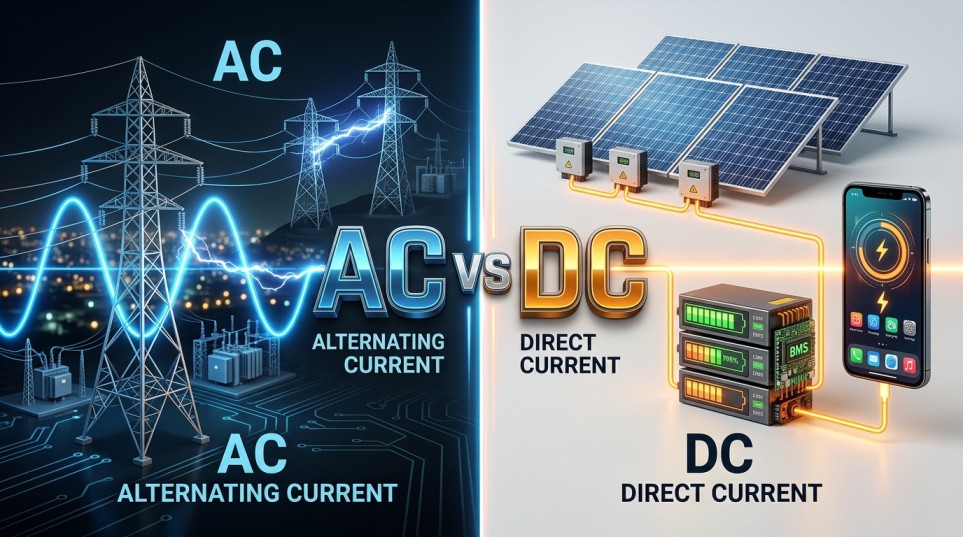
Electricity is a part of almost every aspect of modern life. From the lights in our homes and air conditioners to mobile phones, solar panels, batteries, computers and electric vehicles, electrical energy powers countless devices around us.
But not all electricity is the same.
You may have heard the terms AC electricity and DC electricity, but what exactly do they mean?
The two main types of electrical current are:
- AC – Alternating Current
- DC – Direct Current
The biggest difference is the direction in which electric current flows.
In DC electricity, current flows in one direction.
In AC electricity, the direction of current periodically changes.
This difference may sound simple, but it determines how electricity is generated, transmitted, stored and used.
For Pakistani households, understanding AC and DC is particularly useful because the electricity coming from the utility grid is AC, while solar panels and batteries operate on DC. An inverter is therefore an essential part of many solar and backup-power systems because it converts DC electricity into AC electricity.
In this complete guide, we will explain AC vs DC electricity, how each type works, where it is used, the advantages and disadvantages of both, their role in solar energy, batteries, UPS systems, electric vehicles and household appliances, and why an inverter is needed to convert between them.
What Is AC Electricity?
AC stands for Alternating Current.
In an AC electrical system, the direction of current periodically changes.
Instead of flowing continuously in one direction, the voltage alternates between positive and negative values according to the waveform of the electrical system.
The most common waveform used for utility electricity is a sine wave.
The electrical grid uses AC because AC voltage can be changed efficiently using transformers, making it practical for transmitting electricity over long distances. The U.S. Department of Energy notes that one of AC’s historical advantages was the ability to transform it to higher voltages for long-distance transmission with lower losses.
Simple Example of AC
The electricity supplied to a typical home through the utility grid is AC.
When you plug in:
- A fan
- Refrigerator
- Washing machine
- Air conditioner
- Television
- Iron
- Water pump
the appliance receives electricity from the AC supply.
What Is DC Electricity?
DC stands for Direct Current.
In DC systems, current flows in one primary direction.
The voltage has a fixed polarity, meaning there is normally a positive and negative side.
Common sources of DC electricity include:
- Batteries
- Solar panels
- Power banks
- USB outputs
- Many electronic circuits
- Fuel cells
- Some generators and electronic power systems
A battery, for example, has positive and negative terminals.
When a suitable circuit is connected, electrical current flows through the circuit from the battery’s electrical potential.
AC vs DC: The Basic Difference
The easiest way to understand the difference is:
AC changes direction periodically.
DC maintains one direction.
| Feature | AC | DC |
|---|---|---|
| Full form | Alternating Current | Direct Current |
| Current direction | Changes periodically | Generally one direction |
| Common source | Utility grid | Batteries, solar panels |
| Typical use | Homes, grid, motors | Electronics, batteries, solar |
| Long-distance transmission | Very common | Also possible with HVDC |
| Voltage transformation | Easy using transformers | Requires electronic conversion |
| Storage in batteries | Not directly stored as AC | Stored as DC |
| Solar panel output | No | Yes |
| Battery output | No | Yes |
| Household wall supply | Yes | Usually no |
However, the real-world electrical system is more complicated than simply saying “AC is for homes and DC is for batteries.”
Modern technology uses both.
How Does AC Electricity Work?
Imagine an electrical waveform moving up and down around zero.
During one part of the cycle, the voltage has one polarity.
Then it crosses zero and changes polarity.
This continuous change creates alternating current.
In many power systems, AC operates at a fixed frequency.
For example, a 50 Hz AC system completes 50 cycles per second.
Pakistan’s electricity system operates at 50 Hz.
This frequency is important because appliances and electrical equipment are designed to operate according to the characteristics of the local electrical supply.
How Does DC Electricity Work?
DC is simpler to visualize.
Imagine a battery:
Positive (+) → electrical circuit → Negative (-)
The electrical potential maintains a fixed polarity.
Unlike AC, DC does not naturally alternate between positive and negative directions.
This makes DC particularly useful for electronic circuits and energy storage.
For example:
- A 12 V battery provides DC.
- A 24 V battery bank provides DC.
- A 48 V battery system provides DC.
- Solar panels produce DC electricity.
Why Does the Grid Use AC?
One of the biggest historical advantages of AC is voltage transformation.
Transformers can increase or decrease AC voltage efficiently.
This is extremely useful for power transmission.
Electricity generated at a power station can be transmitted at high voltage and then reduced to lower voltages closer to consumers.
The basic concept is:
Generation → High-voltage transmission → Distribution → Household supply
High voltage allows large amounts of electrical power to travel long distances with lower current for the same power level, which helps reduce resistive losses.
The Department of Energy explains that AC’s ability to be transformed to higher voltages was an important reason for its historical advantage in long-distance electricity transmission.
Does DC Also Work for Long-Distance Transmission?
Yes.
It would be incorrect to say that DC cannot be transmitted over long distances.
Modern electrical systems use HVDC, or High-Voltage Direct Current, for certain transmission applications.
HVDC can be advantageous for some long-distance and high-capacity transmission projects.
The Department of Energy notes that technological improvements in power electronics have enabled high-voltage direct-current applications capable of efficiently moving large amounts of power over very long distances.
So the modern electricity industry uses both AC and DC depending on the application.
Where Is AC Electricity Used?
AC is commonly used for electrical distribution and many household and industrial applications.
1. Homes
The electricity supplied to household sockets is AC.
Common household AC loads include:
- Air conditioners
- Refrigerators
- Fans
- Washing machines
- Water pumps
- Electric irons
- Microwave ovens
- Electric heaters
- Traditional televisions
- Some lighting systems
2. Businesses
Commercial buildings use AC for:
- Lighting
- Air conditioning
- Computers and office equipment
- Refrigeration
- Pumps
- Motors
- Elevators
- Industrial equipment
3. Industrial Equipment
Many industrial motors are designed to operate on AC.
Examples include:
- Pumps
- Compressors
- Fans
- Conveyors
- Machine tools
- Industrial refrigeration
Three-phase AC is particularly important in industrial environments.
Where Is DC Electricity Used?
DC is extremely common in modern electronics.
1. Batteries
Batteries provide DC electricity.
Examples include:
- Car batteries
- Lithium batteries
- UPS batteries
- Solar batteries
- Power banks
- Portable electronics batteries
2. Solar Panels
Solar photovoltaic panels generate DC electricity.
This is one of the most important AC/DC concepts for anyone interested in solar energy.
When sunlight hits photovoltaic cells, the cells produce electrical energy in DC form.
The output then goes to an inverter or other power electronics equipment depending on the system design.
The U.S. Department of Energy confirms that solar PV modules generate DC electricity and that inverters convert it to AC for use by homes and the electrical grid.
3. Mobile Phones
Your phone operates internally using DC electricity.
But the electricity supplied from a household wall socket is AC.
This creates a conversion process.
The basic chain is:
Wall socket AC → Charger → DC → Phone battery/electronics
This is why a phone charger contains electronic circuitry.
4. Computers
Computers internally use DC voltages.
A desktop computer receives AC from the wall socket but its power supply converts that AC into several DC voltages needed by the motherboard, processor, storage devices and other components.
5. LED Lights
LEDs operate using DC.
When you connect an LED bulb to household AC, the bulb’s internal driver converts the incoming electricity into the appropriate form required by the LED electronics.
AC vs DC in Solar Energy
This is particularly important for solar system users.
A basic solar power system can be understood as:
Sunlight → Solar Panels → DC Electricity → Inverter → AC Electricity → Home
Solar panels generate DC.
Most household appliances are designed to operate from the AC electricity supplied by the electrical grid.
Therefore, the inverter acts as the bridge between the two systems.
The Department of Energy describes the inverter as one of the most important components of a solar system because it converts DC generated by PV panels into AC used by the grid and household electrical equipment.
What Does a Solar Inverter Do?
A solar inverter performs much more than simply changing DC to AC.
Depending on the type of inverter, it may:
- Convert DC to AC
- Track solar power production
- Manage battery charging
- Monitor system performance
- Synchronize with the electrical grid
- Provide protection functions
- Control power flow
- Disconnect from the grid under unsuitable conditions
Modern inverters are therefore sophisticated power-electronics systems.
DC Side vs AC Side of a Solar System
A solar installation can generally be divided into two major electrical sections.
DC Side
The DC side can include:
- Solar panels
- PV cables
- DC connectors
- DC isolators
- DC circuit breakers
- DC surge protection
- MPPT inputs
- Battery connections
AC Side
The AC side can include:
- Inverter AC output
- AC breakers
- AC surge protection
- Distribution board
- Grid connection
- Household loads
Both sides require appropriate protection.
This is why you should never assume that an AC-rated protection device can automatically be used on a DC solar circuit.
Why Can’t You Simply Connect a Solar Panel to a Home Socket?
Because the solar panel produces DC while the household socket provides an AC electrical environment.
A solar panel cannot simply be plugged into a normal household outlet to power the house.
A suitable solar inverter and properly designed electrical system are required.
The inverter converts the panel’s DC output into an AC waveform suitable for the intended application.
Grid-connected systems also need synchronization and protection.
AC Coupling vs DC Coupling in Solar + Battery Systems
Solar-plus-storage systems can use different electrical configurations.
Two common concepts are:
DC-Coupled System
Solar panels and batteries are connected on the DC side through appropriate power electronics.
AC-Coupled System
Solar generation and battery systems connect through AC-side equipment, typically involving separate or integrated conversion equipment.
The U.S. Department of Energy describes DC-coupled and AC-coupled solar-plus-storage configurations and notes that DC-coupled systems can connect PV and batteries through bidirectional inverter equipment, while AC-coupled systems use additional conversion equipment.
AC vs DC in Batteries
Batteries are fundamentally DC energy-storage devices.
When a lithium battery is charged, electrical energy is stored through electrochemical processes.
When the battery discharges, it provides DC electricity.
But homes normally need AC.
Therefore, a battery-based backup system commonly works like this:
Battery DC → Inverter → AC → Home appliances
During charging:
AC → Charger/Inverter → DC → Battery
Some modern hybrid inverters perform both directions of power conversion.
AC vs DC in UPS Systems
A UPS, or Uninterruptible Power Supply, commonly involves both AC and DC.
The simplified process is:
Normal operation
AC input → UPS → AC output
At the same time, the battery can be charged.
During power failure
Battery DC → Inverter → AC output
This allows connected AC appliances to continue operating for the available backup period.
The exact internal design depends on the UPS type.
AC vs DC in Electric Vehicles
Electric vehicles also use both forms of electricity.
The vehicle’s battery stores energy as DC.
When charging from an AC source, the vehicle’s charging system converts AC into DC for the battery.
With DC fast charging, the external charging equipment supplies DC to the vehicle’s battery system more directly, with the vehicle’s charging architecture controlling the process.
This is one reason DC fast charging can provide high charging power.
Why Are Some Chargers Called AC Chargers and Others DC Chargers?
The terms refer to the type of electrical power delivered to the vehicle.
AC Charging
The charging station provides AC.
The vehicle’s onboard charger converts it to DC for battery storage.
DC Charging
The charging equipment performs the AC-to-DC conversion externally and delivers DC to the vehicle’s battery system.
The exact charging limits depend on the vehicle and charger.
AC vs DC for Electronic Devices
Most modern electronic devices ultimately operate internally on DC.
This includes:
- Smartphones
- Laptops
- Routers
- TVs
- Cameras
- Computers
- Gaming consoles
- Networking equipment
But many of these devices receive AC from the wall socket.
Their power adapters or internal power supplies convert the electricity.
For example:
230 V AC → Laptop charger → DC → Laptop
This is why your laptop adapter becomes part of the electrical conversion process.
Why Do Electronics Use DC?
Electronic circuits typically require specific, relatively stable DC voltage levels.
A processor may require a much lower voltage than the wall supply.
Different components may require different DC voltage rails.
Power supplies therefore convert the incoming electrical energy into suitable DC levels.
This is one reason modern electronics rely heavily on power electronics.
AC Motors vs DC Motors
Motors can operate using both AC and DC.
AC Motors
AC motors are widely used in:
- Fans
- Pumps
- Compressors
- Industrial machinery
- Air conditioners
They are particularly common because AC power is widely available through the grid.
DC Motors
DC motors are common in:
- Battery-powered equipment
- Toys
- Small electronics
- Automotive systems
- Portable devices
- Some industrial applications
Brushless DC motors are also widely used in modern appliances and equipment.
AC vs DC: Which Is More Efficient?
There is no universal answer.
Efficiency depends on:
- Voltage
- Current
- Distance
- Equipment
- Conversion requirements
- Load
- Cable resistance
- System design
A common mistake is saying:
“DC is more efficient than AC.”
That is too simplistic.
If electricity needs to travel through several conversion stages, each conversion introduces some losses.
For example, a solar system may involve:
Solar DC → Inverter AC → Appliance power supply DC
A DC-based system could potentially avoid some conversion stages for certain DC loads.
But the best architecture depends on the actual application.
Why Don’t Homes Simply Use DC?
This is an interesting question.
If many electronics operate internally on DC, why don’t houses simply use DC electricity?
There are several reasons.
The existing electrical infrastructure is predominantly AC.
AC distribution has historically provided practical voltage transformation and grid infrastructure.
Households also contain many appliances and systems designed around AC supply.
Moving an entire electrical distribution system from AC to DC would require significant changes to:
- Wiring
- Switchgear
- Protection
- Appliances
- Distribution equipment
- Standards
- Grid infrastructure
However, DC is becoming increasingly important in modern energy systems.
Solar panels, batteries, electronics, data centers and EVs all use DC somewhere in their energy chain.
The Growing Importance of DC in Solar Energy
The growth of solar and battery storage has increased the importance of DC systems.
A modern solar-plus-storage installation may have:
- PV DC generation
- DC battery storage
- DC-to-AC conversion
- AC household loads
- Grid interaction
The Department of Energy notes that solar PV systems rely on power electronics for conversion, and increasing solar penetration is increasing the importance of these devices in grid integration.
Pakistan’s regulatory framework is also continuing to evolve around distributed generation and prosumer systems; NEPRA’s legal listings include the Prosumer Regulations, 2026 and amendments issued during 2026.
This makes understanding AC/DC increasingly useful for Pakistani solar consumers.
AC vs DC Safety
Both AC and DC electricity can be dangerous.
It is incorrect to assume that DC is automatically safe because it comes from batteries or solar panels.
High-voltage DC can be extremely dangerous.
Solar PV systems can also remain electrically energized whenever sunlight is available, even if the utility grid is disconnected.
NEPRA’s Power Safety Code emphasizes protection of the public, workers and electrical equipment and includes detailed safety requirements for electrical installations.
Never work on live electrical systems unless you are appropriately trained, equipped and authorized.
Why DC Arcs Can Be Difficult to Interrupt
One important difference for electrical protection is that DC does not naturally cross zero in the same way an AC sine wave does.
This can make interrupting a DC arc more challenging.
Therefore, DC electrical equipment requires protection devices specifically designed and rated for DC applications.
This is particularly important in solar installations.
A DC breaker is not simply an ordinary AC breaker with a different label.
Always use equipment with the appropriate voltage and current ratings for the specific circuit.
AC Protection vs DC Protection
Solar installers and electricians must understand the difference.
AC Protection Equipment
Examples include:
- AC MCBs
- AC MCCBs
- AC isolators
- AC SPDs
DC Protection Equipment
Examples include:
- DC circuit breakers
- DC isolators
- PV-rated fuses
- DC SPDs
The correct device depends on the system voltage, current, fault characteristics and equipment specifications.
AC vs DC in Pakistan’s Solar Systems
For a typical residential solar system in Pakistan, the energy flow can look like this:
Sunlight
↓
Solar Panels
↓
DC Electricity
↓
Solar Inverter
↓
AC Electricity
↓
Home Distribution Board
↓
AC Appliances
At the same time, if a battery is included:
Solar DC / Inverter → Battery Charging
and later:
Battery DC → Inverter → AC → Home
This is why a hybrid inverter is often considered the central component of a modern solar-plus-battery installation.
Which One Is Better: AC or DC?
There is no overall winner.
Each has advantages.
AC is particularly useful for:
- Electrical grids
- Household distribution
- Industrial motors
- Long-established power infrastructure
- Transformer-based voltage conversion
DC is particularly useful for:
- Batteries
- Solar panels
- Electronics
- USB devices
- EV batteries
- Energy storage
- Certain transmission applications
Modern electrical systems use both AC and DC.
Advantages of AC Electricity
1. Easy Voltage Transformation
Transformers can change AC voltage efficiently.
2. Excellent for Grid Distribution
AC is deeply integrated into existing power networks.
3. Suitable for Many Motors
AC motors are widely used.
4. Widely Available
Household utility electricity is normally AC.
5. Established Infrastructure
Power generation, transmission and distribution systems have extensive AC infrastructure.
Disadvantages of AC Electricity
1. Conversion Required for Many Electronics
Many electronic devices ultimately require DC.
2. Power Conversion Losses
AC may need to be converted to DC for electronic devices.
3. Some Applications Prefer DC
Batteries and solar PV naturally operate in DC.
Advantages of DC Electricity
1. Ideal for Batteries
Batteries naturally store and deliver DC.
2. Natural Output of Solar Panels
PV modules produce DC electricity.
3. Suitable for Electronics
Modern electronic circuits commonly use DC.
4. Useful in Energy Storage
Battery systems are fundamentally DC-based.
5. Important for EVs
EV batteries store DC electrical energy.
Disadvantages of DC Electricity
1. Voltage Conversion Requires Power Electronics
Traditional transformers cannot directly transform DC voltage in the same way they transform AC.
2. Protection Can Be More Challenging
DC fault interruption can require specialized equipment.
3. Existing Household Infrastructure Is Primarily AC
Most homes are already designed around AC distribution.
AC vs DC: Quick Comparison
| Category | AC Electricity | DC Electricity |
|---|---|---|
| Full name | Alternating Current | Direct Current |
| Direction | Alternates | One direction |
| Common source | Utility grid | Battery/solar |
| Solar panel output | No | Yes |
| Battery output | No | Yes |
| Household socket | Yes | Usually no |
| Mobile phone internally | No | Yes |
| Laptop internally | No | Yes |
| Transformer-based voltage change | Easy | Not directly |
| Common motor applications | Very common | Common in battery systems |
| Solar inverter input | Often DC | Yes |
| Solar inverter output | Yes | No, for standard AC output |
Simple Real-Life Examples
Understanding AC and DC becomes easier with everyday examples.
Example 1: Mobile Phone
Wall socket → AC
↓
Charger → converts AC to DC
↓
Phone battery → DC
Example 2: Solar Panel
Sunlight
↓
Solar panel → DC
↓
Inverter → AC
↓
Home appliances
Example 3: UPS
Grid → AC
↓
UPS charger → DC
↓
Battery → DC
↓
UPS inverter → AC
↓
Home appliances
Example 4: Electric Vehicle
Grid → AC or charging station → DC
↓
EV battery → DC
↓
Motor drive → controlled electrical power
↓
Electric motor
Common AC and DC Mistakes
Mistake 1: Thinking AC Is Always More Powerful
AC and DC describe the type of current, not whether electricity is automatically more or less powerful.
Power depends on voltage, current and other electrical characteristics.
For a simple DC load:
Power = Voltage × Current
For AC systems, real power also depends on factors such as power factor and waveform.
Mistake 2: Thinking DC Cannot Travel Long Distances
Modern HVDC systems can transmit large amounts of power over long distances.
Mistake 3: Assuming Solar Panels Produce AC
Standard photovoltaic panels produce DC.
The inverter converts that DC into AC for conventional household use.
Mistake 4: Assuming Every Breaker Works on AC and DC
Protection devices have specific ratings.
Always check whether a breaker, isolator, fuse or SPD is rated for the actual AC or DC application.
Mistake 5: Thinking Batteries Store AC
Typical batteries store and deliver electrical energy as DC.
Frequently Asked Questions
Is home electricity AC or DC?
The electricity supplied through normal household wall sockets is AC. However, many devices inside the home convert that AC into DC for their electronic circuits.
Are solar panels AC or DC?
Solar panels produce DC electricity. A solar inverter converts the DC output into AC for household loads and, where applicable, grid connection.
Are batteries AC or DC?
Batteries provide DC electricity.
Why do solar systems need an inverter?
Most conventional household appliances and the electrical grid use AC. Solar panels produce DC, so the inverter converts the panel’s DC electricity into suitable AC electricity.
Is DC safer than AC?
Neither should automatically be considered safe. Both can cause serious injury or death depending on voltage, current, duration and other conditions. High-voltage DC can be extremely dangerous.
Is AC better than DC?
Neither is universally better. AC is highly practical for grid distribution, while DC is essential for batteries, solar PV and electronics.
Why is AC used in homes instead of DC?
AC became widely established for electrical distribution because its voltage can be transformed efficiently and the existing power infrastructure was built around AC.
Does an inverter convert AC to DC?
Some inverters and hybrid power systems perform bidirectional conversion. A typical solar inverter primarily converts DC from solar panels into AC, while battery systems can also involve AC-to-DC charging and DC-to-AC discharge.
What is AC coupling in solar?
AC coupling is a system architecture in which solar and battery equipment are connected through the AC side, using appropriate conversion equipment. It is one approach to integrating solar generation and storage.
What is DC coupling in solar?
DC coupling connects solar PV and battery storage on the DC side through suitable power electronics, potentially reducing some conversion steps depending on system design.
Why can’t I connect a solar panel directly to my home’s AC wiring?
A normal PV panel produces DC, while household wiring and appliances are designed around AC. A properly designed inverter and protection system are required to convert and safely integrate the solar electricity.
Conclusion
AC and DC electricity are not competing forms of electricity where one is simply “better” than the other. They are two different ways electrical current can operate, and both are essential to modern energy systems.
AC, or Alternating Current, is widely used for electricity generation, distribution and household power. Its ability to be transformed between voltage levels has made it particularly useful for electrical grids.
DC, or Direct Current, is fundamental to batteries, solar panels, electronics, power banks and electric vehicles.
For solar energy, the relationship is especially important:
Solar panels produce DC → inverter converts DC to AC → home appliances use AC.
At the same time, batteries store and deliver DC, meaning a hybrid solar system can involve both AC and DC power flows.
As Pakistan’s solar, battery-storage and distributed-energy market continues to develop, understanding the difference between AC and DC can help homeowners make better decisions about solar panels, inverters, batteries, UPS systems, electrical protection and appliance compatibility.
The most important thing to remember is simple:
AC changes direction. DC flows in one direction.
Both are valuable, both have different applications, and modern energy systems increasingly depend on converting efficiently between the two.