
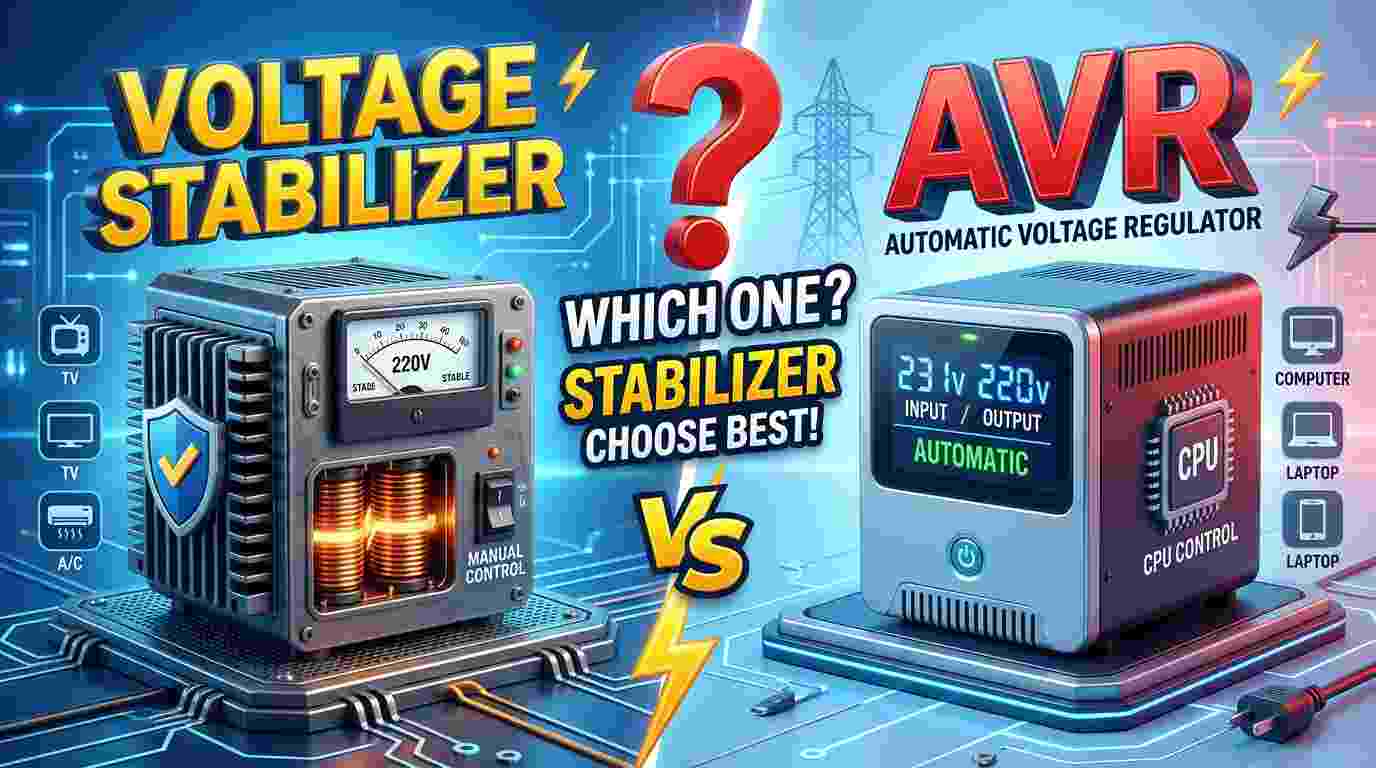
Voltage fluctuations are a common concern for many homeowners in Pakistan. You may notice lights becoming brighter or dimmer, fans changing speed, an air conditioner struggling to start, or electronic appliances behaving strangely when the electricity supply changes.
When this happens, many people start looking for a voltage stabilizer or AVR (Automatic Voltage Regulator).
But there is a common problem: Are a voltage stabilizer and AVR the same thing? Which one is better? Which one should you buy for an AC, refrigerator, TV, computer, solar inverter or entire house?
The answer depends on the type of voltage problem you have.
In everyday Pakistani electrical terminology, AVR and automatic voltage stabilizer are frequently used for essentially the same purpose: automatically correcting an unstable AC supply toward a suitable output voltage. However, stabilizers can use different technologies, including relay-based and servo-based designs, while the term AVR can also be used more broadly for automatic regulation systems.
Pakistan’s NEPRA Power Safety Code states that distribution transformers should be adjusted to provide approximately 220 volts ±5% to consumers, meaning roughly 209–231 V under that reference.
If your actual household voltage frequently moves far outside the expected range, the first step should be to understand the problem rather than simply buying the biggest stabilizer available.
This complete guide explains what a voltage stabilizer is, what an AVR is, how they work, their differences, types, advantages and disadvantages, sizing, AC and refrigerator applications, solar systems, whole-house protection, prices in Pakistan, common mistakes and how to choose the right option in 2026.
What Is a Voltage Stabilizer?
A voltage stabilizer is an electrical device designed to automatically correct variations in incoming voltage and provide a more stable output to connected equipment.
For example, imagine your incoming supply changes from:
220 V → 190 V → 210 V → 240 V
A stabilizer can use its internal control system to adjust the output toward its target voltage.
Depending on the type of stabilizer, it may:
- Boost low voltage
- Reduce high voltage
- Maintain a more stable output
- Protect equipment from certain abnormal voltage conditions
The exact correction range depends on the particular model.
What Is AVR?
AVR stands for Automatic Voltage Regulator.
An AVR monitors voltage and automatically regulates it.
In the Pakistani home-appliance market, AVR and voltage stabilizer are often treated as interchangeable terms.
However, the technology inside the equipment can be different.
For example, an automatic stabilizer may use:
- Relay-based tap switching
- Servo motor control
- Electronic/solid-state control
Therefore, don’t assume that every product labelled “AVR” has the same performance.
Always check the actual specifications and technology.
Voltage Stabilizer vs AVR: Are They the Same?
Short answer:
Often yes in everyday usage, but not always technically.
If a Pakistani retailer says:
“Buy an AVR for your AC.”
they may simply mean an automatic voltage stabilizer.
Another seller may call a similar product:
“Automatic voltage stabilizer.”
Both may perform the same general function.
However, AVR is a broader technical term for automatic voltage regulation, and different AVR/stabilizer technologies can have very different:
- Response speeds
- Accuracy
- Voltage ranges
- Capacities
- Prices
- Maintenance requirements
So the important question isn’t just:
AVR or stabilizer?
The better question is:
What type of voltage regulator/stabilizer do I actually need?
The Basic Difference
The simplest way to understand the two terms is:
| Feature | Voltage Stabilizer | AVR |
|---|---|---|
| Main purpose | Stabilize voltage | Automatically regulate voltage |
| Low voltage correction | Yes, depending on model | Yes, depending on model |
| High voltage correction | Yes, depending on model | Yes, depending on model |
| Automatic operation | Usually | Yes |
| Technology | Relay, servo, electronic | Relay, servo, electronic |
| Home use | Very common | Very common |
| AC protection | Possible | Possible |
| Fridge protection | Possible | Possible |
| Whole-house use | Some models | Some models |
| Exact performance | Depends on model | Depends on model |
The specifications matter much more than the label.
Why Do Homes Need Voltage Regulation?
Electrical appliances are designed to operate within specified voltage ranges.
If voltage is consistently too low or too high, equipment may not perform correctly.
Problems can include:
- Motors struggling to start
- Excessive heating
- Compressor problems
- Electronics malfunctioning
- Flickering lights
- Reduced appliance performance
- Unexpected shutdowns
- Increased electrical stress
This doesn’t mean every voltage variation requires a stabilizer.
Small variations can occur during normal operation.
The question is whether your supply is regularly outside the acceptable range for the equipment you are operating.
Common Voltage Problems in Pakistani Homes
Homeowners may experience:
Low Voltage
For example:
160–190 V
High Voltage
For example:
240–260+ V
Rapid Fluctuation
For example:
180 V → 230 V → 195 V
Momentary Transients
Very short electrical events.
These are different problems and may require different protection devices.
A voltage stabilizer is primarily intended for voltage regulation, not every type of electrical disturbance.
How Does a Voltage Stabilizer Work?
A stabilizer continuously monitors incoming voltage.
When the input changes, the stabilizer’s control system determines whether it needs to:
Boost
or
Buck
the voltage.
A simplified example:
Input:
180 V
Stabilizer:
Boosts the voltage.
Output:
Around the target voltage, depending on the model and load.
Similarly:
Input:
250 V
Stabilizer:
Reduces the voltage.
Output:
Closer to the target level.
The actual output depends on the stabilizer’s design and operating range.
Types of Voltage Stabilizers
There are several technologies.
1. Relay-Type Stabilizer / AVR
Relay-based stabilizers use transformer taps and electronic control to switch between different voltage levels.
For example, the system may select different taps depending on the input voltage.
Advantages
- Relatively affordable
- Simple design
- Suitable for many basic applications
- Common in residential markets
Disadvantages
- Output changes in steps
- Relay switching can produce clicking sounds
- Regulation accuracy depends on the design
- Mechanical relay contacts can wear over time
Relay-type products are commonly marketed for home appliances.
2. Servo Motor Stabilizer
A servo stabilizer uses a motor-driven mechanism to adjust the voltage continuously or in very small increments.
It can provide smoother voltage correction than a basic relay-based system.
Advantages
- Smooth regulation
- Good voltage accuracy
- Suitable for larger loads
- Useful for motor-based equipment
Disadvantages
- More expensive
- Larger
- Moving parts
- Requires more maintenance
- Correction can be slower than some solid-state designs
Servo systems are commonly used where accurate voltage regulation is important.
3. Static or Solid-State AVR
A solid-state AVR uses electronic components rather than mechanical moving parts to regulate voltage.
Depending on its design, it can respond very quickly.
Advantages
- Fast response
- No mechanical motor
- No brush wear
- Suitable for sensitive equipment
- Can provide accurate regulation
Disadvantages
- Higher price
- More complex electronics
- Requires proper sizing and installation
For advanced applications, static regulation can be preferable.
AVR vs Servo Stabilizer
This is another common confusion.
A servo stabilizer is actually one type of automatic voltage regulator.
In simple terms:
AVR = automatic voltage regulation function/category
Servo = one technology used to achieve that regulation
So comparing “AVR vs servo” is not always technically correct.
A better comparison is:
Relay AVR vs Servo AVR vs Static AVR
Which Is Better: Relay or Servo?
It depends on the application.
Relay AVR
Better when you want:
- Lower cost
- Basic automatic regulation
- Single appliance protection
- General household use
Servo Stabilizer
Better when you want:
- More precise regulation
- Larger loads
- Smooth correction
- Long-duration voltage problems
- Certain motor/compressor applications
Static AVR
Better when you want:
- Very fast response
- High regulation accuracy
- Sensitive electronics
- Professional/industrial applications
There is no single “best” technology for every home.
Voltage Stabilizer for Air Conditioner
An air conditioner is one of the most common appliances for which people consider voltage regulation.
This is particularly relevant for:
- Inverter AC
- Non-inverter AC
- 1-ton AC
- 1.5-ton AC
- 2-ton AC
An AC contains electrical and electronic components, and its compressor or inverter system has specific operating requirements.
If your supply regularly falls outside the manufacturer’s recommended range, appropriate voltage protection or regulation may be useful.
Does an Inverter AC Need a Stabilizer?
Not automatically.
Modern inverter ACs often have built-in voltage operating ranges and electronic protection.
Whether an external stabilizer is necessary depends on:
- Actual mains voltage
- AC manufacturer’s specifications
- Frequency of fluctuations
- Duration of low/high voltage
- AC model
- Electrical installation
If your voltage is reasonably stable and within the AC manufacturer’s specified range, an external stabilizer may not provide much benefit.
If your area experiences severe and persistent voltage problems, additional regulation may be worth considering.
Always check the AC manufacturer’s requirements first.
Voltage Stabilizer for Refrigerator
Refrigerators contain compressors and, increasingly, electronic control systems.
A voltage stabilizer may be considered when:
- Supply voltage is consistently abnormal
- The refrigerator manufacturer recommends it
- Your local electrical supply is unstable
However, a stabilizer should not be used as a substitute for fixing a serious electrical installation problem.
Voltage Stabilizer for Deep Freezer
Commercial and household deep freezers can also experience problems when electrical supply conditions are poor.
A suitable regulator may help maintain a more stable supply.
Before selecting one, check the freezer’s:
- Rated power
- Starting characteristics
- Voltage range
- Current
- Manufacturer recommendations
Voltage Stabilizer for TV
Modern LED and smart TVs contain electronic power supplies.
A properly selected voltage protection solution can reduce exposure to abnormal supply conditions.
However, a stabilizer is not necessarily required if the supply is already within the TV manufacturer’s acceptable range.
Voltage Stabilizer for Computer
Computers can be sensitive to poor-quality electrical supply.
For a computer, consider the difference between:
Stabilizer
and
UPS
A stabilizer regulates voltage.
A UPS can provide battery backup during a power failure.
If your main problem is load shedding, a stabilizer alone will not keep your computer running.
AVR vs UPS
These devices solve different problems.
AVR
Regulates voltage.
UPS
Provides backup power.
A UPS may also contain voltage-regulation or power-conditioning functions depending on the model.
For example:
Voltage fluctuation problem → AVR/stabilizer
Power outage problem → UPS
Both problems → A suitable UPS with appropriate regulation, or a properly designed combination
AVR vs Surge Protector
A surge protector primarily addresses short-duration transient voltage events.
An AVR/stabilizer addresses longer-duration voltage variations by adjusting the output.
For example:
Voltage falls to 175 V for several minutes
A suitable stabilizer may boost it.
A short transient occurs
A surge protective device is designed for that type of event.
Therefore:
AVR ≠ Surge Protector
For a complete electrical protection strategy, different devices may perform different functions.
AVR vs Voltage Protector
This distinction is extremely important.
A voltage protector generally monitors voltage and disconnects the load when it goes outside its configured limits.
A stabilizer/AVR actively corrects the voltage.
Imagine your supply drops to 170 V.
Voltage Protector
May say:
Voltage too low → Disconnect
Stabilizer
May attempt:
170 V → Boost → Suitable output
This is why these devices should not be confused.
A voltage protector can be a more economical choice when the supply is normally acceptable but occasionally becomes dangerously high or low.
A stabilizer becomes more useful when abnormal voltage is persistent and you need the equipment to continue operating within the regulator’s correction range.
Do You Need a Stabilizer or Just a Voltage Protector?
This depends on your actual voltage.
Situation 1: Voltage is normally stable
You may not need a stabilizer.
Situation 2: Occasional dangerous fluctuations
A suitable voltage protector may be sufficient.
Situation 3: Voltage stays very low for long periods
A stabilizer may be useful.
Situation 4: Voltage is frequently high and low
A stabilizer may be considered if the input range is within its specified operating limits.
Situation 5: Voltage problem is caused by faulty wiring
Fix the wiring problem instead of relying on a stabilizer.
How to Check Your Home Voltage
Before buying a stabilizer, first understand the actual voltage problem.
You can have voltage measured by a qualified electrician using appropriate test equipment.
Record readings at different times, such as:
- Morning
- Afternoon
- Evening peak hours
- Night
This can reveal whether the problem is:
- Occasional
- Continuous
- Peak-hour related
- Appliance-related
Don’t select a stabilizer based only on what someone tells you the voltage “usually” is.
What Voltage Range Should You Expect in Pakistan?
NEPRA’s Power Safety Code states that distribution companies should adjust transformer output to provide 220 V ±5% at the consumer level under the referenced requirement. This corresponds to approximately 209 V to 231 V.
This doesn’t mean your meter will show exactly 220 V every second.
Electrical loads and network conditions can cause normal variation.
But persistent abnormal readings should not simply be ignored.
If your home’s voltage is consistently outside the expected range, the underlying supply or installation should be investigated.
How to Choose the Correct Stabilizer Capacity
One of the biggest mistakes is buying a stabilizer based only on the appliance name.
You need to consider its electrical load.
Capacity is commonly expressed in:
VA
or
kVA
What Does kVA Mean?
kVA means:
kilovolt-ampere
It is a measure of apparent power.
A stabilizer must be able to handle the electrical demand of the connected equipment.
For example:
1 kVA = 1,000 VA
5 kVA = 5,000 VA
The exact relationship between watts and VA depends on the load’s power factor.
Example: Choosing a Stabilizer for a 1.5-Ton AC
Suppose your AC has a running electrical demand around 1.5–2 kVA depending on its model and operating conditions.
You should not automatically buy a stabilizer with exactly that number.
Starting and operating characteristics, power factor and manufacturer recommendations should be considered.
A suitably rated unit with some margin may be selected.
Always check the AC’s nameplate and stabilizer specifications.
Example: Refrigerator Stabilizer
A refrigerator may have relatively low running power but a compressor can have different starting characteristics.
Therefore, don’t choose the stabilizer solely from the refrigerator’s running wattage.
The stabilizer should be capable of handling the actual load and starting requirements.
Whole-House Stabilizer
A whole-house stabilizer is designed to regulate the supply feeding multiple circuits.
This can be useful when:
- Several appliances experience the same voltage problem
- The whole house has consistently abnormal voltage
- You want centralized regulation
However, whole-house systems can become expensive as capacity increases.
A professional load assessment should be carried out before purchasing one.
Should a 5-Marla House Have a Whole-House Stabilizer?
Not necessarily.
House size alone does not determine stabilizer capacity.
A small house could have:
- 3 ACs
- Electric geyser
- Water pump
- Electric oven
- Washing machine
- Refrigerator
- Freezer
while a larger house might have a smaller electrical load.
The correct sizing factor is the actual connected and expected load, not simply 5-marla, 10-marla or 1-kanal.
Should You Stabilize the Whole House or One Appliance?
This is an important decision.
Appliance-Level Stabilizer
Suitable when one particular appliance experiences voltage problems.
Examples:
- Refrigerator
- AC
- Freezer
Advantages
- Lower initial cost
- Easier installation
- Only protects the selected appliance
Disadvantage
Other appliances remain exposed.
Whole-House Stabilizer
Suitable when the entire home’s voltage is problematic.
Advantages
- Centralized regulation
- Multiple circuits can benefit
Disadvantages
- Higher cost
- Larger equipment
- More complicated installation
- Requires proper load sizing
Voltage Stabilizer for Solar Inverter
Be careful here.
A solar inverter has its own voltage and operating specifications.
Adding a stabilizer to an inverter system without understanding the system design can cause compatibility issues.
For an on-grid, hybrid or off-grid system, consider:
- Grid input
- Inverter input range
- Inverter output
- Battery system
- AC loads
- Bypass arrangement
- Protection devices
- Manufacturer requirements
Don’t automatically place a stabilizer before or after a solar inverter.
The system should be designed as a complete electrical installation.
Does a Solar Inverter Need an AVR?
Not necessarily.
Many modern inverters have wide operating input ranges and internal control systems.
If the grid voltage is outside the inverter’s acceptable input range, the correct solution depends on the inverter’s specifications and system design.
Before purchasing an AVR, check:
Inverter model + grid input range + installation design
An AVR should not be added simply because someone says every solar system needs one.
Voltage Stabilizer for Water Pump
Water pumps contain motors and can be affected by poor voltage conditions.
Persistent low voltage may make motor operation problematic.
A suitable stabilizer can sometimes be useful, but the pump circuit should also be checked for:
- Cable size
- Voltage drop
- MCB
- Earthing
- Connections
- Motor condition
A stabilizer cannot compensate for an incorrectly sized cable or a faulty motor.
Voltage Stabilizer for Electric Geyser
Electric geysers are mainly resistive loads, although their controls can contain electronic components.
A stabilizer is generally not the first thing to consider simply because a geyser uses high power.
Instead, make sure:
- Cable is correctly sized
- MCB is appropriate
- Earthing is proper
- Connections are secure
- Circuit is designed for the load
If the problem is voltage fluctuation, then appropriate regulation can be considered.
Common Mistakes When Buying an AVR
Mistake 1: Buying the Cheapest Unit
Very cheap units may not have the expected build quality or capacity.
Mistake 2: Choosing Capacity by Guessing
Don’t simply buy a 5 kVA unit because someone says:
“5 kVA is enough for every house.”
Calculate or assess the load.
Mistake 3: Ignoring Input Range
A stabilizer must be able to accept the actual voltage range in your area.
If your voltage drops to 140 V but the stabilizer is designed for a much narrower input range, it may not provide the expected output.
Mistake 4: Ignoring Starting Current
Motors and compressors may have different starting characteristics from their normal running load.
Mistake 5: Using a Stabilizer to Hide Wiring Problems
If the problem is:
- Loose neutral
- Damaged cable
- Bad connection
- Overloaded circuit
the electrical installation should be repaired.
Mistake 6: Confusing AVR With Surge Protection
They are not the same.
Mistake 7: Confusing AVR With UPS
A stabilizer does not automatically provide battery backup.
What Are the Advantages of a Voltage Stabilizer?
A suitable stabilizer can provide:
- More stable output voltage
- Correction of low voltage
- Correction of high voltage within its operating range
- Better operating conditions for certain appliances
- Centralized regulation when appropriately installed
- Automatic voltage correction
What Are the Disadvantages?
Potential disadvantages include:
- Additional purchase cost
- Electrical losses
- Physical space requirements
- Maintenance for some technologies
- Noise from relay switching
- Mechanical wear in servo systems
- Incorrect sizing can reduce effectiveness
- It cannot solve every electrical problem
Relay AVR vs Servo Stabilizer
| Feature | Relay AVR | Servo Stabilizer |
|---|---|---|
| Regulation | Stepped | Smooth/continuous |
| Moving motor | No | Yes |
| Relay | Yes | Usually control system differs |
| Cost | Lower | Higher |
| Maintenance | Relatively low | Higher |
| Accuracy | Depends on model | Often higher |
| Noise | Relay clicks | Motor hum |
| Best use | General home appliances | Larger/precision loads |
| Response | Fast step correction | Depends on design |
| Long-term service | Good with quality unit | Requires mechanical maintenance |
These are general characteristics; individual products can differ significantly.
How Much Does a Voltage Stabilizer Cost in Pakistan in 2026?
Prices vary significantly depending on:
- Capacity
- Technology
- Input range
- Output accuracy
- Brand
- Build quality
- Single-phase vs three-phase
- Relay vs servo vs static technology
Current Pakistani market listings show small appliance-level stabilizers in the thousands of rupees, while larger servo and whole-house/commercial units can run into tens or hundreds of thousands of rupees. For example, current 2026 market listings show 1 kVA-class units around several thousand to roughly Rs. 10,000+, while larger 5–10 kVA and three-phase systems can be substantially more expensive. These figures vary by manufacturer and retailer and should be treated as market examples rather than fixed national prices.
Before purchasing, compare the actual:
capacity + input range + regulation accuracy + technology + warranty
rather than choosing solely by price.
How to Select an AVR for Your Home
Use this simple process.
Step 1: Measure the Voltage
Find out your actual minimum and maximum voltage.
Step 2: Identify the Problem
Is it:
- Low voltage?
- High voltage?
- Rapid fluctuations?
- Power outages?
- Surges?
Step 3: Identify the Appliances
List the equipment you want to protect.
Step 4: Calculate the Load
Determine the approximate VA/kVA requirement.
Step 5: Consider Starting Loads
Pay attention to:
- AC compressors
- Refrigerators
- Pumps
- Motors
Step 6: Choose the Technology
Select:
- Relay
- Servo
- Static
depending on your requirements.
Step 7: Check Input Range
Make sure the AVR can work with your actual voltage.
Step 8: Check Safety Features
Look for appropriate:
- Overload protection
- Over-temperature protection
- Short-circuit protection
- High/low-voltage protection
- Bypass where appropriate
Step 9: Check Warranty
A reliable warranty and after-sales service are valuable.
Do You Need AVR for Every Appliance?
No.
Buying a separate stabilizer for every appliance can become unnecessarily expensive.
If your home’s supply is already reasonably stable, you may not need individual AVRs everywhere.
Instead, focus on:
- Appliances with specific voltage requirements
- Areas with severe voltage problems
- Sensitive or expensive equipment
- Manufacturer recommendations
What About a Voltage Protector?
For many homes, this can be an important alternative.
A voltage protector doesn’t continuously correct the voltage.
Instead, it monitors the supply and disconnects the appliance when voltage becomes dangerously high or low.
For example:
Normal voltage → Power ON
Dangerously low voltage → Power OFF
Dangerously high voltage → Power OFF
Voltage returns to safe range → Reconnect after delay
This can be a much cheaper solution where voltage problems are occasional rather than continuous.
Current 2026 Pakistani market guides commonly distinguish the protector from a stabilizer in exactly this way: protector = disconnects during abnormal voltage; stabilizer = actively corrects voltage.
Which One Should You Choose?
Here’s a simple decision guide.
Choose a Voltage Protector If:
- Voltage is normally acceptable
- You only experience occasional dangerous fluctuations
- You want low-cost protection
- You don’t need continuous voltage correction
Choose a Voltage Stabilizer / AVR If:
- Voltage is frequently too low or too high
- The abnormal voltage lasts for extended periods
- Your appliance requires regulated input
- You need the appliance to continue operating while voltage is corrected
- The stabilizer’s input range covers your actual supply
Choose a UPS If:
- Your main problem is power outages
- You need battery backup
Choose an SPD If:
- Your concern is transient voltage surges
These devices solve different problems.
Quick Decision Table
| Your Problem | Better Solution |
|---|---|
| Persistent low voltage | Stabilizer / AVR |
| Persistent high voltage | Stabilizer / AVR |
| Occasional dangerous voltage | Voltage protector |
| Short electrical surge | Surge protection / SPD |
| Load shedding | UPS / inverter |
| Overload | Correct circuit design + MCB |
| Short circuit | Electrical fault repair + MCB |
| Earth leakage | RCCB/RCD/RCBO |
| Poor earthing | Earthing system correction |
| Solar inverter voltage issue | Check inverter specifications/system design |
Safety Tips for Using a Voltage Stabilizer
A stabilizer should not be treated as a substitute for proper electrical installation.
Make sure:
- The circuit is correctly wired.
- The stabilizer is correctly rated.
- Cable size is appropriate.
- The MCB is appropriately selected.
- Earthing is properly installed.
- Connections are tight.
- The stabilizer has sufficient ventilation.
- It isn’t overloaded.
- Water and moisture are kept away.
- Manufacturer instructions are followed.
For permanently installed or high-capacity equipment, use a qualified electrician.
Final Verdict: Voltage Stabilizer vs AVR
So, which one should you choose?
For most ordinary household discussions in Pakistan, the answer is that AVR and automatic voltage stabilizer are often different names for the same basic job: automatically regulating an unstable voltage supply.
But the technology inside matters.
A relay-based AVR may be affordable and suitable for general household applications.
A servo stabilizer can provide smoother and more precise regulation for larger or more demanding loads.
A static AVR can provide very fast electronic regulation for applications where response speed and precision are important.
However, before buying any of them, first ask:
What is actually wrong with my electricity supply?
If your voltage is generally normal but occasionally becomes dangerously high or low, a voltage protector may be more practical than an expensive stabilizer.
If your voltage remains abnormally low or high for long periods, a properly sized voltage stabilizer/AVR may make more sense.
If your problem is load shedding, buy a UPS or inverter, not simply a stabilizer.
If your concern is short-duration electrical surges, consider an appropriate surge protective device.
And if the problem is caused by faulty wiring, loose connections or a neutral fault, fix the electrical installation rather than trying to cover up the problem with a stabilizer.
The best choice is therefore not simply:
AVR vs Stabilizer
It is:
Correct diagnosis → Correct device → Correct capacity → Correct installation.
That approach gives your home appliances much better protection and avoids spending money on equipment that does not solve your actual electrical problem.