
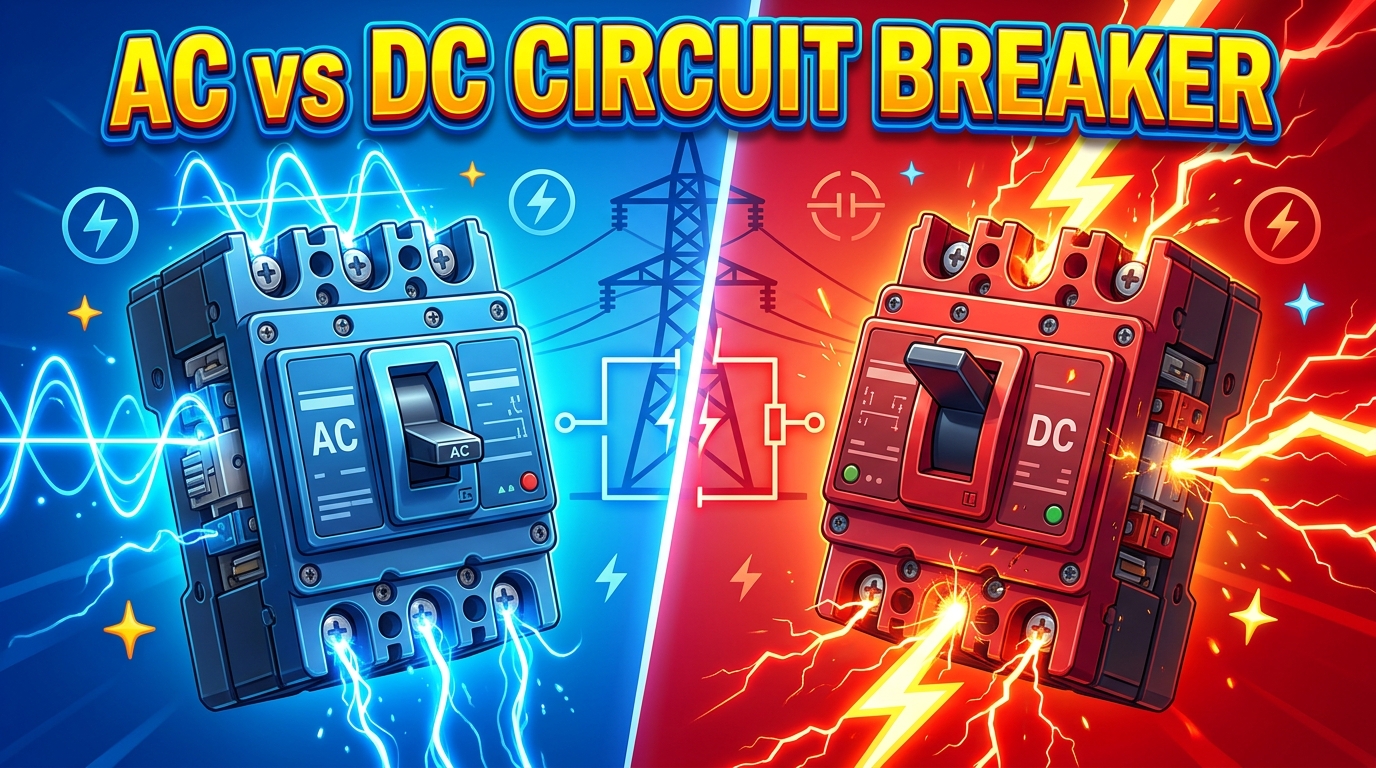
AC and DC circuit breakers may look almost identical from the outside, but they are not automatically interchangeable.
This difference becomes especially important in solar power systems, batteries, inverters, UPS systems, electric vehicles and modern electrical installations where both AC and DC circuits can exist in the same project.
A typical solar system, for example, can contain:
Solar panels → DC cables → DC protection → Solar inverter → AC protection → Home electrical system
The solar panels produce DC electricity, while the inverter normally converts that electricity into AC electricity for household loads or grid connection.
Because AC and DC behave differently when a circuit is interrupted, the breaker used on each side must be suitable for the type of current, voltage, current level and system configuration.
Schneider Electric explains that AC naturally passes through a zero-current point every half cycle, which helps extinguish an electrical arc when contacts open. DC does not have this natural zero crossing, so DC breakers require suitable arc-quenching arrangements to interrupt the current safely.
This complete guide explains the difference between AC circuit breakers and DC circuit breakers, where each is used, why DC breakers are important for solar systems, whether they can be substituted for one another, how ratings work, common mistakes and how to choose the right breaker.
Safety note: Circuit-breaker selection and installation should be performed by a qualified electrician or appropriately trained solar professional. Never work on an energized AC or DC system.
What Is a Circuit Breaker?
A circuit breaker is a protective switching device that can disconnect an electrical circuit when a fault or abnormal current condition occurs.
Depending on the breaker type, it may provide protection against conditions such as:
- Overcurrent
- Overload
- Short circuit
- Some forms of fault current
- Residual/leakage current when combined with appropriate technology
A breaker can also be used to manually isolate a circuit for maintenance.
The important point is that a breaker must be correctly selected for the electrical system.
A breaker is not simply:
“A switch that turns electricity off.”
Its interrupting capability, voltage rating, current rating, pole arrangement, trip characteristics and application must all be appropriate.
NEPRA’s Power Safety Code requires correctly rated overcurrent protective devices, fuses or circuit breakers in electrical systems and also discusses additional protection such as RCCB/RCD and RCBO devices for suitable applications.
What Is AC Electricity?
AC means Alternating Current.
In an AC system, the direction of current periodically changes.
Household electricity supplied through the normal utility network is AC.
In Pakistan, household electrical systems commonly use approximately 230 V nominal single-phase supply, although actual voltage can vary within the permitted system range.
Common AC applications include:
- House wiring
- Lighting
- Fans
- Refrigerators
- Air conditioners
- Water pumps
- Grid connections
- AC output of solar inverters
Because AC periodically passes through a zero-current point, interrupting an AC circuit is generally easier than interrupting DC under comparable conditions.
What Is DC Electricity?
DC means Direct Current.
In a DC circuit, current flows in one direction.
Examples include:
- Solar panels
- Batteries
- Battery banks
- DC UPS systems
- Certain electronic circuits
- Electric vehicles
- Some telecommunications systems
A solar panel does not directly produce the AC electricity used by most household appliances.
It produces DC electricity.
The solar inverter converts that DC electricity into AC.
That is why a solar installation can require both DC-side and AC-side protection.
The Main Difference Between AC and DC Breakers
The biggest technical difference is how the breaker deals with the electrical arc when its contacts open.
When a circuit breaker opens under load, an electrical arc can form between its contacts.
With AC
The alternating current naturally reaches a zero-crossing point.
This helps the arc extinguish.
With DC
There is no natural current zero crossing during steady operation.
The arc can therefore continue unless the breaker is specifically designed to extinguish it.
Schneider Electric states that DC circuit interruption requires additional means of quenching/cooling the arc because DC does not naturally pass through zero like AC.
This is the fundamental reason why a breaker designed and tested for one application cannot automatically be assumed suitable for the other.
AC vs DC Circuit Breaker – Quick Comparison
| Feature | AC Circuit Breaker | DC Circuit Breaker |
|---|---|---|
| Current type | Alternating current | Direct current |
| Common use | Homes, commercial AC circuits | Solar PV, batteries, DC systems |
| Natural zero crossing | Yes | No |
| Arc interruption | Relatively easier | More demanding |
| Arc-quenching design | Designed for AC | Specifically designed for DC |
| Solar panel DC side | Normally not the correct choice | Common application |
| Battery circuits | Not automatically suitable | Common application |
| Household AC DB | Common | Normally not used for standard AC circuits |
| Polarity considerations | Depends on breaker/system | Often important |
| Voltage rating | AC-rated | Must be appropriately DC-rated |
| Interchangeability | Not automatic | Not automatic |
Why Is DC Arc More Difficult to Stop?
Imagine opening a circuit while current is flowing.
The electrical current does not necessarily stop instantly when the physical contacts separate.
An arc can form between the contacts.
With AC, the current naturally reaches zero every cycle.
That provides an opportunity for the arc to extinguish.
With DC, there is no equivalent natural zero crossing.
Therefore, a DC breaker must be designed to control the arc.
This can involve features such as:
- Arc chutes
- Magnetic arc blowout
- Larger contact separation
- Special contact arrangements
- Multiple poles in series in certain designs
- Appropriate insulation distances
The exact technology depends on the breaker design.
Why This Matters in Solar Systems
Solar PV systems are one of the clearest examples of where AC and DC breakers have different jobs.
A simplified system looks like:
Solar Panels
↓ DC
DC Isolator / DC Protection
↓
Solar Inverter
↓ AC
AC Breaker / AC Protection
↓
Home DB / Grid
The two sides operate differently.
Solar panel side
The panels generate DC.
Therefore, protection and switching equipment must be suitable for the actual PV DC voltage and current.
Inverter output side
The inverter produces AC.
Therefore, the output protection is selected according to the inverter’s AC output characteristics and the installation design.
Using the same generic breaker on both sides simply because the current rating appears similar is not a safe design method.
AC Breaker on the DC Side: Is It Safe?
Generally, do not assume that an AC-only breaker can safely interrupt a DC circuit.
An AC breaker may have an arc-interruption design based on the characteristics of alternating current.
If it is used in a DC circuit beyond its specified rating, it may fail to interrupt the fault safely.
Possible consequences can include:
- Persistent electrical arc
- Contact damage
- Overheating
- Fire
- Equipment damage
- Failure to disconnect the circuit
The critical issue is not simply the number printed beside the amp symbol.
The breaker must be specifically rated and tested for the DC application.
DC Breaker on the AC Side: Is It Safe?
The opposite situation also requires caution.
A DC breaker should not automatically be assumed suitable for an AC circuit.
Schneider Electric states for one of its DC breaker families that a DC frame optimized for a DC network is not recommended for an AC network because the construction and testing/certification are different.
Therefore:
DC-rated does not automatically mean AC-rated.
Always check the manufacturer’s marking and documentation.
Can a Breaker Be Rated for Both AC and DC?
Yes.
Some circuit breakers are specifically designed and tested for both AC and DC applications.
However, this does not mean:
“Any breaker can be used for both.”
The manufacturer will specify the permitted applications.
For example, the label may show separate ratings for:
- AC voltage
- DC voltage
- AC current
- DC current
It may also specify:
- Number of poles
- Polarity
- Series/parallel pole arrangement
- Maximum DC voltage
- Short-circuit rating
Always follow the exact manufacturer’s specifications.
DC Breaker Polarity
Polarity is an important consideration for many DC breakers.
A DC circuit can have:
- Positive (+)
- Negative (-)
Some DC breakers have polarity requirements or recommended connection directions.
This can be related to the breaker’s internal arc-quenching design.
Therefore, if the breaker has:
+ / −
or arrows or specific line/load markings, follow them exactly as specified by the manufacturer.
Do not assume that reversing the connections is harmless.
Why Solar DC Breakers May Have Multiple Poles
Solar PV systems can use multi-pole DC protection or isolating devices depending on the system architecture.
The design may allow multiple conductors to be disconnected together.
For example, a PV circuit may require switching/isolation of both positive and negative conductors depending on the system design and equipment requirements.
However, the correct pole arrangement depends on:
- PV system architecture
- Inverter requirements
- Earthing arrangement
- Breaker design
- Local requirements
- Manufacturer instructions
Do not copy a two-pole arrangement from another solar installation without checking the actual system.
AC Breaker Ratings
An AC breaker can have several important ratings.
Current Rating
Examples include:
- 6 A
- 10 A
- 16 A
- 20 A
- 25 A
- 32 A
- 40 A
- 50 A
- 63 A
The correct rating depends on the circuit design.
Voltage Rating
Examples may include:
- 230 V AC
- 400 V AC
depending on the breaker and application.
Breaking Capacity
This is extremely important.
You may see ratings such as:
- 6 kA
- 10 kA
The breaking capacity indicates the fault current the device is designed/tested to interrupt under specified conditions.
The appropriate value depends on the installation’s prospective fault current and applicable requirements.
DC Breaker Ratings
A DC breaker also has several important ratings.
Current
For example:
16 A DC
Voltage
For example:
250 V DC
or
500 V DC
or higher for suitable PV equipment.
Breaking Capacity
The breaker must be capable of interrupting the expected DC fault current.
Pole Configuration
The number and arrangement of poles matter.
Polarity
Some DC breakers have specific polarity requirements.
This is why buying a breaker simply because it says:
“32 A”
is not enough.
A 32A AC Breaker Is Not the Same as a 32A DC Breaker
This is one of the most important points in this article.
Suppose you have:
32 A AC breaker
and
32 A DC breaker
They may both carry approximately 32 A under their specified conditions.
But that does not mean they have identical interrupting capability.
The breaker must be evaluated for:
- Current type
- Voltage
- Fault current
- Application
- Pole arrangement
- Arc-quenching capability
- Manufacturer certification
The number “32 A” alone does not tell the whole story.
AC Breaker vs DC Breaker for Solar Panels
For a typical solar PV installation:
DC side
Use appropriately rated:
- PV DC isolator
- DC circuit breaker/fuse where required
- DC surge protection where required
- DC-rated cables/connectors
AC side
Use appropriately rated:
- AC isolator
- AC circuit breaker
- RCCB/RCBO where appropriate
- AC surge protection where required
The exact protection arrangement depends on the inverter and PV system design.
DC Breaker vs DC Isolator
These are not necessarily the same thing.
A DC circuit breaker is primarily a protective device that can interrupt current during specified fault conditions.
A DC isolator/disconnector is primarily intended to provide safe isolation.
Some devices can perform both functions, but you must verify the manufacturer’s specifications.
For solar installations, you may see equipment described as:
- DC isolator
- PV isolator
- DC breaker
- PV circuit breaker
- DC fuse
- DC protection switch
Don’t assume they all perform exactly the same function.
AC Isolator vs AC Circuit Breaker
The same distinction exists on the AC side.
An isolator is primarily intended for safe isolation.
A circuit breaker provides protective interruption under specified fault conditions.
Some devices combine switching, isolation and protection.
The equipment’s certification and manufacturer’s documentation determine what it can actually do.
AC MCB vs DC MCB
An MCB is a miniature circuit breaker, but the term “MCB” alone does not tell you whether it is suitable for AC or DC.
You should check the marking.
For example, a breaker may be marked for:
AC only
or:
DC only
or may provide both AC and DC ratings.
The exact rating table from the manufacturer should always be used.
Why Solar Installers Use DC Protection
Solar panels can continue producing voltage whenever sufficient light is available.
Unlike an AC grid circuit, the PV source cannot simply be turned off by switching off a household appliance.
Even when the inverter is switched off, the PV array can remain energized during daylight.
This makes proper DC isolation and protection particularly important.
A solar technician must therefore treat PV wiring as energized whenever the array can produce voltage.
DC Breakers in Battery Systems
Battery systems are another major application.
Lithium batteries and other battery banks can provide substantial DC current.
Depending on the battery and inverter system, the DC side may require:
- DC breaker
- Fuse
- Battery isolator
- DC disconnect
- BMS
- Properly sized cables
Battery fault currents can be very high.
Therefore, the protective device must be selected based on the actual battery-system specifications.
Never select a battery breaker only from the inverter’s nominal power rating.
Example: Solar Panel DC Circuit
Suppose a PV string operates at approximately:
400 V DC
and has a design current around:
12 A
A suitable protective device must be selected based on the complete PV design.
It is not enough to say:
“12 A, so I will install a 12 A breaker.”
You also need to consider:
- Maximum PV voltage
- Maximum system voltage
- Short-circuit current
- Temperature effects
- Number of strings
- Cable size
- Inverter requirements
- Breaker DC rating
- Interrupting capacity
- PV-specific certification
Example: AC Inverter Output
Suppose a solar inverter produces:
5 kW AC
At approximately 230 V single phase, the nominal current can be estimated as:
5,000 ÷ 230 ≈ 21.7 A
But this does not automatically mean:
“Install a 22 A breaker.”
The actual breaker selection should consider:
- Inverter manufacturer’s requirements
- Continuous output
- Power factor
- Cable size
- Installation method
- Local electrical requirements
- Protective-device coordination
The breaker and cable must be selected as a coordinated system.
Common Mistakes With AC and DC Breakers
Mistake 1: Using an AC MCB on a Solar DC String
This is one of the most dangerous shortcuts.
The breaker may not have the required DC arc-interruption capability.
Mistake 2: Assuming DC Breakers Are Always Safe on AC
They are not automatically interchangeable.
Check the manufacturer’s AC rating.
Mistake 3: Looking Only at Ampere Rating
A breaker marked 32 A still needs the correct voltage, current type and application rating.
Mistake 4: Ignoring DC Voltage
PV systems can reach hundreds of volts DC.
A breaker rated for low-voltage DC is not automatically suitable for high-voltage PV strings.
Mistake 5: Ignoring Polarity
Some DC protection devices have polarity requirements.
Follow the markings.
Mistake 6: Using Cheap Generic Solar Breakers
A breaker is a safety component.
Don’t select it purely because it is inexpensive.
Check:
- Manufacturer
- Model
- DC voltage rating
- Current rating
- Breaking capacity
- Standards/certification
- PV application suitability
Mistake 7: Using the Wrong Number of Poles
Pole arrangement should match the system design and required isolation.
Mistake 8: Replacing a Tripping Breaker With a Larger One
If a breaker trips repeatedly, find the cause.
Possible causes include:
- Overload
- Short circuit
- Faulty appliance
- Incorrect breaker selection
- Wiring problem
- Equipment fault
AC vs DC Breaker for a Home
For normal household AC circuits such as:
- Lights
- Fans
- Sockets
- Refrigerator
- AC
- Washing machine
you generally use breakers specifically rated for the AC distribution system.
For a solar PV DC circuit, use equipment specifically rated for the PV DC application.
For a battery DC circuit, use equipment rated for the battery voltage and expected fault current.
The answer is therefore not:
“DC breakers are better.”
or:
“AC breakers are better.”
They are designed for different electrical applications.
How to Choose the Correct DC Breaker for Solar
Before purchasing a DC breaker, check:
1. Maximum PV voltage
The breaker must be rated for the maximum possible DC voltage of the circuit.
2. Current
Determine the design current.
3. Short-circuit current
Consider the PV array’s fault current and the protective-device requirements.
4. Number of poles
Determine whether one or multiple conductors need to be disconnected.
5. Polarity
Follow the manufacturer’s polarity requirements.
6. Breaking capacity
The device must be suitable for the prospective fault current.
7. PV application
Choose a breaker specifically intended for the application where required.
8. Inverter manufacturer requirements
Always check the inverter installation manual.
How to Choose the Correct AC Breaker
For an AC circuit, consider:
- Supply voltage
- Phase configuration
- Design current
- Cable size
- Installation method
- Load characteristics
- Short-circuit level
- Breaker curve/type
- Breaking capacity
- Number of poles
- Manufacturer specifications
For a household circuit, an electrician should coordinate the breaker rating with the cable size and expected load.
Does a Bigger Breaker Mean More Power?
No.
A bigger breaker does not create additional electrical capacity.
For example, replacing a:
20 A breaker
with:
32 A breaker
does not magically make the wiring capable of safely carrying 32 A.
If the cable was designed for 20 A under the applicable conditions, increasing the breaker could leave the cable inadequately protected.
This is why breaker and cable selection must be coordinated.
Breaker and Cable Must Match
Consider this simplified system:
Load → Cable → Breaker
The breaker should protect the conductor and circuit under the applicable design conditions.
If the cable is too small for the breaker, the breaker may allow excessive current relative to the cable’s permissible capacity.
This can result in:
- Cable overheating
- Insulation damage
- Fire risk
NEPRA’s Power Safety Code emphasizes correctly rated protective devices and protection against overload and short circuits.
AC and DC Breakers in a Hybrid Solar System
A hybrid solar system may contain several protection points.
A simplified arrangement could be:
Solar Panels
↓ DC
DC Protection
↓
Hybrid Inverter
↓ AC
AC Protection
↓
Home DB
And separately:
Battery
↓ DC
Battery Protection
↓
Hybrid Inverter
The exact architecture varies by inverter.
Some systems have integrated protection, while others require external devices.
Therefore, the inverter manual should always be consulted before designing the protection system.
AC Breaker vs DC Breaker – Advantages and Limitations
AC Circuit Breaker
Advantages
- Designed for AC systems
- Suitable for household distribution
- Widely available
- Many ratings and trip characteristics
- Easy integration into AC DBs
Limitations
- AC-rated models should not automatically be used on DC
- Not necessarily suitable for PV or battery circuits
- DC arc interruption requires different design
DC Circuit Breaker
Advantages
- Designed for DC interruption
- Suitable for solar PV and battery applications when correctly rated
- Designed to manage DC arc interruption
- Available for higher PV voltages
Limitations
- Must be correctly selected for DC voltage
- Polarity may matter
- Not automatically suitable for AC
- Quality and certification are important
- PV/battery applications require careful design
How to Read a Breaker Label
Before installing a breaker, look for:
Current
Example:
16 A
Voltage
Example:
230 V AC
or
500 V DC
Current Type
Look for:
AC
or
DC
Poles
Example:
1P
2P
3P
Breaking Capacity
Example:
6 kA
Standard/Certification
Check the manufacturer’s documentation and applicable standard.
Model Number
Use the model number to find the manufacturer’s technical datasheet.
A professional should never choose a breaker based solely on its appearance.
Can You Use the Same Breaker for Solar and Home Wiring?
Usually, you should use the breaker type and model specifically appropriate for each side of the system.
For example:
PV DC side → appropriately rated DC protection
Inverter AC side → appropriately rated AC protection
The exact equipment may vary if a manufacturer has specifically designed and rated a device for both applications.
Always verify the ratings.
Why Cheap Breakers Can Be Dangerous
Circuit breakers are protective devices.
A low-quality device can create problems if it:
- Does not trip correctly
- Has inaccurate ratings
- Has poor contact quality
- Has inadequate arc suppression
- Has insufficient breaking capacity
- Is counterfeit
- Does not meet the claimed standard
This is particularly important on solar DC systems because high DC voltages can be difficult to interrupt.
For a safety component, documentation and verified specifications matter more than a low purchase price.
NEPRA Safety Guidance for Electrical Protection
NEPRA’s Power Safety Code is particularly relevant to residential electrical safety in Pakistan.
The code calls for appropriately rated overcurrent protective devices, fuses or circuit breakers. It also recommends residual-current protection for human protection and discusses RCBOs as combined residual-current and overcurrent protection.
NEPRA’s current legal pages list the Power Safety Code 2026 among its codes.
This reinforces an important principle:
Electrical protection must be correctly designed and rated rather than selected simply by convenience or price.
AC Circuit Breaker vs DC Circuit Breaker: Final Comparison
| Question | AC Breaker | DC Breaker |
|---|---|---|
| Designed for AC? | Yes, when appropriately rated | Only if manufacturer specifies |
| Designed for DC? | Not automatically | Yes, when appropriately rated |
| Natural current zero crossing? | Yes | No |
| Arc interruption | Easier due to AC zero crossing | Requires specialized DC arc control |
| House AC DB | Common | Not automatically suitable |
| Solar PV strings | Normally not suitable unless specifically DC-rated | Common |
| Battery circuits | Not automatically suitable | Common |
| Polarity considerations | Generally less relevant in typical AC systems | Often important |
| High-voltage solar | Requires specific AC/DC rating | Requires appropriate high-DC-voltage rating |
| Interchangeable? | No, not by default | No, not by default |
Frequently Asked Questions
Can I use an AC MCB for solar panels?
Do not assume it is safe. A solar PV circuit is DC, so the breaker must be specifically rated for the PV system’s DC voltage, current and fault conditions.
Can I use a DC breaker for household AC?
Only if the specific breaker is also rated and tested for the intended AC application. A DC-only breaker should not automatically be installed in an AC system.
Why are DC breakers more expensive?
Some DC breakers require more specialized arc-quenching and insulation arrangements, particularly at higher DC voltages. Price also depends on brand, ratings, breaking capacity and construction.
Is a 32A DC breaker the same as a 32A AC breaker?
No. The 32 A current rating alone does not make the two devices equivalent. Voltage, current type, breaking capacity and application rating must also match.
Do solar panels need DC breakers?
The required protection depends on the PV system design, inverter requirements and applicable standards. Appropriate DC isolation and overcurrent protection may be required depending on the system configuration.
Do lithium batteries need DC breakers?
Battery systems commonly require appropriately rated DC protection or isolation, but the exact arrangement depends on the battery, inverter, BMS and system design.
Why can’t DC arcs simply stop like AC arcs?
AC naturally passes through zero current during each cycle. DC does not have that natural zero crossing, so a breaker must use an appropriate mechanism to extinguish the arc.
Does a DC breaker protect against every solar problem?
No. A breaker is only one part of the protection system. Solar installations can also require appropriate fuses, surge protection, isolation, earthing, cable protection and inverter-specific safeguards.
Can I replace a tripping solar DC breaker with a larger one?
No—not without determining why it is tripping and verifying that the cable, inverter, PV array and protection design support the new rating.
Which breaker is better: AC or DC?
Neither is universally “better.” They are designed for different current types and applications. The correct breaker is the one whose ratings and construction match the electrical circuit.
Conclusion
The difference between an AC circuit breaker and a DC circuit breaker is much more important than the letters printed on the front.
The biggest technical difference is the way each device handles electrical arcs when the circuit is interrupted. AC naturally passes through zero current, while DC does not. Because of this, DC breakers require suitable arc-quenching and interruption characteristics.
For a solar installation, this distinction is especially important:
Solar panels produce DC → DC protection is required where applicable → inverter converts DC to AC → AC protection is used on the AC side.
Similarly, battery systems require appropriately rated DC protection.
The safest approach is to select every breaker according to:
- AC or DC current
- Voltage
- Current rating
- Short-circuit/interrupting capability
- Number of poles
- Polarity requirements
- Cable size
- System design
- Manufacturer specifications
- Applicable electrical standards
Never select a breaker only because the ampere rating looks correct.
A 32 A AC breaker and a 32 A DC breaker are not automatically equivalent, and an AC breaker should not be substituted for a DC breaker on a solar PV circuit simply because it physically fits.
For homes and solar systems in Pakistan, proper breaker selection should be treated as a safety requirement, not simply a component-shopping decision. NEPRA’s Power Safety Code likewise emphasizes correctly rated protective devices and protection against overload, short circuits and electric shock.
If you are installing or upgrading a solar system, always have the AC and DC protection designed and checked by a qualified professional before energizing the system.