
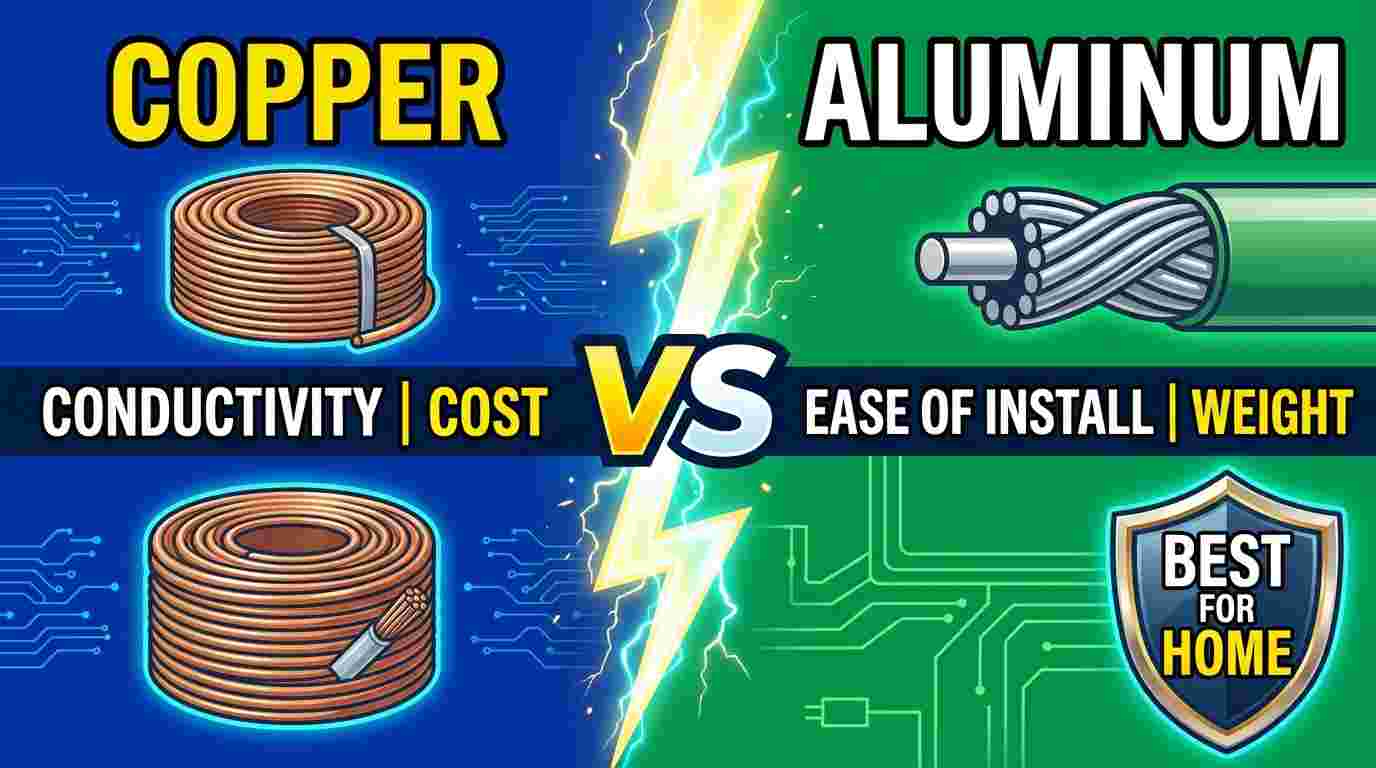
When wiring a new house in Pakistan, one of the most important decisions is choosing the right electrical wire material. The two materials most commonly discussed are copper and aluminium.
At first glance, the decision may look simple:
Copper = better but expensive
Aluminium = cheaper but less efficient
There is some truth behind this comparison, but the real answer is more complicated.
Copper and aluminium can both be used successfully in electrical systems when the conductor size, insulation, terminals, connectors, protective devices and installation method are appropriate. However, they have different electrical and physical characteristics that make copper more attractive for many residential circuits, while aluminium can be useful for larger feeders, service conductors and other applications where weight and cost are important.
For a homeowner in Pakistan, the decision should not be based only on the price per metre. You should also consider electrical conductivity, current-carrying capacity, voltage drop, cable size, connection quality, corrosion, flexibility, installation method, distance, future load and the quality of the cable manufacturer.
NEPRA’s safety guidance emphasizes proper internal wiring, protective conduits, earthing, avoiding overloaded sockets and having electrical work carried out by trained electricians. It also advises consumers to replace defective wires and other electrical components promptly.
So, which is better for home wiring in Pakistan in 2026: copper or aluminium?
For most internal residential wiring, copper is generally the preferred choice. Aluminium can still make sense for certain larger circuits and feeders when it is properly sized, terminated and installed using components suitable for aluminium conductors.
Let’s understand the differences in detail.
What Is a Copper Electrical Wire?
A copper electrical wire uses copper as the conducting material through which electric current flows.
Copper has been widely used for electrical wiring because it combines good electrical conductivity with useful mechanical properties.
Copper wires are commonly found in:
- House wiring
- Lighting circuits
- Socket circuits
- Air-conditioner circuits
- Industrial wiring
- Control systems
- Electrical panels
- Solar installations
- Appliances
- Flexible electrical cords
For residential internal wiring, copper is particularly popular because relatively small conductor sizes can carry substantial current when correctly designed.
What Is an Aluminium Electrical Wire?
An aluminium electrical wire uses aluminium as the conductor.
Aluminium is lighter than copper and generally costs less per unit of conductor material, making it attractive for applications where large amounts of conductor are required.
It is commonly associated with:
- Utility distribution
- Service connections
- Large feeders
- Overhead conductors
- Certain industrial installations
- Large electrical systems
Aluminium can also be used in building electrical systems, but the installation needs to account for its different characteristics.
The important point is:
Aluminium is not simply a cheap version of copper. It requires appropriate sizing, termination and installation practices.
Copper vs Aluminium: Quick Comparison
| Feature | Copper | Aluminium |
|---|---|---|
| Electrical conductivity | Higher | Lower |
| Required size for same current | Generally smaller | Generally larger |
| Weight | Heavier | Much lighter |
| Material cost | Usually higher | Usually lower |
| Flexibility | Generally better for many wiring applications | Less flexible for equivalent current capacity |
| Thermal expansion | Lower | Higher |
| Connection requirements | Relatively straightforward | Requires greater attention |
| Oxide layer | Forms oxide but connections are well established | Oxide can affect connections if poorly handled |
| Residential internal wiring | Very common | Less common |
| Large feeders | Suitable | Often attractive |
| Long-distance distribution | Used | Widely used |
| Solar applications | Common | Possible with suitable design |
| Best general choice for home wiring | Usually copper | Application-dependent |
The exact performance depends on the cable construction, conductor size, insulation, installation method and termination system.
Why Is Copper More Conductive Than Aluminium?
One of the biggest differences between the two materials is electrical conductivity.
Copper conducts electricity better than aluminium.
This means that for the same electrical current and comparable conditions, an aluminium conductor generally needs a larger cross-sectional area than a copper conductor.
For example, you cannot simply assume:
4 mm² aluminium = 4 mm² copper
for the same electrical application.
The conductor material matters.
This is one reason copper is attractive for residential wiring, where space inside conduits and walls can be limited.
Does Higher Conductivity Mean Copper Always Wins?
Not necessarily.
Electrical engineering is not just about conductivity.
Aluminium has a major advantage:
It is much lighter than copper.
For large electrical conductors, reducing conductor weight can be extremely valuable.
Imagine a long electrical distribution line requiring kilometres of conductor.
Using a lighter material can reduce:
- Structural loading
- Transportation requirements
- Installation difficulty
- Material cost
This is one reason aluminium is widely used in power distribution.
So:
Copper is generally better electrically for a given cross-sectional area.
But:
Aluminium can be more economical and practical for large conductors when appropriately designed.
Copper vs Aluminium for Home Wiring
For ordinary internal house wiring, copper is usually the more practical option.
Why?
Because residential circuits often run through:
- Walls
- Conduits
- Electrical boxes
- Distribution boards
- Switches
- Sockets
Space is limited, and copper’s higher conductivity allows a smaller conductor for a given current-carrying requirement.
Copper also has good mechanical properties for repeated handling and termination.
For these reasons, copper is commonly preferred for:
- Lighting
- Socket circuits
- AC circuits
- Kitchen wiring
- Appliance circuits
- Internal distribution
However, the final choice should still follow the electrical design and applicable standards.
Why Is Aluminium Popular for Large Electrical Systems?
Aluminium’s biggest advantages become more noticeable as conductor size and installation distance increase.
Suppose an electrical project requires a very large quantity of conductor.
Copper would provide excellent conductivity, but the material can become expensive and heavy.
Aluminium can provide a practical alternative because:
- It is lighter.
- It generally costs less per kilogram.
- Larger cross-sections can compensate for its lower conductivity.
- It is suitable for many distribution applications when correctly installed.
This is why aluminium is widely associated with overhead electricity distribution and larger feeders.
Copper vs Aluminium: Cost
Price is one of the biggest reasons homeowners consider aluminium.
Copper is generally more expensive as a conductor material.
Aluminium is usually less expensive for the same weight of conductor material.
However, comparing prices by simply looking at:
Rs. per metre
can be misleading.
You also need to consider the amount of aluminium required to achieve the desired electrical performance.
Because aluminium has lower conductivity, a larger cross-sectional area may be needed compared with copper for the same application.
Therefore, the real comparison should be:
Complete installed cost
rather than simply:
Price per metre
Is Aluminium Always Cheaper Than Copper?
Not necessarily when comparing complete installations.
Suppose you compare:
- Copper cable of one size
- Aluminium cable of another larger size
The aluminium conductor may be cheaper, but the complete installation may also require:
- Larger terminals
- Different connectors
- Larger conduit
- Suitable lugs
- Special termination practices
- Different handling
Therefore, calculate the complete project cost rather than comparing the raw cable price alone.
Copper vs Aluminium and Voltage Drop
Voltage drop is an important consideration when choosing electrical conductors.
Every conductor has electrical resistance.
When current flows through that resistance, some voltage is lost along the cable.
A longer cable generally has more resistance than a shorter cable of the same cross-sectional area.
Because aluminium has higher resistivity than copper, an aluminium conductor generally needs a larger cross-sectional area than copper to achieve comparable resistance under similar conditions.
This becomes particularly important for:
- Long pump cables
- Long sub-DB feeds
- Solar systems
- Large buildings
- Outdoor equipment
- Long-distance power distribution
Example of Voltage Drop
Imagine two identical 5 kW loads.
One is located:
5 metres from the DB
The other is:
60 metres from the DB
Even if the loads are identical, the second installation has a much longer conductor path.
If an aluminium cable is being considered, the designer may need to select a larger conductor to keep voltage drop within acceptable limits.
This is why cable sizing should never be based solely on the appliance wattage.
Copper vs Aluminium for Air Conditioners
For residential AC circuits, copper is usually the more convenient choice.
Air conditioners can have:
- High operating loads
- Compressor startup characteristics
- Long cable runs
- Sensitive electronic controls
An AC circuit should be designed according to the manufacturer’s electrical specifications.
For example, simply saying:
1.5-ton AC = 4 mm² copper
is not a universal rule.
The actual requirement depends on:
- AC model
- Rated current
- Maximum current
- Cable length
- Installation method
- Ambient temperature
- Breaker
- Voltage drop
If aluminium is used, the conductor size and termination system must be selected accordingly.
Copper vs Aluminium for Water Pumps
Water pumps are another important application.
A pump motor can have a higher starting current than its normal operating current.
This means cable selection should consider more than just the pump’s running wattage.
Important factors include:
- Motor rating
- Rated current
- Starting current
- Cable length
- Voltage
- Single-phase or three-phase operation
- Installation method
- Voltage drop
For a long-distance pump installation, a larger aluminium conductor may be practical, but it must be correctly sized and terminated.
Copper vs Aluminium for Electric Geysers
Electric geysers can be continuous or high-load appliances.
Suppose a heater is rated:
3,000 watts
At approximately 230 volts:
Current ≈ 3,000 ÷ 230
Current ≈ 13 A
The circuit then needs appropriate:
- Cable
- MCB
- Socket/isolator
- Earthing
- Connections
Copper is often convenient for such dedicated residential circuits because of its conductivity and ease of termination.
For larger installations, aluminium can also be used where appropriate.
Copper vs Aluminium for Socket Wiring
For general household sockets, copper is generally preferred.
Why?
A socket circuit may supply many different appliances, such as:
- TV
- Laptop
- Iron
- Vacuum cleaner
- Fan
- Kettle
- Microwave
- Charger
- Heater
The load can vary considerably.
Copper provides good conductivity and is commonly used for internal socket circuits.
The bigger concern, however, is not simply copper versus aluminium.
It is:
Correct cable size + correct breaker + correct installation + no overloading.
NEPRA specifically warns against overloading switches, sockets, plugs and extension cords because overheating can lead to fire.
Copper vs Aluminium for Lighting
Lighting circuits generally have relatively modest loads, particularly with modern LED lamps.
Copper is commonly used for residential lighting circuits because:
- Small cable sizes are practical
- Installation is straightforward
- Connections are convenient
- It is widely available
Aluminium could theoretically be used in appropriate systems, but for small internal circuits the advantages of aluminium are often less compelling.
Copper vs Aluminium for Main House Supply
This is where the comparison becomes more interesting.
The main supply cable can carry a significantly higher current than individual lighting circuits.
Depending on the connection, distance and electrical design, aluminium may become economically attractive.
For example, a large house may require a substantial feeder from:
Meter/Main Supply → Main DB
or:
Main DB → Sub-DB
For a large feeder, aluminium can provide a cost-effective solution when correctly sized.
The final selection should be based on engineering calculations and the requirements of the electricity distribution system.
Copper vs Aluminium for Sub-DB Wiring
Suppose a large house has:
- Main DB
- Ground-floor DB
- First-floor DB
- Garage DB
The cables feeding these sub-DBs may carry relatively high loads.
Aluminium may be considered for some larger feeder applications because of its lower weight and cost.
However, the conductor must be:
- Correctly sized
- Properly protected
- Correctly terminated
- Suitable for the equipment terminals
Copper vs Aluminium for Solar Systems
Solar installations can contain both DC and AC conductors.
A simplified system looks like:
Solar Panels → DC Cable → Solar Inverter → AC Cable → Home DB
Copper is widely used for solar wiring because PV systems often require compact conductors, reliable connections and outdoor-rated cable.
Aluminium can also be used in suitable larger conductors and certain system sections, but the equipment and termination system must be specifically compatible.
You should never assume that any aluminium wire can simply replace a copper solar cable.
Copper vs Aluminium in Solar DC Wiring
Solar panel strings operate at DC voltage.
PV cables need to be appropriate for:
- DC voltage
- Current
- Outdoor exposure
- UV radiation
- Temperature
- Moisture
- Solar installation conditions
For typical rooftop solar string wiring, purpose-designed PV cables are used.
The conductor material is only one part of the cable specification.
The cable also needs appropriate insulation and environmental ratings.
Copper vs Aluminium for Solar Inverter AC Wiring
For larger solar inverters, the AC connection can carry substantial current.
For example, a 10 kW single-phase inverter operating around 230 V would have a rough output-current figure of:
10,000 ÷ 230 ≈ 43.5 A
The actual inverter output current and installation design must be used for final cable selection.
At this scale, aluminium may become worth considering for certain feeder applications, particularly when the cable run is long.
However, the inverter terminals must be compatible with the selected conductor and appropriate lugs/connectors must be used.
Why Aluminium Connections Need Extra Attention
One of the most important differences between copper and aluminium is the way connections need to be handled.
Electrical connections are often the weakest point of a circuit if they are poorly installed.
Aluminium has:
- Higher thermal expansion
- Different mechanical behavior
- A surface oxide layer
- Different termination requirements compared with copper
Therefore, aluminium conductors need suitable:
- Lugs
- Terminals
- Connectors
- Torque
- Jointing methods
A connection designed only for copper should not automatically be used with aluminium.
What Is Aluminium Oxide?
When aluminium is exposed to air, it quickly forms a thin oxide layer on its surface.
This oxide layer has much poorer electrical conductivity than the underlying aluminium.
That is one reason aluminium electrical connections require suitable termination practices.
The solution is not to avoid aluminium completely.
The solution is to use:
properly rated connectors + correct preparation + correct torque + suitable installation practices.
What About Thermal Expansion?
Aluminium expands and contracts more with temperature changes than copper.
Electrical connections heat up when current flows and cool down when the load decreases.
Repeated expansion and contraction can affect poorly made connections.
This is why aluminium installations need appropriate terminals and correct tightening procedures.
Loose connections can generate heat, and heat can further worsen connection conditions.
This is a problem that can occur with any conductor if connections are poor, but aluminium installations require particular attention to compatible termination methods.
Can Copper and Aluminium Wires Be Connected Together?
They can be connected in some applications, but not by simply twisting the two wires together.
Directly joining copper and aluminium without an appropriate connector can create problems.
The connection should use a connector or terminal specifically rated for the conductor materials and application.
Depending on the installation, suitable:
- Bi-metallic lugs
- Al/Cu-rated terminals
- Approved connectors
may be required.
The exact method depends on the equipment and electrical system.
Never Twist Copper and Aluminium Together
This is an important safety rule.
You should not make a connection like:
Copper wire + aluminium wire → twisted together → tape
This is not an acceptable substitute for an appropriately rated connection.
NEPRA’s Power Safety Code provides guidance on properly insulating and protecting cable connections and emphasizes protective conduits for indoor and outdoor wiring.
For mixed-metal connections, use components specifically designed for the materials involved.
Is Copper Safer Than Aluminium?
It is not accurate to say that copper is automatically safe and aluminium is automatically unsafe.
Both can be used safely when:
- Correctly sized
- Properly protected
- Correctly terminated
- Installed according to applicable requirements
- Properly maintained
However, copper is often easier to use in small residential circuits because of its conductivity and familiar termination practices.
Aluminium becomes a practical option when the installation is designed for it.
Which Wire Has a Longer Life: Copper or Aluminium?
There is no simple answer.
Cable life depends on:
- Temperature
- Loading
- Insulation quality
- Moisture
- Mechanical damage
- UV exposure
- Connection quality
- Corrosion
- Installation environment
A high-quality aluminium cable that is properly installed can last a long time.
A poorly installed copper cable can also fail.
The conductor material is only one part of the overall system.
Copper vs Aluminium for Underground Wiring
For underground applications, several factors become important:
- Cable insulation
- Moisture resistance
- Mechanical protection
- Soil conditions
- Cable length
- Current
- Voltage drop
- Installation method
Both copper and aluminium cables can be used in appropriate underground applications.
However, you should use a cable specifically designed for the environment rather than simply burying an ordinary indoor wire.
Copper vs Aluminium for Outdoor Wiring
Outdoor wiring has additional challenges:
- Sunlight
- UV exposure
- Rain
- Humidity
- Temperature changes
- Mechanical damage
The cable needs suitable environmental protection.
NEPRA’s Power Safety Code calls for protective conduits for indoor and outdoor electrical wiring and recommends replacing defective wiring promptly.
Copper vs Aluminium in Pakistan’s Hot Climate
Pakistan’s summer temperatures can be very high.
This matters because conductor temperature affects cable performance and allowable current.
A cable installed in a hot environment may have less ability to dissipate heat than the same cable installed in cooler conditions.
This means cable selection should account for:
- Ambient temperature
- Installation method
- Cable grouping
- Insulation rating
- Continuous load
Simply copying a cable rating from a different environment may not give an accurate result.
Does Aluminium Wire Heat More Than Copper?
It is not correct to say that aluminium always “heats more” simply because it is aluminium.
Aluminium has higher electrical resistivity than copper, so a same-size aluminium conductor has higher resistance.
But engineers compensate for this by using an appropriately larger aluminium conductor.
The actual operating temperature depends on:
- Current
- Conductor size
- Resistance
- Installation
- Cooling
- Ambient temperature
- Connection quality
Therefore:
Correctly sized aluminium ≠ automatically overheating
and
Copper ≠ automatically cool
Copper vs Aluminium: Weight Difference
Weight is one of aluminium’s strongest advantages.
Aluminium is substantially lighter than copper.
This matters especially for:
- Long feeders
- Overhead conductors
- Large electrical installations
- Utility distribution
- Large solar projects
For a residential circuit only a few metres long, weight may not matter much.
For hundreds of metres of large conductor, it can become a major engineering consideration.
Copper vs Aluminium: Flexibility
Copper is generally easier to handle for many small residential wiring applications.
This can be useful when:
- Routing through conduit
- Connecting switches
- Connecting sockets
- Working inside DBs
- Making appliance connections
Larger aluminium conductors can be less convenient to bend and terminate, especially when the conductor size becomes substantial.
Copper vs Aluminium for DB Boxes
Inside a residential distribution board, copper conductors are commonly convenient because the DB may contain:
- MCBs
- RCCBs
- RCBOs
- Busbars
- Neutral bars
- Earth bars
- SPDs
Many devices have relatively compact terminals.
If aluminium is being used, the terminals and lugs must be compatible with the conductor.
This is particularly important for:
- Main incoming cables
- Sub-DB feeders
- Solar inverter connections
Copper vs Aluminium for MCB Connections
Before connecting an aluminium conductor to an MCB, check whether the device terminal is rated for aluminium or for both copper and aluminium.
Don’t assume compatibility.
Electrical equipment manufacturers specify what conductor types and sizes their terminals can accept.
Using an incompatible conductor can create a poor connection and excessive heating.
Which Is Better for a New House in Pakistan?
For most new residential houses, a practical approach is:
Use Copper for:
- Lighting circuits
- Socket circuits
- Room circuits
- Kitchen circuits
- AC circuits
- Appliance circuits
- Internal DB wiring
Consider Aluminium for:
- Large feeders
- Main supply sections
- Long sub-DB feeds
- Certain large-scale applications
This isn’t an absolute rule.
The actual design may call for different materials.
Copper vs Aluminium for a 5-Marla House
For a typical 5-marla house with:
- 1–3 ACs
- Refrigerator
- Washing machine
- Water pump
- Fans
- Lights
- Normal kitchen appliances
copper is usually the straightforward choice for internal wiring.
The main supply may be a separate engineering decision.
The house size itself doesn’t determine the conductor material.
Copper vs Aluminium for a 10-Marla House
A larger house may have:
- More ACs
- Multiple pumps
- Electric ovens
- Electric geysers
- Larger solar systems
- Multiple floors
Here, copper can still be used throughout.
But larger feeders may make aluminium economically attractive.
The important question becomes:
Where does the larger conductor begin, and what are the connection requirements?
Copper vs Aluminium for a Large House
For a large property, a mixed approach can sometimes make sense.
For example:
Main supply → Aluminium feeder → Main DB → Copper internal circuits
This can provide a balance between:
- Cost
- Weight
- Electrical performance
- Practical internal wiring
However, the transition between aluminium and copper must use proper compatible connectors.
Copper vs Aluminium for Three-Phase Systems
Three-phase systems often carry higher total power than ordinary single-phase residential circuits.
As conductor size increases, aluminium can become increasingly attractive.
For example:
- Main feeder
- Large sub-DB
- Commercial building
- Pump system
- Large solar inverter
may use aluminium conductors depending on the design.
For individual final circuits inside a home, copper often remains more convenient.
Copper vs Aluminium for Single-Phase Systems
Single-phase residential circuits are generally smaller.
Copper is therefore often the practical choice because:
- Cable sizes are manageable
- Conductivity is high
- Terminations are straightforward
- Internal conduit space is limited
Aluminium can still be used where appropriate, but the economic advantage may be smaller for short, small circuits.
Which Is Better for Solar: Copper or Aluminium?
For most standard rooftop solar string wiring, purpose-built copper PV cable is commonly used.
For larger AC feeders or other larger conductors, aluminium can sometimes be considered.
The correct material depends on:
- Current
- Voltage
- Cable length
- Installation
- Inverter terminals
- Cable environment
- Connector compatibility
Don’t choose the material simply because it is cheaper.
Copper vs Aluminium for Battery Systems
Battery systems can involve very high currents, particularly at low DC voltages.
For example, a 5 kW load at 48 V would require an idealized current of:
5,000 ÷ 48 ≈ 104 A
The real system current can differ because of efficiency and operating conditions.
At these current levels, cable selection becomes extremely important.
Battery cables must be:
- Correctly sized
- Properly protected
- Suitable for DC
- Properly terminated
- Kept as short as practical where appropriate
Copper is often favored for battery connections because compact, high-current conductors are useful.
However, the final choice should follow the battery/inverter manufacturer’s requirements.
Copper vs Aluminium for Electric Vehicle Chargers
EV charging can involve substantial continuous current.
A charger may operate for several hours at a time, making conductor selection particularly important.
The cable needs to be selected based on:
- Charger rating
- Voltage
- Current
- Installation method
- Cable length
- Continuous load
- Temperature
- Protection
Copper is commonly attractive for EV charging circuits because of its conductivity and ease of installation.
For larger feeders, aluminium may be considered if the equipment terminals and design support it.
What Should You Look for When Buying Copper Wire?
Don’t buy cable based only on the word “copper”.
Check:
1. Conductor Material
Make sure it is actually copper as specified.
2. Cross-Sectional Area
Check the stated mm² size.
3. Insulation
Verify the insulation type and voltage rating.
4. Manufacturer
Buy from a reputable manufacturer and authorized supplier where possible.
5. Cable Markings
Look for clear manufacturer and specification markings.
6. Application
Make sure the cable is designed for your intended installation.
How to Avoid Fake or Poor-Quality Electrical Wire
Cable quality is a serious issue when buying electrical materials.
A cable may appear thick from the outside because of insulation while having a conductor that doesn’t meet the claimed specification.
Before purchasing a large quantity:
- Buy from a reputable supplier.
- Check manufacturer markings.
- Verify specifications.
- Ask for product documentation where appropriate.
- Compare conductor size rather than only overall cable thickness.
- Avoid suspiciously cheap products.
For a complete house wiring project, saving money on poor-quality cable can create much larger costs later.
Copper vs Aluminium: Pros and Cons
Copper
Advantages
- Higher electrical conductivity
- Smaller conductor size for comparable electrical performance
- Good mechanical properties
- Convenient for residential wiring
- Widely available
- Good choice for compact installations
- Commonly used for appliances and internal circuits
Disadvantages
- More expensive
- Heavier
- Higher material cost for large feeders
Aluminium
Advantages
- Lightweight
- Generally lower material cost
- Suitable for large conductors
- Attractive for long-distance distribution
- Useful for large feeders
- Easier to transport for large conductor quantities
Disadvantages
- Lower conductivity than copper
- Larger conductor may be required
- Greater thermal expansion
- Connection requires appropriate components and installation
- More attention required at terminations
- Not always practical for small residential circuits
Copper vs Aluminium: Which Is More Efficient?
If we compare conductors of the same cross-sectional area, copper has lower electrical resistance than aluminium.
But that is not how real electrical systems should be compared.
Engineers can increase the aluminium conductor size to achieve the required electrical performance.
Therefore:
Same size → Copper generally performs better electrically
but:
Properly sized aluminium → Can be a very effective conductor
The correct comparison is therefore based on the complete application rather than simply the material name.
Is Copper Worth the Extra Money?
For internal residential wiring, often yes.
The additional cost can provide:
- Smaller conductor sizes
- Convenient installation
- Good conductivity
- Easier termination
- Strong performance for compact circuits
For a homeowner building a new house, the electrical wiring is not the place where choosing the cheapest possible conductor should be the only objective.
However, that doesn’t mean copper should be used everywhere regardless of cost.
For large feeders, properly designed aluminium can sometimes provide better overall value.
When Should You Choose Copper?
Copper is usually the better choice when:
- Wiring a normal home
- Running short internal circuits
- Installing lighting circuits
- Installing socket circuits
- Wiring ACs
- Wiring kitchen circuits
- Connecting appliances
- Space is limited
- Compact terminations are important
- You want straightforward residential installation
When Should You Consider Aluminium?
Aluminium can be worth considering when:
- The conductor is large
- The cable run is long
- Weight matters
- Cost of copper becomes significant
- The installation is a main feeder
- The system is three-phase
- A sub-DB is far from the main DB
- The equipment supports aluminium conductors
- Proper aluminium-rated terminals are available
Should You Use Copper and Aluminium Together in One House?
Yes, a house can have both materials.
For example:
Utility/Main Supply → Aluminium Feeder → Main DB → Copper Internal Circuits
This can be a practical design.
The important thing is to make the transition properly.
Do not simply twist copper and aluminium wires together.
Use an approved connector or terminal system suitable for the two conductor materials.
Common Mistakes When Choosing Copper vs Aluminium
Mistake 1: Choosing Only by Price
The cheapest cable isn’t necessarily the best.
Mistake 2: Comparing the Same mm² Size
4 mm² copper and 4 mm² aluminium do not have identical electrical performance.
Mistake 3: Ignoring Cable Length
Long circuits require voltage-drop consideration.
Mistake 4: Using Aluminium With Copper-Only Terminals
Always check terminal compatibility.
Mistake 5: Twisting Copper and Aluminium Together
Use an appropriate rated connector.
Mistake 6: Ignoring Cable Temperature
Hot environments affect cable performance.
Mistake 7: Oversizing or Undersizing Protection
The MCB must be coordinated with the conductor.
Mistake 8: Buying From an Unreliable Supplier
Cable quality matters.
Mistake 9: Ignoring Earthing
The conductor material does not replace the need for proper protective earthing.
Mistake 10: Doing Major Electrical Work Yourself
Electrical wiring should be installed and tested by qualified professionals.
NEPRA advises consumers to have electrical repairs and internal wiring work performed by trained electricians and emphasizes proper earthing and protective wiring practices.
How to Choose Between Copper and Aluminium: Simple Decision Guide
Use this basic approach.
Choose Copper If:
You are wiring a normal home → circuits are relatively short → space is limited → you want simple installation.
Consider Aluminium If:
You are installing a large feeder → cable run is long → conductor size is substantial → cost and weight matter → equipment supports aluminium.
For Solar:
Use the cable material specified by the equipment and system design.
For Battery Systems:
Follow the inverter/battery manufacturer’s cable requirements and calculate current carefully.
Frequently Asked Questions
Is copper better than aluminium for home wiring?
For most internal residential wiring, copper is generally the preferred choice because of its higher conductivity, practical conductor sizes and convenient termination.
Is aluminium wire safe for a house?
Yes, aluminium can be safe when correctly sized, properly terminated and installed using compatible equipment and appropriate protection.
Which wire is cheaper, copper or aluminium?
Aluminium is generally less expensive as a conductor material, but the complete installed cost depends on the required conductor size, connectors, installation and cable length.
Which wire carries more current, copper or aluminium?
For the same cross-sectional area under comparable conditions, copper generally has higher conductivity. Aluminium can carry the required current when its conductor is appropriately sized.
Can I use aluminium wire for house wiring?
It can be used in suitable applications, but for many internal residential circuits copper is more practical. Aluminium requires appropriate conductor sizing and termination.
Can copper and aluminium wires be joined?
Yes, but only using connectors or terminals specifically suitable for the conductor materials and application. Do not simply twist the wires together.
Is aluminium wire dangerous?
Aluminium itself is not inherently dangerous. Poor sizing, incompatible terminals, loose connections or incorrect installation can create hazards.
Does aluminium wire heat more than copper?
For the same size and current, aluminium has higher resistance. Properly sized aluminium conductors can be used safely, but installation and termination conditions are important.
Which wire is better for AC wiring?
Copper is commonly preferred for residential AC circuits, but the final conductor size should be selected according to the AC’s electrical rating, cable length, installation method and protection.
Which is better for solar wiring?
Purpose-designed copper PV cable is common for many rooftop solar applications. Aluminium can be appropriate for certain larger conductors when the equipment and installation are designed for it.
Which is better for long-distance electrical wiring?
Aluminium can be particularly attractive for long-distance and large-conductor applications because of its lower weight and material cost, provided it is correctly sized and installed.
Which lasts longer, copper or aluminium?
Neither has an automatic lifespan advantage. Cable life depends on insulation, loading, temperature, moisture, installation quality, mechanical damage and connection quality.
Is copper worth the extra cost?
For many residential internal circuits, the practical advantages of copper can justify its higher cost. For large feeders, aluminium may provide better economic value.
Can aluminium replace copper with the same cable size?
No. You should not assume that an aluminium cable of the same mm² size has the same electrical performance as copper. The conductor material and required ampacity must be considered.
Final Verdict: Copper or Aluminium?
For most homeowners asking:
“Which wire should I use for my house?”
the straightforward answer is:
Copper is generally the better choice for internal home wiring.
It offers higher conductivity, practical conductor sizes and convenient installation for typical residential circuits.
For:
- Lights
- Sockets
- ACs
- Kitchen circuits
- Appliances
- Internal DB wiring
copper is usually the practical option.
However, aluminium should not be considered a poor-quality alternative.
It has important advantages for large feeders, long cable runs, utility distribution and other high-capacity applications, particularly because it is lighter and can be more economical.
The best solution can even be a combination:
Aluminium for a properly designed large feeder + Copper for internal residential circuits.
The key is proper engineering.
Don’t select a cable simply because:
- It is cheaper.
- It is thicker.
- Someone used it in another house.
- A shopkeeper recommended it.
- It says “heavy duty” on the packaging.
Instead, consider:
Load + Current + Cable Size + Length + Temperature + Installation Method + Voltage Drop + Protective Device + Terminal Compatibility
NEPRA’s safety guidance reinforces the importance of proper internal wiring, protective conduits, earthing, avoiding overloaded sockets and using trained electricians for electrical work.
For a new house in Pakistan, good-quality copper wiring for internal circuits is usually the safest and simplest practical choice, while properly designed aluminium can be an excellent option where larger feeders make its lower weight and cost advantageous.
In electrical wiring, the cheapest conductor is not necessarily the cheapest solution in the long run.
Choose the conductor based on the application—not just the price.