
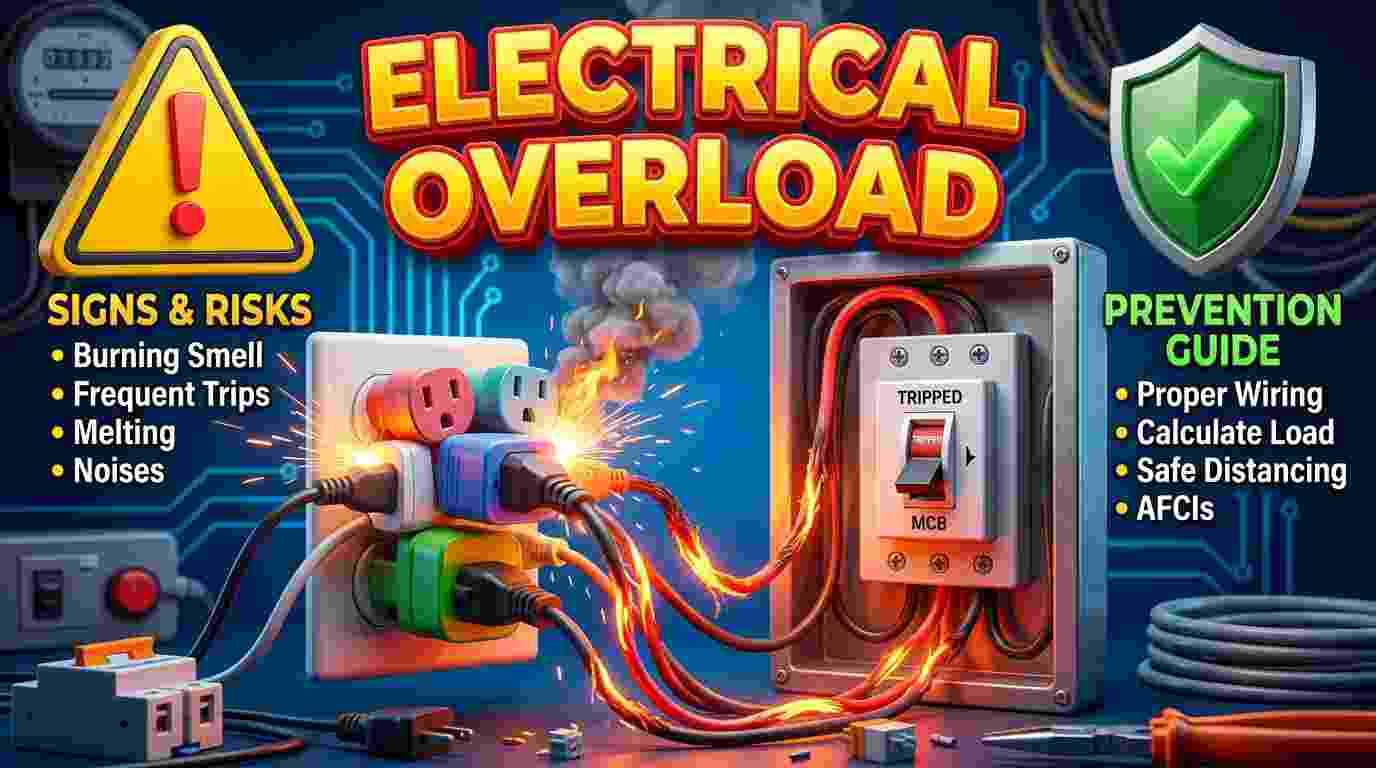
Electrical overload is one of the most common and often overlooked electrical problems in homes. Many people only notice it when an MCB repeatedly trips, a socket becomes hot, a wire starts smelling like burnt plastic, or an appliance suddenly stops working.
The problem becomes more important as modern Pakistani homes use more high-power appliances at the same time. Air conditioners, refrigerators, water pumps, electric irons, microwave ovens, washing machines, geysers, electric heaters, kitchen appliances and computers can place a significant load on a home’s electrical wiring.
If too many appliances are connected to the same circuit, or if the wiring and protective devices are not properly sized, excessive current can flow through the circuit. This can cause overheating, nuisance tripping, insulation damage and, in serious cases, electrical fire.
NEPRA’s public safety guidance specifically warns consumers not to overload electrical switches, sockets and plugs because overheating can lead to fire. Its Power Safety Code also advises replacing defective wiring, switches, sockets, plugs and other electrical components and using proper protective arrangements.
This guide explains what electrical overload is, why it happens, the warning signs, how to calculate your approximate electrical load, what MCBs do, how to prevent overload, and what Pakistani homeowners should check before adding new appliances or a solar system.
What Is Electrical Overload?
An electrical overload happens when an electrical circuit is asked to carry more current than it is designed to handle safely.
In simple words:
Too many electrical loads + one circuit = excessive current = overheating risk.
Every electrical circuit has a limit based on factors such as:
- Cable size
- Cable material
- Installation method
- Circuit breaker rating
- Socket and switch ratings
- Ambient temperature
- Length of the cable
- Type of load
- Continuous operating time
For example, imagine a room has a circuit supplying:
- Air conditioner
- Electric iron
- Heater
- Refrigerator
- Several lights
If these appliances operate simultaneously on a circuit that was not designed for that combined load, the circuit can become overloaded.
The important point is that the number of appliances alone does not determine overload.
Their electrical power and the circuit’s design matter.
Electrical Overload vs Short Circuit
People often confuse an overload with a short circuit, but they are different problems.
Electrical Overload
An overload occurs when a circuit is carrying more current than it should because of excessive connected load.
Example:
An extension board is being used for:
- Electric heater
- Iron
- Microwave
- Kettle
All at the same time.
The combined demand may exceed what the circuit or extension equipment can safely carry.
Short Circuit
A short circuit occurs when electricity finds an unintended low-resistance path, such as a fault between live and neutral conductors.
A short circuit can cause a very large current to flow almost immediately.
Simple difference
Overload: Too much normal load.
Short circuit: An abnormal electrical fault.
Both can require circuit protection, but they are not the same condition.
Why Does Electrical Overload Happen in Pakistani Homes?
There are several common reasons.
1. Too Many Appliances on One Socket
This is probably one of the easiest mistakes to spot.
For example, someone may use a multi-plug adapter for:
- TV
- Refrigerator
- Microwave
- Electric kettle
- Laptop charger
- Heater
The socket may physically have enough places to plug everything in, but that does not mean the circuit can safely carry the combined load.
2. Too Many Appliances on One Circuit
A house may have several sockets connected to the same circuit.
This means that even if every individual socket looks normal, the total circuit load may become excessive.
For example:
- Room 1 socket
- Room 2 socket
- TV socket
- Kitchen socket
could potentially share a circuit depending on how the house was wired.
You cannot determine the circuit arrangement simply by looking at the sockets.
3. Undersized Wiring
Cable size must be appropriate for the circuit’s expected current and installation conditions.
If a circuit is carrying a load that exceeds what its wiring can safely handle, the conductor can heat up.
This is particularly concerning when someone increases the MCB rating without upgrading the cable and other components.
Never solve an MCB-tripping problem simply by installing a larger breaker.
The breaker, cable and connected load need to be designed as a coordinated system.
4. Old House Wiring
Older houses may have electrical wiring that was designed for a much smaller electrical load.
Years ago, a typical home might have used:
- Fans
- Lights
- Television
- Refrigerator
- A few basic appliances
Today, the same house may have:
- Multiple inverter ACs
- Washing machine
- Microwave
- Electric oven
- Water pump
- Electric geyser
- Computers
- Multiple TVs
- Gaming equipment
- Solar inverter
- Battery system
- Water dispenser
The electrical demand can therefore be much higher than the original design anticipated.
5. Extension Cords
Extension cords are convenient, but they are not a substitute for properly designed fixed wiring.
NEPRA’s Power Safety Code specifically warns against overloading electrical switches, sockets, plugs and extension cords because overheating can lead to fire.
This is particularly important with high-power appliances.
Avoid using one ordinary extension board for several high-wattage appliances.
6. Electric Heaters
Electric heaters can consume a substantial amount of power.
For example, a heater rated at:
2,000 watts
can draw significantly more power than a:
20-watt LED light.
This is why plugging heaters into ordinary low-capacity extension boards can create problems.
7. Electric Iron
An electric iron may also have a relatively high power rating.
Using it simultaneously with a heater, kettle or microwave can significantly increase the load on the circuit.
8. Water Pump
Water pumps contain motors and can have starting-current characteristics that differ from their normal running current.
A pump circuit should be designed appropriately rather than simply connected to an overloaded household circuit.
9. Air Conditioner
Air conditioners are among the largest electrical loads in many Pakistani homes.
An AC’s electrical demand depends on:
- Capacity
- Inverter/non-inverter design
- Outdoor temperature
- Compressor operation
- Efficiency
- Set temperature
- Supply voltage
- Operating conditions
Multiple ACs operating simultaneously can significantly increase the home’s total demand.
10. Electric Geyser
Electric geysers can be high-power loads.
If a home is already operating:
- ACs
- Water pump
- Refrigerator
- Washing machine
- Iron
- Kitchen appliances
adding an electric geyser can push the total demand considerably higher.
Signs of Electrical Overload
Electrical overload does not always produce an obvious warning.
Watch for the following signs.
1. MCB Keeps Tripping
One of the most obvious signs is repeated circuit-breaker tripping.
For example:
You turn on the microwave.
The MCB trips.
You reset it.
Then you turn on the kettle.
It trips again.
This may indicate excessive load, a fault or another electrical problem.
Do not repeatedly reset the breaker without investigating the cause.
2. Hot Socket
A socket should not become unusually hot during normal operation.
If you notice:
- Hot socket face
- Hot plug
- Warm extension board
- Discolored plastic
stop using it and have it inspected.
3. Burning Smell
A smell similar to:
burning plastic
is a serious warning sign.
It can indicate overheating insulation, a loose connection, damaged equipment or another electrical fault.
Switch off the affected circuit if this can be done safely and contact a qualified electrician.
4. Buzzing or Crackling
Electrical components should not normally produce persistent buzzing, crackling or sizzling sounds.
Possible causes include:
- Loose connection
- Damaged switch
- Faulty breaker
- Arcing
- Overheating
Do not ignore these sounds.
5. Flickering Lights
Flickering can have several causes.
It does not automatically mean overload.
Possible causes include:
- Loose connection
- Voltage fluctuation
- Faulty lamp
- Poor wiring
- Heavy load switching
- Utility-side problems
If multiple lights flicker when a high-power appliance starts, have the circuit inspected.
6. Discolored Sockets
Brown, black or melted plastic around a socket or plug is a major warning sign.
It can indicate overheating or arcing.
Replace the damaged component rather than continuing to use it.
7. Hot Electrical Panel
A distribution board should not have unexplained excessive heat.
If a breaker or terminal becomes unusually hot, professional inspection is required.
8. Appliances Suddenly Switching Off
If appliances repeatedly lose power when another appliance starts, the circuit may be overloaded or there may be a wiring/supply problem.
Do not automatically assume that replacing the appliance will solve it.
What Are the Risks of Electrical Overload?
Electrical overload can create several serious risks.
1. Fire
This is the most serious concern.
Excessive current can produce heat in conductors and connections.
If the heat becomes high enough, insulation and nearby combustible materials can ignite.
NEPRA explicitly warns that overloaded switches, sockets, plugs and extension cords can overheat and cause fire.
2. Damaged Wiring
Continuous overheating can damage cable insulation.
Once insulation becomes brittle, cracked or melted, the risk of further electrical faults increases.
3. Damaged Sockets and Plugs
Overloading can heat:
- Socket terminals
- Plug pins
- Extension contacts
- Adapters
Repeated heating and cooling can worsen connections over time.
4. Appliance Damage
Poor electrical conditions can affect appliances.
However, remember that overload is not the same as high voltage.
An overloaded circuit primarily involves excessive current, while abnormal voltage is a different electrical problem.
Both can damage equipment, but they require different diagnostic approaches.
5. MCB Tripping
An MCB may trip when current exceeds its protective characteristics.
This is not necessarily a sign that the MCB is defective.
Often, the breaker is doing its job.
What Does an MCB Do?
MCB stands for:
Miniature Circuit Breaker
It is a protective device designed to disconnect a circuit when an overcurrent condition such as an overload or short circuit reaches its operating limits.
In simple terms:
MCB = automatic electrical circuit protection.
If too much current flows for the conditions the breaker is designed to detect, it can disconnect the circuit.
But an MCB is not permission to overload the wiring.
Why You Should Not Install a Bigger MCB Just to Stop Tripping
This is a very important point.
Suppose a circuit has a breaker that repeatedly trips.
Someone might say:
“40A laga do, phir trip nahi karega.”
This can be dangerous.
If the cable and other circuit components were designed for a lower current, increasing the breaker rating can allow excessive current to flow before the breaker disconnects.
That can increase overheating risk.
The correct approach is to determine:
- Why the breaker is tripping.
- What the circuit cable size is.
- What the actual connected load is.
- Whether there is a fault.
- Whether the circuit needs to be divided.
- Whether the protective device is correctly rated.
How to Calculate Electrical Load
You can estimate appliance power using the wattage shown on the appliance label.
For example:
| Appliance | Example Power |
|---|---|
| LED lights | 100 W |
| Ceiling fans | 300 W |
| Refrigerator | 250 W |
| TV | 150 W |
| Computer | 300 W |
| Washing machine | 800 W |
| Microwave | 1,200 W |
| Electric kettle | 2,000 W |
| Iron | 2,000 W |
| Heater | 2,000 W |
| Water pump | 750 W |
These are illustrative values only. Actual appliance ratings vary by model.
Add the power of the appliances that may operate simultaneously.
For example:
TV = 150W
Lights = 100W
Fans = 300W
Refrigerator = 250W
Computer = 300W
Total = 1,100W
If the supply voltage is approximately 230V:
Current ≈ Power ÷ Voltage
1,100 ÷ 230 ≈ 4.8A
This is an approximate calculation.
For motors, compressors and other non-resistive loads, actual current behavior can be more complicated.
Watts, Amps and Volts: Simple Explanation
The basic relationship is:
Power (W) = Voltage (V) × Current (A)
Therefore:
Current (A) ≈ Power (W) ÷ Voltage (V)
For example:
A 2,000W heater operating around 230V would draw approximately:
2,000 ÷ 230 ≈ 8.7A
This is why high-wattage appliances can quickly increase circuit current.
For AC motors, pumps and other equipment, power factor and starting current also matter, so a simple watts-divided-by-volts calculation should not be used as the sole basis for selecting breakers or cables.
Why You Should Calculate the Maximum Simultaneous Load
You do not necessarily need to add every appliance in the house and assume they will all operate at maximum power simultaneously.
Instead, consider realistic simultaneous usage.
For example, during a summer evening:
- 2 ACs
- Refrigerator
- Fans
- Lights
- TV
- Water pump
may operate together.
During winter:
- Heater
- Iron
- Geyser
- Refrigerator
- Lights
- Fans
may create a different load profile.
The important question is:
What is the maximum load likely to occur at the same time?
How to Prevent Electrical Overload
1. Avoid Overloading Sockets
Do not connect multiple high-power appliances to one socket through cheap adapters.
A socket’s physical number of outlets does not tell you its safe total load.
2. Avoid Overloading Extension Boards
Do not connect high-power appliances such as:
- Heater
- Iron
- Kettle
- Microwave
- Electric oven
to one ordinary extension board unless the equipment is specifically designed and rated for the combined load.
3. Give High-Power Appliances Dedicated Circuits Where Required
Some appliances may require their own properly designed circuit.
Examples can include:
- Air conditioners
- Electric geysers
- Electric ovens
- Water pumps
- High-power heaters
The exact circuit arrangement should be determined according to appliance specifications and local electrical practice.
4. Use Correct Cable Size
Cable size must match the expected load and installation conditions.
Do not select cable size based only on:
“Mere neighbor ne ye wire use ki hai.”
A qualified electrician should assess the installation.
5. Use Correctly Rated MCBs
The MCB should coordinate with the circuit wiring and expected load.
The goal is not:
“MCB kabhi trip na kare.”
The goal is:
“MCB aur wiring mil kar circuit ko safely protect karein.”
6. Divide Large Loads Across Circuits
Instead of putting everything on one circuit, larger homes can use separate circuits.
For example:
Circuit 1
Lights
Circuit 2
General sockets
Circuit 3
Kitchen
Circuit 4
AC
Circuit 5
Water pump
Circuit 6
Geyser
This reduces the chance that one circuit becomes overloaded.
The exact distribution should be designed according to the home’s electrical layout and load.
7. Inspect Old Wiring
NEPRA advises regular inspection of internal wiring by a qualified/licensed electrician and recommends replacing defective wiring, switches, sockets, plugs and related components.
Consider an inspection if:
- Your house is old.
- Wiring has never been upgraded.
- MCBs trip frequently.
- Sockets are hot.
- You smell burning plastic.
- New high-power appliances have recently been added.
- You are installing solar.
- You are adding multiple ACs.
8. Use Proper Earthing
Electrical safety is not only about overload.
Proper earthing is another important part of a home’s electrical protection system.
NEPRA’s Power Safety Code recommends a permanent earthing system and explains that earthing helps provide a path for fault current and can reduce risks to people, equipment and property.
Use properly earthed three-pin connections for appliances that require them.
9. Use RCCB or RCBO Where Appropriate
An MCB and an RCCB/RCBO serve different purposes.
MCB
Primarily protects against:
- Overcurrent
- Short circuits
RCCB
Primarily detects:
- Residual/leakage current
RCBO
Can combine:
- Overcurrent protection
- Short-circuit protection
- Residual-current protection
These devices should be correctly selected and installed as part of the electrical system.
10. Do Not Use Damaged Extension Cords
Replace extension cords showing:
- Melted plastic
- Exposed conductors
- Burn marks
- Loose plugs
- Broken insulation
- Damaged sockets
NEPRA recommends replacing defective electrical wiring, switches, sockets, plugs and wires rather than continuing to use them.
11. Keep Electrical Equipment Away From Water
Water and electricity create an especially dangerous combination.
Keep:
- Extension boards
- Sockets
- Switches
- Cables
- Portable electrical equipment
away from water and moisture.
NEPRA advises that wet or submerged electrical switchboards and appliances should not be used until they have been checked by a qualified electrician.
12. Turn Off Appliances When They Are Not Needed
If a high-power appliance is not being used, switch it off.
This can reduce unnecessary electrical demand and also reduce heat and fire risks associated with faulty or aging equipment.
NEPRA’s safety guidance also recommends turning off and unplugging appliances when they are not in use.
Common High-Power Appliances in Pakistani Homes
Modern homes can have many significant electrical loads.
Air Conditioner
An AC can become one of the largest loads during summer.
Multiple ACs operating simultaneously can substantially increase total household demand.
Electric Heater
Electric heaters can draw considerable power, especially at higher heating settings.
Electric Iron
An iron may draw significant power while its heating element is active.
Electric Kettle
A kettle can have a high wattage even though it operates for a relatively short period.
Microwave Oven
Microwave ovens can add a substantial load to a kitchen circuit.
Electric Geyser
An electric geyser can be a major continuous load while heating water.
Water Pump
Pump motors have their own starting and running characteristics.
How to Identify an Overloaded Circuit
Imagine you have a bedroom circuit.
You turn on:
- AC
- Iron
- Heater
- Computer
The MCB trips.
You reset it.
You turn on only:
- AC
- Computer
It remains on.
Then you turn on the iron.
The MCB trips again.
This pattern suggests that the total load may be exceeding the circuit’s capacity, although a faulty appliance or wiring fault can produce similar symptoms.
A qualified electrician should diagnose the actual cause.
What If the MCB Trips Even With One Appliance?
This is important.
If one appliance causes the MCB to trip immediately, do not automatically assume the circuit is overloaded.
Possible causes include:
- Faulty appliance
- Short circuit
- Damaged cable
- Earth fault
- Faulty socket
- Incorrect breaker
- Wiring problem
Stop using the appliance and have the circuit checked.
What If the MCB Trips After 20–30 Minutes?
This can be different from an immediate trip.
If the breaker works initially but trips after a period of heavy use, possibilities include:
- Sustained overload
- Heating
- Poor connection
- Thermal operation of the breaker
- Faulty appliance
- Environmental temperature
- Incorrect circuit design
A qualified electrician should investigate rather than repeatedly resetting it.
Electrical Overload and Solar Systems
Solar systems also require proper load management.
Installing solar panels does not automatically mean that every appliance can be operated simultaneously.
A home’s:
- Inverter capacity
- Battery capacity
- Solar generation
- AC load
- Pump load
- Geyser load
- Kitchen load
must be considered together.
For example, a 5kW inverter cannot simply be treated as unlimited power because the house has solar panels.
The inverter has a maximum output and may have specific limits for surge and motor loads.
Solar Inverter Overload
A solar inverter can show an overload warning when connected loads exceed its permitted output.
Depending on the inverter, this may cause:
- Alarm
- Automatic shutdown
- Bypass operation
- Reduced output
- Fault condition
The exact behavior depends on the inverter model.
If an inverter repeatedly reports overload, investigate the actual connected loads rather than repeatedly restarting it.
How to Manage Loads on a Solar Home
You can divide appliances into categories.
Essential Loads
- Lights
- Fans
- Refrigerator
- Internet router
- CCTV
- Selected electronics
Heavy Loads
- AC
- Electric heater
- Electric geyser
- Water pump
- Electric oven
During battery operation, heavy loads may need to be limited depending on inverter and battery capacity.
This is particularly important during nighttime or cloudy weather.
Electrical Load vs Electricity Consumption
These two terms are often confused.
Electrical Load
The amount of power appliances are demanding at a particular time.
Usually measured in:
Watts (W) or kilowatts (kW)
Electricity Consumption
The amount of electrical energy used over time.
Usually measured in:
kilowatt-hours (kWh)
Your electricity bill is based on energy consumption, not simply the maximum load at one moment.
For example:
A 2kW heater operating for 1 hour consumes approximately:
2 kWh
If it operates for 5 hours:
10 kWh
This distinction is important when planning both home wiring and solar systems.
Electrical Overload vs High Voltage
Electrical overload and high voltage are not the same.
Overload
Usually involves:
Too much current
High Voltage
Involves:
Voltage above the intended operating range
You can experience one without the other.
This is why a voltage protector does not replace an MCB, and an MCB does not replace a voltage protector.
Each protective device addresses a different electrical problem.
Signs Your House May Need an Electrical Upgrade
Consider having your electrical system professionally assessed if:
- The house is several decades old.
- Multiple ACs have been installed.
- You recently added an electric geyser.
- You added an electric oven.
- MCBs trip frequently.
- Sockets become hot.
- Wires show damage.
- The DB is crowded or poorly labeled.
- There are multiple extension boards permanently in use.
- The house is being renovated.
- A solar inverter is being installed.
- You are adding major appliances.
An upgrade may involve:
- New distribution board
- Additional circuits
- Correct cable sizes
- Proper MCBs
- RCCB/RCBO
- SPD
- Earthing improvements
- Better socket distribution
The actual requirements depend on the property’s electrical design.
A Practical Home Load Example
Consider a house with the following appliances:
| Appliance | Example Load |
|---|---|
| 2 inverter ACs | 2,000 W combined average* |
| Refrigerator | 250 W |
| Fans | 300 W |
| Lights | 150 W |
| TV | 150 W |
| Computer | 300 W |
| Water pump | 750 W |
| Microwave | 1,200 W |
| Kettle | 2,000 W |
The theoretical total is:
7,100 W
However, this does not mean the house will always consume exactly 7.1kW.
Some appliances cycle, inverter ACs vary their power, refrigerators cycle their compressors and appliances may not operate simultaneously.
This is why electrical design should consider realistic demand, appliance characteristics and applicable engineering requirements rather than simply adding nameplate watts and selecting a breaker.
Why You Should Not Make Electrical Changes Based on Online Calculations Alone
Online load calculations are useful for understanding the concept, but they should not replace professional electrical design.
Actual circuit capacity depends on:
- Cable type
- Cable size
- Installation method
- Ambient temperature
- Circuit length
- Grouping
- Protective device
- Load characteristics
- Local electrical requirements
Therefore, before changing an MCB, cable or distribution board, have the installation inspected by a qualified electrician.
NEPRA’s public guidance specifically advises consumers to have internal wiring regularly inspected and to use trained/licensed electricians rather than attempting electrical repairs themselves.
Common Electrical Overload Mistakes
Mistake 1: Using One Extension Board for Everything
Convenient does not mean safe.
Mistake 2: Increasing the MCB Rating
This can hide the actual problem and potentially leave the wiring inadequately protected.
Mistake 3: Ignoring Hot Sockets
A hot socket is a warning, not a normal operating condition.
Mistake 4: Continuing to Use Burnt Plugs
Replace them and investigate why they overheated.
Mistake 5: Running Heater, Iron and Kettle Together
These appliances can each draw significant power.
Mistake 6: Assuming Solar Eliminates Overload
Solar reduces grid dependence but does not remove the maximum output limitations of an inverter or the current limits of circuits.
Mistake 7: Ignoring Old Wiring
A house’s electrical demand can change dramatically over the years.
Mistake 8: Repeatedly Resetting a Tripping Breaker
If a breaker repeatedly trips, investigate the cause instead of repeatedly forcing it back on.
What to Do If You Suspect Electrical Overload
Follow these practical steps:
Step 1: Reduce the Load
Switch off unnecessary high-power appliances.
Step 2: Identify the Circuit
Find out which circuit or MCB is affected.
Step 3: Look for Warning Signs
Check for:
- Heat
- Burning smell
- Discoloration
- Buzzing
- Melted plastic
Do not touch suspicious components.
Step 4: Stop Using Damaged Equipment
Do not continue using a burnt socket, plug or extension board.
Step 5: Get the Wiring Inspected
Use a qualified/licensed electrician.
Step 6: Calculate Your Actual Load
List the appliances that normally operate simultaneously.
Step 7: Upgrade the Circuit if Necessary
The electrician may recommend additional circuits, appropriate wiring or correctly rated protection.
Electrical Safety Checklist for Pakistani Homes
Use this simple checklist:
- Do not overload sockets.
- Do not overload extension boards.
- Avoid cheap, damaged adapters.
- Do not use burnt plugs.
- Replace damaged cables.
- Check unusually hot sockets.
- Investigate repeated MCB trips.
- Do not increase MCB rating without checking cable capacity.
- Use appropriate circuits for high-power appliances.
- Maintain proper earthing.
- Use suitable MCB/RCCB/RCBO protection.
- Consider SPD protection where appropriate.
- Keep electrical equipment away from water.
- Have old wiring inspected.
- Use three-pin plugs for appliances that require protective earthing.
- Have electrical work performed by a qualified electrician.
These practices are consistent with NEPRA’s public safety guidance and Power Safety Code, which emphasize proper wiring, earthing, protective devices, avoiding overloaded sockets and regular professional inspection.
Frequently Asked Questions
What is electrical overload?
Electrical overload occurs when a circuit carries more current than it is designed to safely handle.
What is the biggest sign of electrical overload?
Repeated MCB tripping is one of the most obvious signs, but hot sockets, burning smells, discoloration, buzzing and damaged plugs can also indicate an electrical problem.
Can an overloaded socket cause a fire?
Yes. Overloading can cause excessive heating, particularly at sockets, plugs, connections and extension cords. NEPRA specifically warns that overloaded electrical equipment can overheat and lead to fire.
Why does my MCB keep tripping?
Possible causes include excessive load, short circuit, faulty appliance, wiring fault, earth fault or an incorrectly selected protective device. Repeated tripping should be investigated rather than ignored.
Should I install a bigger MCB if my current MCB keeps tripping?
No. Do not simply increase the breaker rating. The cable size, circuit design, connected load and protective-device coordination must be checked first.
Can an extension board cause electrical overload?
Yes. An extension board can become overloaded when too many high-power appliances are connected to it.
Can an AC overload a circuit?
Yes. An AC can be a significant electrical load, especially when several ACs operate simultaneously.
Can an electric heater overload a socket?
Yes. High-power heaters can draw substantial current. They should be connected only to appropriately rated electrical circuits and equipment.
Does an MCB prevent electrical overload?
An appropriately selected MCB provides overcurrent protection and can disconnect a circuit when its operating limits are exceeded. It does not make an incorrectly designed or overloaded circuit safe to use indefinitely.
Does RCCB protect against overload?
An RCCB primarily provides residual-current protection. It should not be treated as a replacement for an MCB or other overcurrent protection.
Can solar panels prevent electrical overload?
No. Solar panels can generate electricity, but the inverter, wiring, protective devices and circuits still have maximum operating limits.
How can I calculate my home’s electrical load?
List the power ratings of appliances likely to operate simultaneously, add their approximate wattages, and consider motor/compressor starting characteristics and other design factors. A qualified electrician should verify the final circuit and protection design.
How often should home wiring be inspected?
There is no single interval that fits every property. Homes with old wiring, repeated breaker trips, new high-power appliances or signs of overheating should be inspected promptly. NEPRA recommends regular internal-wiring inspection by a qualified/licensed electrician.
Is a hot socket normal?
No. An unusually hot socket, plug or extension board should be treated as a warning sign and inspected.
What should I do if I smell burning plastic from a socket?
Stop using the affected equipment. If it is safe to do so, isolate the relevant electrical supply and contact a qualified electrician. Do not continue using the socket simply because the appliance still works.
Conclusion
Electrical overload is a preventable problem, but it requires more than simply installing a circuit breaker.
The safest approach is to understand your home’s electrical demand, distribute high-power appliances correctly, use properly sized wiring and protective devices, avoid overloaded extension boards and sockets, and regularly inspect older electrical installations.
Pay particular attention to appliances such as air conditioners, electric heaters, irons, kettles, microwaves, geysers and water pumps, because they can significantly increase electrical demand.
If an MCB repeatedly trips, do not treat the breaker as the problem automatically. The real cause could be excessive load, faulty equipment, damaged wiring or an incorrectly designed circuit.
Most importantly, never increase an MCB rating just to stop it from tripping without checking the cable and circuit design.
For homes in Pakistan, proper electrical protection should work as a complete system: suitable wiring, correctly rated breakers, appropriate residual-current protection, proper earthing, safe sockets and plugs, and professional inspection where needed.
NEPRA’s current safety guidance reinforces the same basic principle: do not overload electrical switches, sockets or extension cords; maintain proper wiring and earthing; replace defective electrical components; and use qualified/licensed electricians for electrical work.
A few minutes spent checking your electrical system can help prevent much more expensive appliance damage, wiring repairs and potentially dangerous electrical fires.
If your home is adding new ACs, a geyser, electric oven, water pump or a solar system, it is a good time to review the complete electrical load before connecting everything to the existing wiring.