
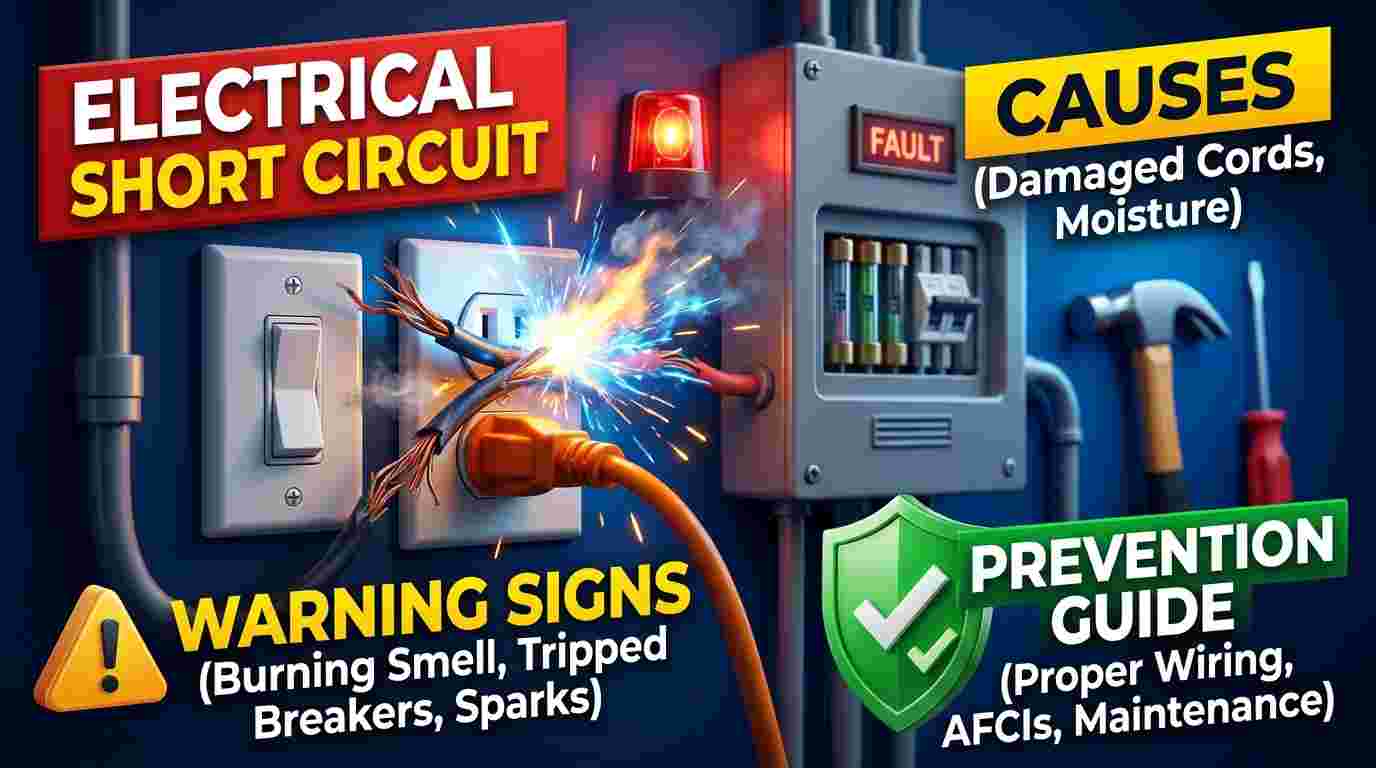
An electrical short circuit is one of the most common and potentially dangerous electrical problems in homes, offices, shops and industrial buildings. A short circuit can happen suddenly, sometimes producing a spark, loud sound, burning smell, smoke or even an electrical fire.
In Pakistan, electrical short circuits can become more likely when wiring is old, connections are loose, cables are overloaded, electrical equipment is damaged, or installations are exposed to moisture. Many people only think about a short circuit after an MCB trips or a spark comes from a socket. However, understanding the causes and warning signs beforehand can help prevent serious damage.
A short circuit is not simply “electricity going off.” It is an abnormal electrical connection that allows current to flow through an unintended path with very low impedance. Because the resistance of the fault path can be very low, the current can become extremely high. Protective devices such as MCBs, fuses and other circuit protection equipment are designed to disconnect the affected circuit when appropriate.
This complete guide explains what a short circuit is, why it happens, common causes, warning signs, what happens during a short circuit, how MCBs protect your home, the difference between short circuits and overloads, prevention methods, appliance-related short circuits, solar systems, common wiring mistakes and frequently asked questions.
What Is an Electrical Short Circuit?
An electrical short circuit occurs when electricity finds an unintended low-resistance path between points that normally should not be directly connected.
In a normal household circuit, electricity follows the intended path through:
Live → Appliance/Load → Neutral
During a short circuit, the live conductor may come into direct or near-direct contact with:
- Neutral
- Another live conductor
- Ground/earth through a fault
- A conductive metal part
This can create a very large current.
For example, imagine the insulation of a live wire becomes damaged inside a wall. If the exposed live conductor touches the neutral conductor, the current may bypass the normal appliance load.
Instead of:
Live → Appliance → Neutral
the fault path may become:
Live → Fault → Neutral
Because the fault path has very low impedance, the current can rise rapidly.
That is why a short circuit can produce sparks, heat, arcing and fire.
Why Is a Short Circuit Dangerous?
A short circuit can cause several dangerous effects.
1. Extremely High Current
The fault can cause current to rise far above the normal operating current of the circuit.
2. Rapid Heating
Electrical conductors and connection points can heat very quickly.
3. Electrical Arcing
A fault may produce an electrical arc, especially where conductors are damaged or separated by a small gap.
4. Equipment Damage
Electronic equipment, motors, power supplies and appliances can be damaged.
5. Fire Risk
Excessive current and arcing can ignite surrounding materials.
6. Electric Shock
Depending on the fault and installation, exposed conductive parts can become hazardous.
This is why electrical protection should never be ignored.
What Causes an Electrical Short Circuit?
There are many possible causes of a short circuit.
The most common include:
- Damaged wire insulation
- Loose electrical connections
- Incorrect wiring
- Water or moisture
- Overheated cables
- Faulty appliances
- Damaged plugs
- Damaged sockets
- Rodents chewing cables
- Nails or screws penetrating cables
- Old wiring
- Poor-quality electrical accessories
- Incorrectly installed equipment
- Internal appliance failures
- Cable damage during construction
Let’s look at these causes in more detail.
1. Damaged Wire Insulation
Electrical cables have insulation around their conductors.
This insulation prevents conductors from accidentally touching each other or other conductive materials.
If insulation becomes:
- Cracked
- Burned
- Cut
- Melted
- Brittle
- Mechanically damaged
the conductor can become exposed.
An exposed live conductor may then contact another conductor or conductive surface.
This can cause a short circuit.
2. Loose Electrical Connections
Loose connections are another common electrical problem.
A loose terminal can create:
- Increased resistance
- Heat
- Arcing
- Burning
- Carbon deposits
- Eventually a short or other fault
Loose connections can occur in:
- Distribution boards
- Switches
- Sockets
- Plugs
- Junction boxes
- Appliance terminals
A connection that becomes hot repeatedly should not be ignored.
3. Water and Moisture
Water and electricity are a dangerous combination.
Moisture can enter:
- Outdoor sockets
- Water pumps
- Bathrooms
- Kitchens
- Roof installations
- Air-conditioning equipment
- Damaged cables
- Appliances
Depending on the circumstances, moisture can create leakage paths or faults.
Never use electrical equipment with wet hands or when the equipment, plug or socket is wet.
4. Faulty Appliances
Sometimes the house wiring is fine and the short circuit originates inside an appliance.
Examples include:
- Refrigerator
- Washing machine
- Microwave
- Iron
- Water pump
- Air conditioner
- Electric heater
- Geyser
- Computer power supply
- UPS
- Inverter
An internal component may fail and create an electrical fault.
If the MCB trips every time you connect a particular appliance, don’t repeatedly reset the breaker and continue using it.
The appliance may require inspection.
5. Damaged Plugs
A damaged plug can become dangerous.
Warning signs include:
- Burn marks
- Melted plastic
- Loose pins
- Cracked casing
- Exposed wires
- Sparking
- Excessive heat
A damaged plug should be replaced or repaired appropriately.
6. Damaged Sockets
Sockets can also develop faults.
A socket may become dangerous if:
- Terminals are loose
- Plastic is cracked
- Wiring is damaged
- Contacts are worn
- The socket becomes hot
- There are burn marks
- It produces sparks
Do not continue using a socket that shows visible signs of damage.
7. Nails and Screws Through Cables
This is a surprisingly common cause of hidden wiring damage.
During construction, someone may drill or hammer a nail into a wall without knowing that an electrical cable is behind it.
The nail or screw can damage the cable insulation.
This can cause:
- Immediate short circuit
- Intermittent faults
- Leakage
- Heating
- Dangerous exposed wiring
Electrical cable routes should therefore be planned carefully during construction and renovation.
8. Rodent Damage
Rats and other rodents can chew electrical cable insulation.
This can expose conductors and increase the risk of:
- Short circuits
- Electrical shocks
- Fire
- Equipment failure
If rodents are present around an electrical installation, inspect accessible wiring and repair damaged cables appropriately.
9. Overheated Wiring
Heat can damage cable insulation.
Overheating may happen because of:
- Excessive current
- Undersized cables
- Loose connections
- Poor ventilation
- Bundled cables
- Continuous heavy loads
Once insulation becomes damaged, the risk of faults increases.
10. Incorrect Wiring
Incorrect wiring during installation or repair can create dangerous conditions.
Examples include:
- Incorrect terminal connections
- Damaged insulation
- Incorrectly joined conductors
- Improper junctions
- Incorrect circuit separation
- Poor-quality connectors
Electrical work should be performed by a qualified electrician.
What Happens During a Short Circuit?
Let’s use a simple example.
Suppose a household socket normally supplies a refrigerator.
Under normal conditions:
Live → Refrigerator → Neutral
The refrigerator has electrical resistance and consumes a normal amount of current.
Now suppose the live conductor accidentally touches the neutral conductor.
The circuit changes to:
Live → Short Fault → Neutral
The resistance of the fault path may be extremely low.
According to Ohm’s law:
Current = Voltage ÷ Resistance
When resistance becomes very low, current can become extremely high.
This large current can cause:
- Heating
- Sparks
- Arcing
- Mechanical forces
- Damage
- Protective-device operation
This is why circuit protection is so important.
What Is the Role of an MCB During a Short Circuit?
An MCB, or Miniature Circuit Breaker, is designed to protect an electrical circuit from excessive current.
Most MCBs provide protection against:
- Overload
- Short circuit
During a significant short-circuit current, the MCB’s instantaneous or magnetic protection mechanism can operate rapidly and disconnect the circuit, depending on the device characteristics and fault conditions.
This helps reduce the amount of energy delivered to the fault.
However:
An MCB does not make an unsafe installation safe by itself.
The entire electrical system must be properly designed.
What Is the Difference Between a Short Circuit and an Overload?
People often confuse these two problems.
Short Circuit
A short circuit usually involves an unintended low-impedance connection between conductors or between a conductor and another conductive path.
The resulting current can be extremely high.
Example:
Live directly touching Neutral
Overload
An overload occurs when a circuit carries more current than it is designed to carry, but the current is still flowing through the intended circuit path.
Example:
A circuit rated for a certain load is used simultaneously for:
- Electric heater
- Iron
- Microwave
- Kettle
The total demand may exceed the circuit’s design capacity.
Simple Difference
Short circuit = unintended low-resistance fault path
Overload = too much normal load on a circuit
Both require appropriate protection.
Short Circuit vs Earth Fault
An earth fault occurs when a live conductor makes unintended contact with earth or an exposed conductive part connected to the protective earth system.
A short circuit can involve:
- Live-to-neutral
- Live-to-live
- Live-to-earth
The exact terminology depends on the fault type.
Earth faults are particularly important from a safety perspective because they can energize metal equipment parts.
This is where proper:
- Earthing
- Bonding
- RCD/RCCB
- RCBO
- Circuit protection
become important.
Warning Signs of a Possible Short Circuit
A short circuit does not always happen without warning.
Look for signs such as:
1. MCB Trips Repeatedly
If the same breaker trips again and again, there may be:
- Short circuit
- Overload
- Appliance fault
- Wiring problem
2. Burning Smell
A smell similar to:
Burning plastic or electrical insulation
should never be ignored.
3. Sparks
Sparking from:
- Socket
- Plug
- Switch
- Appliance
can indicate an electrical problem.
4. Buzzing or Crackling
Unusual electrical sounds can indicate:
- Arcing
- Loose connections
- Faulty equipment
5. Hot Socket
A socket should not become unusually hot during normal operation.
6. Black or Brown Marks
Discoloration around a socket or plug can indicate overheating or arcing.
7. Flickering Lights
Flickering can have multiple causes, but persistent flickering should be investigated.
8. Sudden Power Loss
If only one circuit loses power while other circuits remain active, the corresponding breaker may have operated.
What Should You Do If an MCB Trips?
First, do not repeatedly force the MCB back on.
If a breaker trips immediately after being reset, there may be an active fault.
A safe approach is:
- Stop using the affected circuit.
- Disconnect obvious appliances only if it can be done safely.
- Do not touch exposed wires.
- Do not open the distribution board unless you are qualified.
- Have the circuit inspected by a qualified electrician.
- Identify the cause before restoring normal operation.
If there is smoke, fire, severe arcing or a strong burning smell, prioritize safety and contact emergency services/fire assistance as appropriate.
Why Does the MCB Keep Tripping?
Repeated MCB trips do not automatically mean there is a short circuit.
Possible causes include:
- Short circuit
- Overload
- Faulty appliance
- Damaged wiring
- Incorrect MCB selection
- Loose connection
- Motor starting current
- Other electrical faults
An electrician should diagnose the actual cause instead of simply replacing the MCB with a higher-rated one.
Is Replacing a 16A MCB With a 32A MCB a Solution?
No.
This is one of the most dangerous mistakes people make.
Suppose a circuit is designed around a particular cable size and protection rating.
If the MCB trips because the circuit is overloaded, replacing it with a much larger MCB may allow excessive current to flow through the existing cable.
The cable could overheat before the breaker operates appropriately.
The correct approach is to determine:
- Cable size
- Load
- Circuit design
- MCB rating
- Installation method
- Ambient conditions
- Fault level
Never increase a breaker rating simply to stop nuisance tripping.
How to Prevent Electrical Short Circuits
Short circuits cannot always be predicted, but many risks can be reduced.
1. Use Correct Cable Sizes
Electrical cables should be appropriately selected for the expected load and installation conditions.
An undersized cable can overheat and suffer insulation damage.
2. Use Appropriate Circuit Protection
Use properly selected:
- MCBs
- Fuses
- RCCBs/RCDs
- RCBOs
- Surge protection where required
Each device has a specific purpose.
3. Inspect Old Wiring
Old electrical wiring may have:
- Brittle insulation
- Damaged conductors
- Poor connections
- Outdated accessories
Older homes should be inspected by a qualified electrician.
4. Avoid Overloading Sockets
Do not connect multiple high-power appliances through one socket or cheap extension board.
High-power appliances such as:
- Heater
- Iron
- Kettle
- Microwave
- AC
- Geyser
can place significant loads on circuits.
5. Use Quality Electrical Accessories
Poor-quality:
- Sockets
- Switches
- Plugs
- Connectors
- Extension boards
can increase electrical risk.
Choose suitable products from reputable manufacturers and have them installed correctly.
Extension Boards and Short Circuits
Extension boards can be useful, but they should not be treated as permanent substitutes for proper household wiring.
Avoid connecting several high-power appliances to one extension board.
For example, don’t casually connect:
Heater + Iron + Kettle + Microwave
to the same extension board.
The extension lead and socket may not be designed for that combined load.
Short Circuits in Air Conditioners
Air conditioners contain:
- Compressor
- Fan motor
- Control electronics
- Capacitors
- Power wiring
A fault in any of these components can cause a breaker to trip.
If your AC immediately trips its breaker after switching on, don’t repeatedly reset the breaker.
The fault may be inside the AC or its supply circuit.
Short Circuits in Washing Machines
Washing machines contain:
- Motor
- Heater in some models
- Control board
- Pump
- Wiring
- Metal enclosure
Water and electrical equipment make proper protection especially important.
If a washing machine causes the breaker to trip, stop using it until the problem is professionally checked.
Short Circuits in Refrigerators
A refrigerator can develop faults in:
- Compressor
- Wiring
- Start components
- Control board
- Power cord
If the refrigerator repeatedly trips the breaker, disconnect it safely and arrange inspection.
Do not keep resetting the breaker indefinitely.
Short Circuits in Water Pumps
Water pumps can be exposed to:
- Moisture
- Outdoor conditions
- Motor faults
- Damaged cables
A pump circuit should have appropriate:
- Circuit protection
- Earthing
- Isolation
- Cable selection
A qualified electrician should inspect a pump that repeatedly trips protection.
Short Circuits in Solar Systems
Solar systems have both DC and AC electrical sections.
A typical system may include:
Solar Panels → DC Wiring → DC Protection → Inverter → AC Protection → House
A short circuit can occur because of:
- Damaged PV cable
- Incorrect connector
- Poor connection
- Cable insulation damage
- Faulty inverter
- Damaged equipment
- Incorrect installation
Solar DC faults can be particularly serious because PV modules can continue producing electrical energy when illuminated.
Do not disconnect or handle damaged solar wiring yourself.
Why Solar DC Short Circuits Need Extra Care
With AC household circuits, the voltage naturally crosses zero many times per second.
DC does not behave the same way.
An electrical arc in a DC system can be more difficult to extinguish.
Therefore, solar PV installations require appropriately rated:
- DC isolators
- Fuses
- Circuit protection
- Connectors
- Cables
- Surge protection
- Inverter protection
Never use an ordinary AC-rated protective device where a properly rated DC device is required.
Short Circuits in Inverters
An inverter can trip because of:
- Output short circuit
- Input fault
- Battery problem
- Internal component failure
- Wiring problem
- Overload
- Protection system operation
Modern inverters usually contain internal protective functions, but this does not mean that external electrical protection can be ignored.
Always follow the inverter manufacturer’s installation requirements.
Short Circuit Protection for Lithium Battery Systems
Lithium battery systems can deliver very high fault currents.
A battery short circuit can cause:
- Extremely high current
- Cable heating
- Arcing
- Equipment damage
- Fire
Battery systems therefore require appropriately designed:
- Fuses
- DC breakers
- Disconnects
- BMS
- Cables
- Connections
Never intentionally short a lithium battery.
Short Circuits and Earthing
Proper earthing is an important part of electrical safety.
If a fault causes a live conductor to contact an exposed metal enclosure, a properly designed protective earth path can help fault current flow through the intended path and allow appropriate protection to operate.
This is one reason earthing should be installed and tested properly.
For a detailed explanation, homeowners can also read our guide:
What Is Earthing? Complete Electrical Grounding Guide for Pakistani Homes
Can a Short Circuit Cause a Fire?
Yes.
A short circuit can create very high current and electrical arcing.
The resulting heat can ignite:
- Cable insulation
- Plastic
- Wood
- Dust
- Other nearby combustible materials
However, not every short circuit causes a fire.
Properly designed protection can disconnect a fault quickly and reduce the energy released.
This is why correctly selected circuit breakers and good electrical installation practices are essential.
Can a Short Circuit Damage Electronics?
Yes.
A short circuit or associated electrical fault can damage:
- TVs
- Computers
- Routers
- Chargers
- Inverters
- Solar equipment
- Appliances
- Control boards
Surge protection can help protect sensitive equipment against certain transient overvoltage events, although it cannot prevent every possible type of electrical fault.
How to Protect Sensitive Electronics
For sensitive equipment, consider appropriate protection such as:
- Surge protective devices
- UPS
- Proper grounding
- Voltage monitoring
- Correct circuit protection
However, these should be selected according to the equipment and electrical system.
A cheap extension board labeled “surge protector” should not automatically be considered equivalent to a properly designed building-level surge protection system.
Electrical Short Circuit Prevention Checklist
Use this checklist for your home:
- Inspect old wiring.
- Replace damaged cables.
- Do not overload sockets.
- Use appropriate cable sizes.
- Use properly rated MCBs.
- Install appropriate RCD/RCCB/RCBO protection.
- Maintain proper earthing.
- Replace damaged plugs.
- Replace cracked sockets.
- Keep electrical equipment away from unnecessary moisture.
- Do not use damaged extension boards.
- Do not repeatedly reset a tripping breaker.
- Have solar installations professionally inspected.
- Keep distribution boards accessible.
- Do not perform dangerous electrical repairs yourself.
- Arrange periodic electrical inspection.
What Should You Do During an Electrical Fire?
If an electrical fire occurs:
Do not throw water on energized electrical equipment.
Water can conduct electricity and create additional shock hazards.
If it is safe to do so, power should be isolated using the appropriate disconnecting device.
Use a fire extinguisher that is suitable for electrical equipment and follow local emergency guidance.
If the fire is growing or cannot be controlled safely, evacuate and contact the relevant emergency/fire service.
Never risk your life trying to save electrical equipment.
Common Myths About Short Circuits
Myth 1: Every MCB Trip Means a Short Circuit
False.
An MCB can trip because of an overload, short circuit or other conditions.
Myth 2: A Bigger MCB Fixes the Problem
False.
Increasing the MCB rating without checking the cable and circuit design can create a serious fire risk.
Myth 3: Earthing Prevents Every Short Circuit
False.
Earthing is a protective measure. It does not prevent every electrical fault.
Myth 4: If the Appliance Works, It Is Safe
False.
An appliance can operate normally while having damaged insulation or other hidden problems.
Myth 5: Sparks From a Socket Are Normal
False.
A small amount of switching-related arcing can occur in some electrical equipment, but visible, repeated or unusual sparking from a household socket or plug should be investigated.
Myth 6: Resetting the Breaker Solves the Problem
False.
Resetting restores power but does not necessarily remove the cause of the fault.
If the breaker immediately trips again, the circuit needs inspection.
Frequently Asked Questions
What is an electrical short circuit?
An electrical short circuit is an unintended low-resistance electrical path that allows excessive current to flow through a circuit.
What is the most common cause of a short circuit?
Common causes include damaged insulation, faulty appliances, loose connections, incorrect wiring, moisture and damaged electrical accessories.
Why does an MCB trip during a short circuit?
A short circuit can produce very high current. The MCB’s short-circuit protection mechanism can operate rapidly and disconnect the circuit when the fault current reaches the required operating level.
Is a short circuit the same as an overload?
No. A short circuit creates an unintended low-impedance fault path, while an overload occurs when a circuit carries more current than intended through its normal path.
Can a short circuit cause a fire?
Yes. High fault current and electrical arcing can produce enough heat to ignite surrounding materials.
Why does my breaker keep tripping?
Possible causes include short circuit, overload, faulty appliance, damaged wiring or an incorrectly selected protective device.
Should I replace my MCB with a higher rating?
Not simply because it keeps tripping. The circuit, cable size, load and protection design must first be checked by a qualified electrician.
Can water cause a short circuit?
Water or moisture can create unintended conductive paths and contribute to electrical faults. Electrical equipment exposed to water should be treated carefully.
Can an appliance cause a short circuit?
Yes. An internal component or wiring failure inside an appliance can create a short circuit.
Can a short circuit damage a refrigerator?
Yes. A serious electrical fault can damage a refrigerator’s compressor, control electronics, wiring or other components.
Can a solar panel short circuit?
A fault can occur in a solar PV circuit, including damaged cables or connectors. Solar DC circuits require appropriately rated protection and should not be handled casually.
Does earthing prevent short circuits?
No. Earthing provides a protective path for certain fault conditions. It does not prevent every short circuit.
Can an RCCB stop a short circuit?
An RCCB/RCD primarily responds to residual-current imbalance rather than functioning as the main overcurrent/short-circuit protection device. It should be used together with appropriate overcurrent protection.
What should I do if my socket sparks?
Stop using the socket and have it inspected by a qualified electrician. Do not continue plugging and unplugging equipment to see whether the problem disappears.
Is a burning smell from an electrical socket dangerous?
Yes. A burning plastic or insulation smell can indicate overheating, arcing or another electrical fault and should be investigated promptly.
Why does only one room lose electricity?
The circuit supplying that room may have tripped or developed a fault. Check the distribution board only if doing so is safe and you understand the installation; otherwise contact a qualified electrician.
Can old wiring cause short circuits?
Yes. Aging insulation, deteriorated connections and damaged accessories can increase the risk of electrical faults.
How can I prevent short circuits at home?
Use correctly sized cables, suitable protective devices, good-quality electrical accessories, proper earthing, avoid overloaded sockets and arrange regular electrical inspections.
Final Conclusion
An electrical short circuit is a serious fault that should never be ignored.
It happens when electricity finds an unintended low-resistance path, potentially causing very high current, heating, arcing, equipment damage and fire.
The most common causes include:
- Damaged insulation
- Faulty appliances
- Loose connections
- Water or moisture
- Incorrect wiring
- Damaged plugs and sockets
- Old electrical installations
- Rodent damage
- Construction-related cable damage
The best protection is not a single device. A safe electrical installation uses several layers of protection, including:
Correct cable sizing + MCBs/fuses + appropriate RCD/RCCB/RCBO protection + proper earthing + quality connections + regular inspection
One of the most important rules for homeowners is simple:
If an MCB repeatedly trips, don’t simply replace it with a larger breaker or keep resetting it. Find the cause.
Likewise, if you notice:
- Burning smell
- Sparks
- Buzzing
- Crackling
- Hot sockets
- Melted plastic
- Black marks
- Repeated breaker trips
stop using the affected equipment or circuit and have it inspected by a qualified electrician.
For solar homes, additional attention is required because PV systems contain both DC and AC circuits. Solar cables, connectors, DC protection, inverter wiring, batteries and AC distribution equipment should all be installed according to the equipment manufacturer’s requirements and applicable electrical standards.
Electrical safety is not about waiting for something to go wrong.
The safest approach is to identify problems early, use the right protection and never ignore warning signs.