
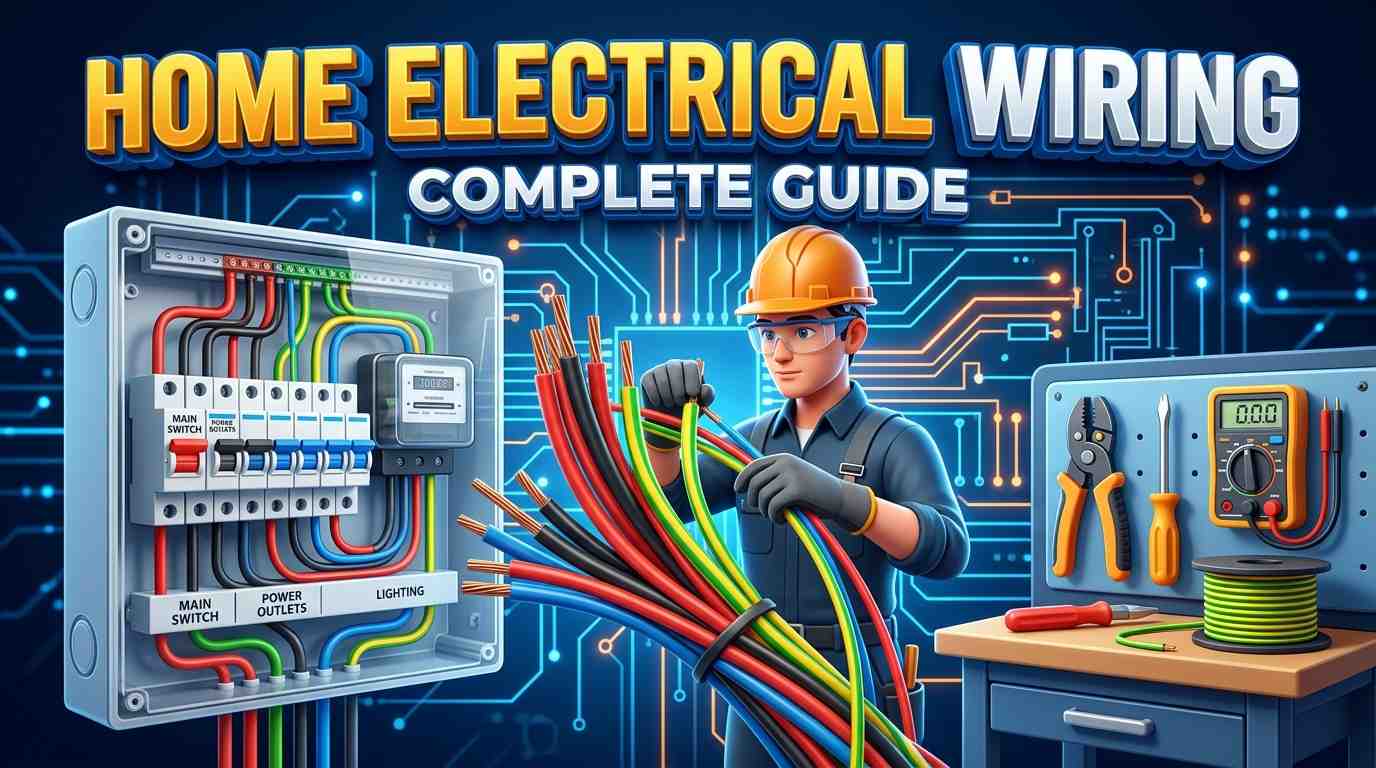
Electrical wiring is one of the most important parts of any new home or renovation project. Good-looking walls, quality switches and expensive appliances cannot make a house electrically safe if the wiring underneath is poorly designed, undersized or incorrectly installed.
In Pakistan, many homeowners focus on the visible parts of electrical work—switches, lights, fans and sockets—but the hidden wiring, distribution board, earthing, circuit protection and cable selection are equally important. A small mistake during construction can later cause MCB tripping, hot sockets, voltage drop, damaged appliances, electric shocks and, in serious cases, electrical fires.
This Home Electrical Wiring Guide 2026 explains the main types of house wiring, commonly used wire sizes, estimated costs in Pakistan, distribution boards, MCBs, RCCBs/RCBOs, earthing, safety practices, common mistakes and practical planning tips.
Safety note: Electrical installation and testing should be performed by a qualified electrician. Do not open energized panels or attempt live electrical work yourself.
What Is Home Electrical Wiring?
Home electrical wiring is the system of cables, conduits, switches, sockets, distribution boards, protective devices and earthing used to distribute electricity throughout a house.
A typical residential electrical system can include:
- Electricity meter
- Main incoming cable
- Main isolator
- Distribution board (DB)
- MCBs
- RCCB or RCBO
- Surge protection
- Live wires
- Neutral wires
- Earth wires
- Switches
- Socket outlets
- Lighting circuits
- Fan circuits
- Dedicated appliance circuits
- Earthing electrode/system
The purpose is not simply to deliver electricity. A properly designed system must also control, distribute and safely disconnect electricity when something goes wrong.
NEPRA’s Power Safety Code emphasizes permanent earthing, appropriate protective systems, three-pin plugs and regular inspection/maintenance of electrical installations.
Why Proper House Wiring Matters
Poor wiring may work normally for months or even years before a problem becomes visible.
For example, a small house might initially use only lights, fans and a refrigerator. Later, the owner adds:
- Air conditioners
- Electric heater
- Microwave
- Washing machine
- Water pump
- Geyser
- Electric iron
- Kitchen appliances
- Solar inverter
If the original electrical system was not planned for additional loads, circuits may become overloaded.
Poor wiring can cause:
- MCB tripping
- Hot wires
- Hot sockets
- Burning smell
- Flickering lights
- Voltage drop
- Appliance damage
- Electric shock
- Short circuits
- Insulation damage
- Electrical fires
NEPRA specifically warns against overloaded sockets and advises correcting defective wiring and replacing damaged electrical components.
Types of Electrical Wiring Used in Homes
Modern houses generally use insulated copper conductors installed inside protective conduits.
However, wiring can be classified according to cable construction, installation method and circuit purpose.
1. Single-Core Copper Wire
Single-core insulated copper wire is extremely common in Pakistani residential construction.
It normally contains:
- One copper conductor
- PVC or similar insulation
- Different insulation colors for identification
The wire is installed inside PVC conduit and routed through walls or ceilings.
It is commonly used for:
- Lights
- Fans
- Sockets
- AC circuits
- Kitchen circuits
- Distribution circuits
The exact size must be selected according to the expected load, installation method, cable length and protective-device rating.
2. Multi-Core Cable
Multi-core cable contains multiple insulated conductors within one outer cable.
It can be useful for:
- Main connections
- Outdoor equipment
- Pumps
- Certain appliance connections
- Control systems
- Specialized installations
The appropriate cable construction depends on the installation environment.
Copper vs Aluminum Wiring
Copper is commonly preferred for residential internal wiring because of its electrical conductivity, mechanical properties and suitability for many building-wire applications.
Aluminum conductors can also be used in appropriate applications, particularly larger distribution cables, but they require correct sizing, terminals and installation practices.
For normal house wiring, don’t choose a conductor simply because it is cheaper.
Copper advantages
- Good electrical conductivity
- Generally easier to terminate
- Good mechanical strength
- Widely available for residential wiring
- Suitable for many indoor circuits
Aluminum advantages
- Lower material cost in some applications
- Lower weight
- Useful for larger conductors and specific installations
The correct choice depends on the design rather than price alone.
Common Wire Sizes for Home Wiring
There is no single wire size that is correct for every circuit.
Common metric sizes include:
| Cable Size | Typical Residential Application |
|---|---|
| 1.0 mm² | Some low-load lighting/control applications |
| 1.5 mm² | Lighting and fan circuits |
| 2.5 mm² | General socket circuits |
| 4 mm² | Higher-load dedicated circuits |
| 6 mm² | Higher-load circuits/main distribution applications |
| 10 mm² | Main supply or higher-capacity feeders |
| 16 mm²+ | Larger feeders depending on design |
These are typical applications, not universal rules. A qualified electrician should calculate the appropriate conductor based on current, cable length, installation method, ambient temperature, voltage drop and protective-device coordination.
Pakistan Cables’ February 2026 suggested retail list provides benchmark prices for common metric copper/PVC building wires, including 1.5 mm², 2.5 mm², 4 mm², 6 mm² and 10 mm² sizes.
1.5 mm² vs 2.5 mm² vs 4 mm² vs 6 mm²
One of the most common questions during house construction is:
Which wire size should I use?
A simple way to understand the difference is:
1.5 mm²
Often used for lighting and fan circuits where the designed load is appropriate.
2.5 mm²
Commonly used for general-purpose socket circuits.
4 mm²
Can be suitable for higher-load dedicated circuits depending on the appliance and installation conditions.
6 mm²
Often considered for larger loads or feeders, depending on design.
10 mm²
Can be used for main supply/feeders in appropriately designed residential systems.
But never select a cable simply because someone says:
“4 mm² is always enough for an AC.”
The actual requirement depends on the AC’s electrical specifications, circuit length, installation method, protective device and expected operating conditions.
Electrical Circuits Should Be Divided
One of the biggest mistakes in house wiring is putting too many appliances on one circuit.
Instead of having one circuit for an entire floor, divide the electrical system.
For example:
Circuit 1
Lights
Circuit 2
Fans
Circuit 3
Bedroom sockets
Circuit 4
Living-room sockets
Circuit 5
Kitchen sockets
Circuit 6
Air conditioner
Circuit 7
Water pump
Circuit 8
Geyser
Circuit 9
Washing machine
This approach makes troubleshooting easier and prevents one fault from shutting down the entire house.
Dedicated Circuits for Heavy Appliances
Some appliances can consume significantly more power than normal lighting or small electronics.
Examples include:
- Air conditioners
- Electric geysers
- Electric heaters
- Water pumps
- Electric ovens
- Large microwaves
- Washing machines
- Electric irons
These appliances may require dedicated circuits.
A dedicated circuit generally means that the appliance is supplied through its own appropriately sized wiring and protective device rather than sharing a general-purpose socket circuit.
What Is a Distribution Board?
The Distribution Board (DB) is the central point where electrical circuits are distributed and protected.
A residential DB may contain:
- Main isolator
- MCBs
- RCCB
- RCBOs
- Surge protective device
- Neutral bar
- Earth bar
A simplified arrangement can look like:
Meter → Main Isolator → Protection → DB → Individual MCB/RCBO Circuits → Appliances
The DB should be properly labeled so that you know which breaker controls each part of the house.
For example:
| Breaker | Circuit |
|---|---|
| MCB 1 | Ground-floor lights |
| MCB 2 | Ground-floor fans |
| MCB 3 | Bedrooms |
| MCB 4 | Kitchen sockets |
| MCB 5 | AC-1 |
| MCB 6 | AC-2 |
| MCB 7 | Water pump |
| MCB 8 | Geyser |
MCB in Home Wiring
An MCB (Miniature Circuit Breaker) protects a circuit against conditions such as overcurrent and short circuit.
If excessive current flows, the MCB can disconnect the circuit.
However, an MCB does not make undersized wiring safe.
For example, installing a larger MCB simply because the existing MCB keeps tripping can be dangerous if the cable cannot safely carry the additional current.
Never solve repeated MCB tripping by blindly increasing the breaker rating.
First determine why it is tripping.
Possible causes include:
- Overload
- Short circuit
- Faulty appliance
- Damaged wiring
- Loose connection
- Incorrect breaker selection
RCCB and RCBO for Home Safety
MCBs and residual-current protection serve different purposes.
RCCB
An RCCB (Residual Current Circuit Breaker) is designed to detect residual/leakage current and disconnect the supply when the leakage exceeds its operating threshold.
It provides important protection against electric shock and leakage-related hazards.
RCBO
An RCBO combines residual-current protection with overcurrent protection in a single device.
Depending on the design, individual circuits can therefore have their own protective device.
For a modern home, the electrical protection strategy should be designed as a complete system rather than simply buying individual breakers based on price.
Why Earthing Is Important
Earthing is one of the most important parts of electrical safety.
If a fault causes a metal appliance enclosure to become energized, a correctly designed earthing system can provide a path for fault current and help protective devices operate.
NEPRA’s Power Safety Code states that a permanent earthing system should be installed to reduce the risk of electric shock, fire and equipment damage. It also recommends three-pin plugs for residential appliances and equipment.
A home should therefore have:
- Proper earth conductor
- Proper earthing system
- Correct earth connections
- Appropriate earth bar in the DB
- Proper three-pin outlets where required
Never treat the earth wire as an optional extra.
Three-Pin Plugs and Sockets
A three-pin connection normally provides:
- Live
- Neutral
- Earth
The earth connection provides an important safety path for fault current.
NEPRA specifically advises using three-pin plugs rather than two-pin plugs for residential appliances and equipment.
This is especially important for appliances with exposed or metal bodies.
Electrical Conduit: Why It Matters
Electrical wires should normally be protected using an appropriate conduit system during concealed house wiring.
Conduit helps protect wires from:
- Mechanical damage
- Moisture
- Construction activity
- Future drilling
- Abrasion
- Heat-related problems
Good conduit planning also makes future maintenance and replacement easier.
Avoid:
- Loose wires inside walls
- Damaged conduit
- Extremely crowded conduit
- Sharp bends
- Poorly supported wiring
- Hidden unauthorized joints
Avoid Hidden Wire Joints
A concealed joint inside a wall is a major maintenance problem.
If a connection becomes loose, it can generate heat.
Instead of hiding joints randomly behind plaster, use suitable junction boxes and proper electrical accessories where connections are necessary.
All connections should be mechanically secure and electrically appropriate.
Home Electrical Wiring Cost in Pakistan 2026
There is no single price for complete house wiring because the total cost depends on:
- House size
- Number of floors
- Number of rooms
- Number of electrical points
- Number of ACs
- Kitchen appliances
- Water pumps
- Geysers
- Cable sizes
- Cable brand
- DB size
- MCB/RCCB/RCBO selection
- Switch/socket brand
- Conduit
- Earthing
- Labour
- Wall condition
- New construction vs renovation
Therefore, a contractor’s quote should always specify what is included.
2026 Wire Price Examples in Pakistan
As a current benchmark, Pakistan Cables’ suggested retail list effective February 1, 2026 lists registered 90-meter coils at approximately:
| Size | Approx. Registered 90m Coil |
|---|---|
| 1.5 mm² stranded | Rs. 9,920 |
| 2.5 mm² stranded | Rs. 15,830 |
| 4 mm² | Rs. 23,645 |
| 6 mm² | Rs. 35,135 |
| 10 mm² | Rs. 60,735 |
| 16 mm² | Rs. 90,875 |
These are manufacturer suggested retail benchmarks, not guaranteed shop prices. Actual prices can change by brand, city, dealer, copper prices, quantity and specification.
A separate August 2026 market reference gives broader approximate 90-meter coil ranges of around Rs. 6,600–9,500 for 1.5 mm², Rs. 10,700–15,000 for 2.5 mm², Rs. 21,000–24,500 for 4 mm², Rs. 31,500–37,000 for 6 mm² and Rs. 52,000–61,000 for 10 mm². These figures are indicative and can vary considerably.
How Much Wire Does a House Need?
Wire quantity depends much more on the electrical design than simply the covered area.
For example, one August 2026 industry estimate for a single-storey 5-marla house with approximately 46 points and 11 circuits estimated around 1,800 meters of single-core copper wiring, plus a main earth/main cable allowance.
This should not be treated as a universal quantity.
A 5-marla house with:
- 2 ACs
may require a very different design from a 5-marla house with:
- 5 ACs
- Electric geyser
- Electric oven
- Water pump
- Solar inverter
- Multiple kitchen appliances
The correct approach is to prepare a circuit and point schedule before purchasing cable.
Complete House Wiring Cost
The total project can include:
1. Wires
Live, neutral and earth conductors.
2. Conduit
PVC conduit and accessories.
3. DB
Distribution board and enclosure.
4. Protection
MCBs, RCCB/RCBO and potentially surge protection.
5. Switches
Light and fan switches.
6. Sockets
General and dedicated appliance outlets.
7. Fan regulators/controllers
Where applicable.
8. Earthing
Earth electrode/system, conductor and connections.
9. Labour
Electrician and installation team.
10. Testing
Inspection and electrical testing.
A quote that says “complete wiring Rs. X” is not useful unless the contractor clearly explains what is included.
Per-Point vs Complete Wiring Quote
Electricians may quote in different ways.
Per Point
For example:
- Light point
- Fan point
- Socket point
- AC point
The problem is that one “point” may not include everything.
Ask whether the price includes:
- Wire
- Conduit
- Box
- Switch
- Socket
- Labour
- DB connection
- Accessories
Complete Package
A contractor may quote for the complete electrical installation.
This can be easier to manage, but you should still ask for a material list.
How to Plan Electrical Wiring for a New House
Step 1: Make an Appliance List
Before wiring begins, list all major appliances.
For example:
- 4 fans
- 15 LED lights
- 2 ACs
- Refrigerator
- Washing machine
- Water pump
- Microwave
- Electric iron
- TV
- Computers
- Geyser
This prevents important circuits from being forgotten.
Step 2: Estimate the Load
Find the wattage of each appliance.
The basic relationship is:
Current (A) = Power (W) ÷ Voltage (V)
For example, if an appliance consumes 2,000 W at approximately 230 V:
2,000 ÷ 230 ≈ 8.7 A
This is useful for understanding the electrical demand, but cable and breaker selection requires more than a simple wattage calculation.
Step 3: Divide the Loads
Don’t put everything on one circuit.
Separate:
- Lighting
- Fans
- General sockets
- Kitchen
- ACs
- Pump
- Geyser
- Other heavy appliances
Step 4: Design the DB
Decide how many circuits are needed.
Leave some spare capacity for future expansion.
This is especially useful if you may later install:
- Solar
- Additional ACs
- EV charger
- Electric water heater
- More kitchen appliances
Step 5: Select Cable Sizes
Cable sizes should be selected according to:
- Design current
- Installation method
- Cable length
- Voltage drop
- Ambient temperature
- Grouping/bundling
- Protective-device rating
- Manufacturer specifications
Don’t select cable size only by appliance name.
Step 6: Install Conduit
Run conduit through walls and ceilings before plastering.
Keep routes organized and accessible where practical.
Step 7: Install Boxes
Install suitable boxes for:
- Switches
- Sockets
- Fans
- Junctions
- DBs
Ensure they are positioned correctly before finishing walls.
Step 8: Pull the Wires
After conduit installation, wires are pulled through the appropriate routes.
Use proper identification and avoid damaging insulation.
Step 9: Install the DB
The DB should be:
- Accessible
- Properly enclosed
- Correctly labeled
- Neatly wired
- Properly earthed
- Protected from moisture
Step 10: Test Before Handover
Do not wait until the house is occupied to discover electrical problems.
The installation should be inspected and appropriately tested by a qualified electrician.
Common Home Electrical Wiring Mistakes
Mistake 1: Using Undersized Wire
Trying to save money by using smaller cable can create excessive heating and voltage drop.
The small initial saving may not justify the safety risk.
Mistake 2: Increasing the MCB When It Trips
If an MCB repeatedly trips, replacing it with a larger one without checking the wiring is dangerous.
Find the cause first.
Mistake 3: One Circuit for Everything
Lights, sockets, ACs, pumps and kitchen appliances should not automatically share one circuit.
Separate circuits make the system safer and easier to maintain.
Mistake 4: No Proper Earthing
Skipping earthing to reduce construction costs is a serious mistake.
Earthing is a safety system, not a luxury feature.
Mistake 5: Too Many Appliances on One Socket
A single extension board should not become the permanent power source for multiple high-load appliances.
NEPRA warns against overloading electrical sockets because it can create fire hazards.
Mistake 6: Poor-Quality Cable
Very cheap cable may not provide the conductor size, insulation quality or consistency expected from a reputable product.
Buy according to specification and from a reliable supplier.
Mistake 7: No Spare Capacity
A house may not have the same electrical demand five years from now.
Consider future needs during the original design.
Mistake 8: Poor DB Labeling
If every breaker is simply labeled “MCB 1, MCB 2, MCB 3,” troubleshooting becomes difficult.
Use labels such as:
Kitchen Sockets
Bedroom AC
Ground Floor Lights
Water Pump
Mistake 9: Hidden Connections
Avoid inaccessible joints inside walls.
Use appropriate boxes and connection methods.
Mistake 10: Ignoring Voltage Drop
Long cable runs can experience voltage drop.
This becomes particularly important for:
- Pumps
- ACs
- Long feeders
- Separate buildings
- Large appliances
Cable sizing therefore cannot be based only on current.
Signs Your Existing House Wiring Needs Inspection
You should consider professional inspection if you notice:
- Burning smell
- Black marks around sockets
- Hot switches
- Hot plugs
- Flickering lights
- Repeated MCB trips
- Sparking sockets
- Buzzing/crackling sounds
- Damaged insulation
- Loose sockets
- Electric shocks from appliances
- Old brittle wiring
- Frequent appliance failures
Do not ignore these warning signs.
Home Wiring and Solar Installation
If you are planning solar for your house, electrical wiring should ideally be considered before installation.
A solar system may introduce:
- Hybrid inverter
- AC input
- AC output
- Solar DC wiring
- Battery wiring
- Protection devices
- Additional DB connections
- Earthing requirements
The house wiring should be capable of handling the intended solar configuration.
For example, if the homeowner plans to add a hybrid inverter later, leaving suitable space in the DB and planning appropriate cable routes can reduce future modification work.
Should You Upgrade Old House Wiring Before Installing Solar?
Sometimes yes, but it depends on the condition of the existing installation.
An electrician should inspect:
- Main cable
- DB
- Earthing
- Existing circuits
- Cable insulation
- MCBs
- Socket connections
- Load distribution
If the existing wiring is damaged, overloaded or incorrectly protected, adding a solar inverter without addressing those problems does not solve the underlying electrical-safety issue.
Electrical Wiring Safety Checklist
Before completing a new house, check the following:
Wiring
- Correct cable sizes selected
- Good-quality cable used
- Wires protected inside suitable conduit
- No unnecessary hidden joints
- Proper cable identification
Distribution Board
- Main isolator installed
- Correct MCBs installed
- Residual-current protection considered/installed as appropriate
- Earth bar installed
- Neutral bar correctly arranged
- Circuits labeled
- Spare capacity available
Earthing
- Proper earthing system installed
- Earth conductors connected correctly
- Appliance earth connections checked
- Three-pin outlets used where appropriate
Appliances
- AC circuits planned separately
- Pump circuit planned
- Geyser circuit planned
- Kitchen loads considered
- Washing machine outlet planned
Final Inspection
- Wiring inspected
- Protective devices tested
- Connections checked
- Polarity verified where applicable
- Earthing checked
- Faults corrected before occupancy
NEPRA’s safety guidance also calls for periodic inspection/maintenance by a qualified electrician for protective systems and electrical components.
How to Save Money on House Wiring Without Compromising Safety
Saving money does not mean buying the cheapest wire.
Instead:
1. Plan Before Construction
Changing wiring after plastering is expensive.
2. Avoid Unnecessary Points
Install enough sockets and switches for practical use, but don’t create hundreds of unused points.
3. Use a Proper Circuit Design
Correct load distribution reduces future problems.
4. Compare Material Specifications
Compare the same cable size, conductor type, voltage rating, coil length and standard—not simply the brand name.
5. Get an Itemized Quote
Ask the electrician to separate:
- Wire
- Conduit
- DB
- Breakers
- Switches
- Sockets
- Earthing
- Labour
6. Plan for Future Solar
If solar is likely, reserve appropriate space and routes during construction.
What Should You Ask an Electrician Before Starting?
Before giving the project to an electrician, ask:
- How many circuits will the house have?
- What cable sizes will be used?
- Which circuits will be dedicated?
- What type of DB will be installed?
- Which MCB ratings will be used?
- Will RCCB/RCBO protection be provided?
- How will earthing be installed?
- How will the wiring be tested?
- Is conduit included?
- Are switches and sockets included?
- Is labour included?
- What happens if additional points are required?
- Is the quote based on actual measurements?
- Is spare DB capacity included?
- Can the system accommodate future solar?
A professional electrician should be able to explain the design clearly.
Frequently Asked Questions
What wire size is commonly used for home wiring in Pakistan?
Common residential sizes include 1.5 mm², 2.5 mm², 4 mm², 6 mm² and 10 mm², but the correct size depends on the specific circuit and installation conditions.
Is 1.5 mm² wire enough for a house?
It may be suitable for certain lighting and fan circuits, but it is not automatically suitable for every circuit in a house.
Is 2.5 mm² wire suitable for sockets?
2.5 mm² is commonly used for general-purpose socket circuits, subject to the circuit design and protective-device rating.
Can I use the same wire size for lights and AC?
Not necessarily. Different loads can require different cable sizes and protective devices.
Why does my MCB keep tripping after new wiring?
Possible causes include overload, short circuit, faulty appliances, incorrect breaker selection or wiring faults. The cause should be diagnosed instead of simply installing a larger MCB.
Is earthing really necessary in a home?
Yes. Proper earthing is an important electrical-safety measure. NEPRA’s Power Safety Code specifically calls for permanent earthing and explains its role in reducing shock, fire and equipment-damage risks.
Should every AC have a separate circuit?
A dedicated circuit is commonly appropriate for higher-load appliances such as AC units, but the exact design should be determined from the appliance rating and electrical installation requirements.
How much does complete house wiring cost in Pakistan in 2026?
There is no universal price. The total depends on house size, number of points, cable sizes, appliances, DB/protection, switches, sockets, earthing and labour. Current wire prices alone can range widely depending on size and brand.
How many wires are normally used in a home circuit?
A typical single-phase circuit involves live and neutral conductors, with an earth conductor provided as required for safety and equipment grounding.
Should I install solar before or after house wiring?
For a new house, it is better to consider the future solar system during the electrical design stage. This allows appropriate space, cable routes and protection to be planned from the beginning.
Final Thoughts
Good home electrical wiring is an investment in safety, reliability and future flexibility.
The cheapest electrical installation is not necessarily the most economical one. Saving a small amount on cable, protection or earthing can create expensive problems later.
A properly designed home electrical system should include:
- Correctly sized cables
- Proper circuit separation
- Quality switches and sockets
- A well-designed distribution board
- Appropriate MCB protection
- Residual-current protection where required
- Proper earthing
- Suitable conduit
- Dedicated circuits for major loads
- Clear DB labeling
- Professional inspection and testing
For homeowners in Pakistan, the most important lesson is simple: don’t design electrical wiring only around today’s appliances. Design it around safe operation and reasonable future expansion.
If you’re constructing a new house, renovating an existing property or preparing a home for solar installation, plan the electrical system before the walls are closed. A little extra planning at the construction stage can prevent major electrical problems later.
Punjab Solar Bahawalpur can also help homeowners understand electrical load planning, solar-ready wiring, inverter connections and the relationship between household wiring and solar systems. For any live electrical installation, always use a qualified electrician and follow applicable electrical safety requirements.