
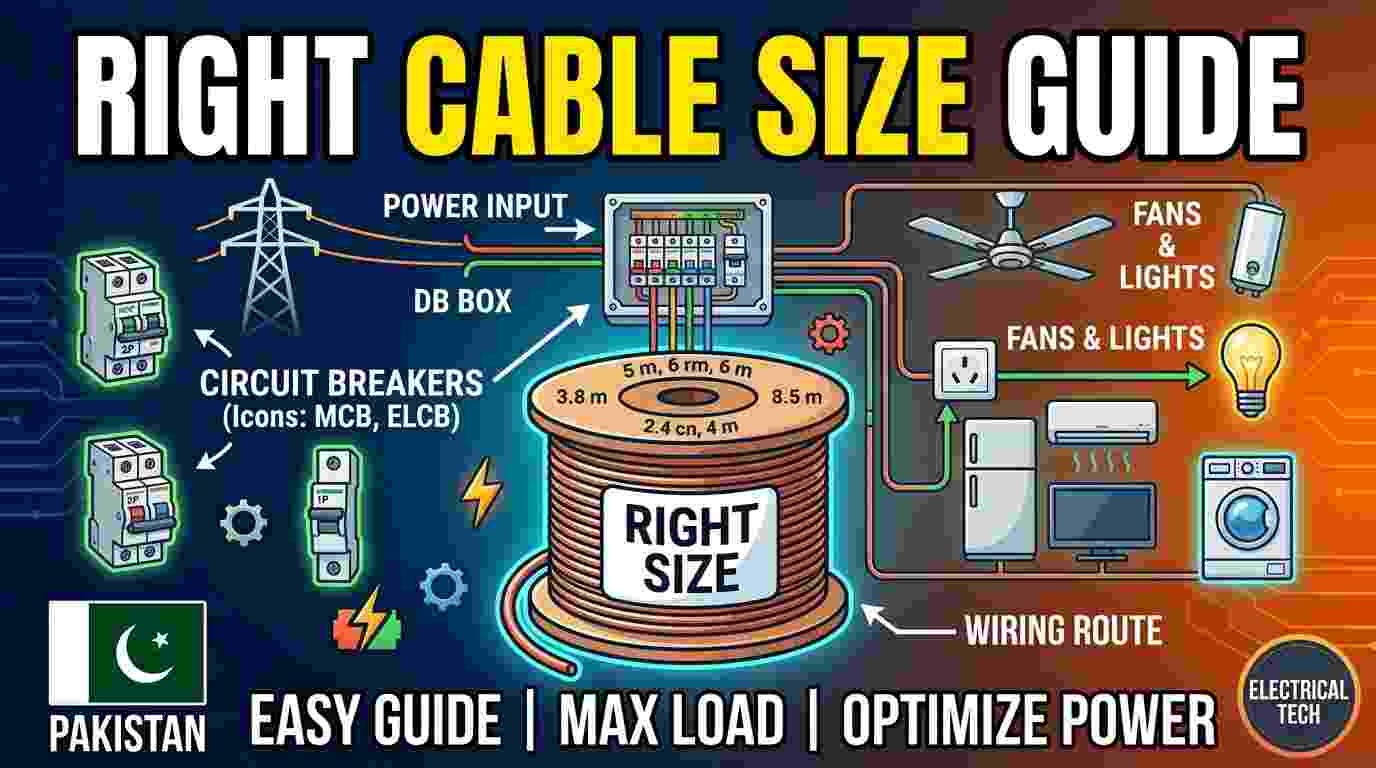
Choosing the correct electrical cable size is one of the most important decisions when wiring a new house, renovating an old electrical system, installing an air conditioner, adding a water pump or preparing a home for solar power.
A cable that is too small for the load can overheat, suffer excessive voltage drop and create a serious electrical safety risk. On the other hand, using an unnecessarily large cable can increase installation costs without providing a practical benefit.
In Pakistan, homeowners often hear simple rules such as 1.5 mm² for lights, 2.5 mm² for sockets and 4 mm² for ACs. These rules can be useful as general starting points, but they are not a substitute for proper electrical design. The correct cable size depends on several factors, including load current, cable length, installation method, conductor material, ambient temperature, grouping of cables, voltage drop and the protective device protecting the circuit.
NEPRA’s safety guidance emphasizes proper internal wiring, the use of conduit for exposed wiring, proper earthing and inspection by trained electricians. Its Power Safety Code also stresses that electrical protection systems and earthing should work together to reduce risks from faults, electric shock, fire and equipment damage.
This complete guide explains how to choose the right electrical cable size for a Pakistani home in 2026, including practical cable-size examples for lights, sockets, ACs, refrigerators, washing machines, water pumps, geysers and solar systems.
What Is Electrical Cable Size?
Electrical cable size usually refers to the cross-sectional area of the conductor, expressed in square millimetres or mm².
Common sizes used in residential electrical work include:
- 1.0 mm²
- 1.5 mm²
- 2.5 mm²
- 4 mm²
- 6 mm²
- 10 mm²
- 16 mm²
- Larger sizes for high-current applications
The number does not mean the cable’s diameter.
For example:
2.5 mm² cable
means that the conductor has an approximate cross-sectional area of 2.5 square millimetres.
A larger cross-sectional area generally allows a conductor to carry more current, subject to the cable’s construction and installation conditions.
Why Is Choosing the Correct Cable Size Important?
Cable sizing affects three major things:
1. Safety
An undersized cable carrying excessive current can become hot.
2. Performance
An undersized or excessively long cable can experience voltage drop, which may affect equipment performance.
3. Cost
Oversized cables cost more and may be unnecessary if the electrical design does not require them.
Therefore, the objective is not:
“Use the biggest cable possible.”
The objective is:
Use a properly sized cable that safely carries the expected load under the actual installation conditions.
What Happens If the Cable Is Too Small?
Using an undersized cable can create several problems.
Excessive Heating
When current passes through a conductor, the conductor experiences electrical resistance and produces heat.
If the current is too high for the cable’s permitted conditions, the cable may become excessively hot.
Insulation Damage
Continued overheating can damage the cable’s insulation.
Voltage Drop
Long or undersized cables can experience greater voltage drop.
Equipment Problems
Some appliances and motors may perform poorly when supplied with insufficient voltage.
Fire Risk
Severe overheating, poor connections or damaged insulation can contribute to electrical fires.
This is one reason protective devices and correctly sized conductors need to be designed together.
What Happens If the Cable Is Too Large?
A larger cable is not normally dangerous simply because it is larger, provided it is properly installed and compatible with the equipment and terminals.
However, unnecessarily large cable can cause:
- Higher material cost
- More difficult installation
- Larger conduits
- More difficult termination
- Wasted space
- Unnecessary project expense
For example, using a very large cable for a small LED lighting circuit doesn’t automatically make the circuit better.
The Most Common Cable Sizes for Home Wiring in Pakistan
A simplified residential guide often looks like this:
| Cable Size | Typical Residential Use* |
|---|---|
| 1.0–1.5 mm² | Lighting and low-load circuits |
| 2.5 mm² | General socket circuits |
| 4 mm² | Higher-load dedicated circuits |
| 6 mm² | Larger dedicated loads / selected sub-feeds |
| 10 mm²+ | Main feeds or higher loads |
Important: These are general examples, not universal rules.
The correct cable size must be calculated according to the actual load, cable length, installation method, conductor material, temperature, grouping and protective device.
A 4 mm² cable is not automatically correct for every AC, and a 2.5 mm² cable is not automatically safe for every socket circuit.
How Is Cable Size Selected?
A proper cable-selection process considers several factors.
1. Load Current
First determine how much current the appliance or circuit is expected to draw.
2. Cable Length
The longer the cable, the more important voltage drop becomes.
3. Copper or Aluminium
Copper and aluminium have different electrical properties and therefore different current-carrying capabilities for the same cross-sectional area.
4. Installation Method
A cable installed:
- In conduit
- In trunking
- In a wall
- Underground
- In free air
- Bundled with other cables
may have different thermal conditions.
5. Ambient Temperature
Higher surrounding temperatures can reduce the amount of heat the cable can safely dissipate.
6. Cable Grouping
Multiple loaded cables installed together can heat each other.
7. Protective Device
The MCB or other protective device must be coordinated with the cable and circuit.
8. Voltage Drop
Long circuits may require a larger conductor to keep voltage drop within an acceptable range.
Step 1: Calculate the Load
A basic electrical relationship is:
Power = Voltage × Current
Therefore:
Current = Power ÷ Voltage
For a simple single-phase example:
If an appliance consumes 2,000 watts at approximately 230 volts:
Current = 2,000 ÷ 230
Current ≈ 8.7 amps
This gives you an initial idea of the operating current.
However, this is only the beginning of cable selection.
Example: 1,000-Watt Appliance
Suppose a heater has a rated power of:
1,000 W
At approximately:
230 V
The approximate current is:
1,000 ÷ 230 = 4.35 A
That does not mean you should automatically select a particular cable solely from this number.
You still need to consider:
- Cable length
- Installation method
- Protective device
- Other loads
- Continuous operating time
- Local requirements
Step 2: Understand Voltage Drop
Voltage drop is one of the most important factors that homeowners often ignore.
When current flows through a cable, the cable has some resistance.
As the cable becomes longer, the total resistance increases.
This means the voltage measured at the appliance can be lower than the voltage at the distribution board.
For example:
DB → 230 V
but at the end of a long cable:
Appliance → lower voltage
The exact amount depends on conductor resistance, current, cable length and conductor size.
A larger conductor generally has lower resistance and therefore can reduce voltage drop.
Why Cable Length Matters
Consider two identical appliances.
House A
Cable length:
5 metres
House B
Cable length:
50 metres
Even if both appliances consume the same power, the longer circuit can experience significantly greater voltage drop.
Therefore, saying:
“This appliance uses 10 amps, so use the same cable size everywhere.”
is not a complete cable-sizing method.
The cable length matters.
What Is Ampacity?
Ampacity means the amount of current a conductor can safely carry under specified conditions.
It depends on factors such as:
- Conductor material
- Conductor size
- Insulation type
- Ambient temperature
- Installation method
- Number of loaded conductors
- Cable construction
For this reason, there isn’t one universal current rating that applies to every 2.5 mm² cable.
Two cables with the same conductor cross-sectional area can have different permitted ratings depending on their construction and installation conditions.
Copper vs Aluminium Cable
The conductor material is another important factor.
Copper Cable
Copper is widely used for residential wiring because it has good electrical conductivity and is mechanically practical for many building installations.
Advantages include:
- Good conductivity
- Good mechanical properties
- Reliable connections when correctly terminated
- Common availability
Aluminium Cable
Aluminium is lighter and can be economical for certain larger conductors and applications.
However, its electrical and termination characteristics differ from copper.
Aluminium conductors require appropriate connectors, terminals and installation practices.
Important:
Do not assume:
4 mm² copper = 4 mm² aluminium
in every practical sense.
Cable selection must consider the actual conductor material and manufacturer’s specifications.
1.5 mm² Cable: Where Is It Used?
A 1.5 mm² copper cable is commonly associated with lighting circuits in residential installations.
It may be used for:
- LED lights
- Ceiling lights
- Small lighting circuits
- Some low-load control circuits
However, the correct size depends on the circuit design.
A lighting circuit may have many lights but still have a relatively low total load because modern LED lamps consume comparatively little power.
2.5 mm² Cable: Where Is It Used?
2.5 mm² copper cable is commonly used for residential socket circuits.
Typical applications can include:
- General-purpose sockets
- Bedroom sockets
- Living-room sockets
- Office sockets
- Some dedicated appliance circuits
But again, the MCB rating, cable installation method and circuit arrangement must be considered.
A socket circuit can become overloaded if many high-power appliances are connected to it.
4 mm² Cable: Where Is It Used?
4 mm² cable is commonly considered for higher-load circuits.
Possible applications include:
- Certain air conditioners
- Electric ovens
- Water heaters
- Larger dedicated socket circuits
- Pumps
- Other higher-power appliances
However, 4 mm² is not automatically the correct size for every heavy appliance.
The appliance’s rated current, startup behavior, cable length and installation conditions must be considered.
6 mm² Cable: Where Is It Used?
6 mm² cable may be used for larger dedicated circuits or selected sub-feeds.
Possible examples include:
- Larger air-conditioning circuits
- Electric water heaters
- Higher-power kitchen appliances
- Sub-distribution board feeds
- Certain solar or inverter connections
The exact application depends on the electrical design.
For a large load, don’t choose 6 mm² simply because someone says:
“6 mm² is heavy-duty.”
Calculate the requirement first.
What Cable Size Is Needed for an AC?
This is one of the most searched questions in Pakistan.
The answer depends on:
- AC capacity
- Inverter or non-inverter design
- Rated current
- Maximum current
- Startup characteristics
- Cable length
- Installation method
- Ambient temperature
- MCB rating
- Manufacturer requirements
Therefore, there is no universal rule that:
1-ton AC = X mm²
or
1.5-ton AC = X mm²
without checking the actual electrical specifications.
Example
A modern inverter AC may have a different operating current profile from an older fixed-speed AC.
Two 1.5-ton ACs from different manufacturers may therefore have different electrical requirements.
The safest approach is to check the manufacturer’s nameplate and installation manual.
Suggested Starting Point for AC Circuits
For many residential installations, dedicated AC circuits are used.
A rough planning concept may be:
| Appliance | Possible Cable Range* |
|---|---|
| Small AC | 2.5–4 mm² |
| Medium AC | 4 mm² |
| Higher-load AC | 4–6 mm² |
| Very high-load equipment | Calculated individually |
*This is only a general planning guide. The actual cable size must be selected from the equipment rating, cable length, installation conditions and applicable electrical requirements.
Don’t use this table as a substitute for engineering calculations.
What Cable Size Is Needed for a Water Pump?
Water pumps are particularly important because motors can have higher starting currents than their normal running current.
A pump’s nameplate may specify:
- Voltage
- Current
- Power
- Frequency
- Phase
- Power factor
- Motor rating
For example, a pump may be:
1 HP
but its electrical requirements depend on its actual motor design.
The cable must therefore be selected based on the pump’s electrical current and installation conditions, including the distance from the DB to the pump.
For long pump runs, voltage drop becomes particularly important.
What Cable Size Is Needed for a Geyser?
Electric geysers can be relatively high-power loads.
Suppose a geyser is rated:
2,000 W
At 230 V:
2,000 ÷ 230 ≈ 8.7 A
If another heater is:
3,000 W
then:
3,000 ÷ 230 ≈ 13.0 A
The second appliance draws substantially more current.
A dedicated circuit may be appropriate for higher-power water heaters, depending on the installation.
Cable size and breaker selection should be coordinated with the appliance rating.
What Cable Size Is Needed for Kitchen Appliances?
The kitchen can contain some of the highest household electrical loads.
Examples include:
- Microwave
- Electric oven
- Air fryer
- Electric kettle
- Refrigerator
- Dishwasher
- Electric stove
- Coffee machine
- Blender
A common mistake is to put too many high-power appliances on one socket circuit.
For example:
Kettle + microwave + air fryer + electric oven
can create a substantial simultaneous demand.
A kitchen should therefore be planned with adequate socket circuits and dedicated circuits for high-power appliances where appropriate.
Cable Size for Refrigerator
A refrigerator normally has a relatively modest running power compared with devices such as electric heaters.
However, refrigerators contain compressors, and startup conditions can differ from steady-state operation.
A properly designed household socket circuit is usually more important than simply selecting an oversized cable specifically because the appliance is a refrigerator.
Use a properly earthed three-pin socket and appropriate protection.
NEPRA specifically recommends three-pin plugs for appliances including refrigerators, washing machines and irons.
Cable Size for Washing Machine
Washing machines can have motors, pumps and heating elements depending on the model.
Their electrical requirements therefore vary.
Check:
- Rated power
- Rated current
- Manufacturer instructions
The circuit should also have appropriate residual-current protection and earthing where required.
Cable Size for LED Lights
LED lights consume relatively little power compared with traditional incandescent lamps.
For example:
10 LED bulbs × 12 W:
10 × 12 = 120 W
At 230 V:
120 ÷ 230 ≈ 0.52 A
This illustrates why lighting circuits generally require much less current capacity than high-power appliance circuits.
However, cable and protection still need to comply with the applicable electrical design requirements.
Cable Size for Socket Circuits
Socket circuits require special attention because you don’t always know what the homeowner will plug into them.
A socket may be used for:
- Mobile charger
- Laptop
- Fan
- TV
- Iron
- Heater
- Kettle
- Vacuum cleaner
A socket circuit designed for general loads can become overloaded if several high-power appliances are used simultaneously.
NEPRA warns consumers not to overload electrical sockets because doing so can create a fire hazard.
Why the MCB and Cable Size Must Match
This is a critical concept.
Suppose a cable is only suitable for a certain current under the actual installation conditions.
Installing a much larger MCB can allow excessive current to flow through the cable before the breaker trips.
Therefore:
Cable → Protective Device → Load
must be coordinated.
The MCB isn’t selected merely to match the appliance.
It also protects the circuit conductors.
Don’t Increase the MCB When It Keeps Tripping
Imagine a circuit has a breaker that keeps tripping.
A homeowner might think:
“Replace the 16A MCB with 25A and the problem will disappear.”
This is dangerous if the cable and circuit are not designed for the higher current.
The correct procedure is:
Breaker trips → Find the reason → Check load → Check wiring → Check appliance → Correct the circuit
not:
Breaker trips → Install larger breaker
What Is Voltage Drop?
Voltage drop is the reduction in voltage that occurs as electrical current travels through a conductor.
It becomes more important when:
- Cable runs are long
- Current is high
- Cable is relatively small
- Motor loads are involved
For example, a pump located far from the house may need a larger cable than a similar pump located close to the DB.
This is one reason cable sizing cannot be based only on appliance wattage.
Cable Size for Long-Distance Wiring
Suppose you need to supply a pump:
Installation A
DB to pump:
10 metres
Installation B
DB to pump:
80 metres
The second installation has a much longer cable run.
Even if both pumps have identical power ratings, the second installation may require a larger conductor to keep voltage drop within acceptable limits.
The electrician should calculate the voltage drop rather than simply copying the cable size from the shorter installation.
Cable Size for a New House
If you are building a new home, plan the electrical wiring before plastering and finishing.
Make a list of:
- Rooms
- Lights
- Fans
- Sockets
- AC units
- Water pumps
- Kitchen appliances
- Geysers
- Solar system
- Inverter
- Battery
- Generator
- Future EV charger
Then divide the installation into appropriate circuits.
This is much better than trying to add circuits later.
Recommended Circuit Planning for a House
A typical house might have separate circuits for:
Lighting
Bedrooms, hallways and other lights.
Fans
Where appropriate based on the design.
General Sockets
Bedroom and living-room sockets.
Kitchen
Dedicated kitchen circuits.
ACs
Separate circuits for major AC units.
Water Pump
Dedicated pump circuit.
Geyser
Dedicated high-power circuit.
Outdoor
Outdoor lights, sockets and equipment.
Solar
Dedicated solar protection and connection arrangements.
This separation makes the DB more organized and simplifies fault finding.
Cable Size for Solar Systems
Solar installations require additional attention because both DC and AC sides are involved.
A simplified system is:
Solar Panels → DC Cables → DC Protection → Inverter → AC Cables → AC DB → Home Loads
Cable sizing depends on:
- PV current
- String configuration
- Cable length
- Voltage
- Temperature
- Installation method
- Number of parallel strings
- Inverter rating
- Applicable solar standards
Solar PV cables should be suitable for the DC environment and outdoor conditions where applicable.
You should not simply use an ordinary household AC cable because the solar system “doesn’t use much current.”
The voltage and environmental conditions matter too.
DC Cable Size in Solar Systems
Solar panels produce DC electricity.
The DC cable must be suitable for:
- PV voltage
- Current
- UV exposure
- Temperature
- Outdoor installation
- DC insulation requirements
The cable size should be selected based on the PV design and manufacturer’s requirements.
Incorrect DC cabling can cause:
- Excessive voltage drop
- Heating
- Energy losses
- Connection problems
- Safety hazards
AC Cable Size for Solar Inverters
The inverter’s AC output also requires appropriately sized cable.
For example, a large inverter producing several kilowatts may require a larger AC conductor than a small inverter.
A basic calculation can start with:
Current ≈ Power ÷ Voltage
For example, at 230 V:
A 5,000 W load:
5,000 ÷ 230 ≈ 21.7 A
But the final cable selection must consider the inverter’s rated output current, installation method, cable length, temperature and protection.
Single Phase vs Three Phase Cable Requirements
Your electrical connection also matters.
A single-phase system typically has:
- Phase
- Neutral
- Protective earth
A three-phase system has:
- Phase 1
- Phase 2
- Phase 3
- Neutral where required
- Protective earth
Three-phase systems require proper load balancing and cable selection.
For larger houses and high loads, three-phase distribution can make it easier to distribute demand across phases.
You can read our related guide:
Single Phase vs Three Phase Electricity – Which One Is Better for Your Home?
Copper Cable vs Aluminium Cable for Home Wiring
For many residential internal wiring applications, copper is commonly preferred.
Why?
Because copper has good conductivity and is practical for building wiring.
Aluminium can be useful for certain larger feeders and specialized applications, but it requires appropriate termination and installation practices.
If you are comparing cables, don’t compare only:
Price per metre
Also compare:
- Conductor material
- Cross-sectional area
- Insulation quality
- Voltage rating
- Temperature rating
- Manufacturer
- Applicable standards
- Actual application
The cheapest cable is not necessarily the best value.
How to Identify a Good Electrical Cable
When purchasing cable, check the printing on the cable.
Depending on the product, markings may identify:
- Manufacturer
- Conductor size
- Number of cores
- Voltage rating
- Standard
- Insulation type
- Temperature rating
- Batch or manufacturing information
Buy from a reputable supplier and avoid products with unclear specifications.
For a major house-wiring project, verify the cable specifications rather than relying only on the seller’s verbal claim.
What Does 2-Core, 3-Core and 4-Core Mean?
The number of cores refers to the number of insulated conductors within the cable.
Examples:
2-Core
Two conductors.
3-Core
Three conductors.
4-Core
Four conductors.
The appropriate number of cores depends on the application.
For a typical single-phase appliance circuit, you may need:
- Live
- Neutral
- Earth/protective conductor
But the exact cable arrangement depends on the wiring system and applicable requirements.
For three-phase applications, more conductors may be required depending on whether neutral is needed.
What Is a Flexible Cable?
Flexible cables are designed for applications where the cable may need to bend or move.
They are commonly used for:
- Appliance cords
- Extension leads
- Portable equipment
They are not automatically interchangeable with fixed building wiring cables.
For permanent house wiring, use cable types specifically intended and rated for that application.
Solid vs Stranded Cable
Electrical conductors can be constructed in different ways.
Solid Conductor
Made from a single conductor.
Stranded Conductor
Made from multiple smaller wires.
Stranded cable can offer flexibility and may be useful for certain installations.
The choice depends on the application, termination method and cable specification.
Common Electrical Cable Sizes for Different Home Loads
The following table can be used as a general educational reference:
| Home Application | Common Starting Range* |
|---|---|
| LED lighting | 1.0–1.5 mm² |
| General sockets | 2.5 mm² |
| Small dedicated appliances | 2.5–4 mm² |
| AC circuits | 2.5–6 mm² |
| Water pumps | 2.5–6 mm²+ |
| Electric geyser | 4–6 mm²+ |
| Oven/electric stove | 4–10 mm²+ |
| Sub-DB feed | 6–16 mm²+ |
| Main supply | Load calculation required |
*These are broad educational ranges, not fixed installation rules. Actual sizing must be calculated from the equipment rating, conductor material, cable length, installation method, temperature, grouping, voltage drop and applicable electrical requirements.
Example: Choosing Cable for a 1.5-Ton AC
Suppose an AC has a rated electrical input of:
1,500 W
Approximate current at 230 V:
1,500 ÷ 230 ≈ 6.5 A
You might initially think:
“Any small cable can handle 6.5 amps.”
But that is incomplete.
You still need to check:
- Maximum rated current
- Compressor/start characteristics
- Cable length
- Installation method
- Ambient temperature
- MCB
- Manufacturer instructions
A properly designed dedicated circuit may use a cable larger than the simple running-current calculation suggests.
Example: Choosing Cable for a 3,000-Watt Heater
Suppose:
Power = 3,000 W
Voltage = 230 V
Then:
Current ≈ 13 A
This is a substantial continuous household load.
A dedicated circuit may be appropriate.
The electrician should select the cable and protective device based on the actual installation.
Example: Choosing Cable for a 5-kW Inverter
Suppose a single-phase inverter can deliver approximately:
5,000 W
At 230 V:
Current ≈ 21.7 A
The final AC cable size must consider the inverter’s rated current, cable length, installation conditions and protection.
If the inverter is located far from the DB, voltage drop may require a larger conductor.
Why Long Cable Runs Need More Attention
Cable length affects both:
Voltage drop
and
Power losses
For example, a long cable feeding a remote pump can experience more voltage drop than a short cable feeding the same pump.
This can cause motors to struggle or operate outside their intended voltage range.
When planning:
- Water pumps
- Outdoor buildings
- Farm equipment
- Solar arrays
- Garage supplies
- Sub-DBs
always tell the electrician the approximate cable length.
Common Cable-Sizing Mistakes in Pakistan
Mistake 1: Choosing Cable by Appliance Name Only
“1.5-ton AC = 4 mm²” is not a complete calculation.
Mistake 2: Ignoring Cable Length
A long cable run can require a different conductor size.
Mistake 3: Ignoring Installation Method
A cable in conduit and a cable installed differently may have different thermal conditions.
Mistake 4: Oversizing the MCB
A larger MCB should never be used simply to stop nuisance tripping without checking the cable.
Mistake 5: Using Cheap Unknown Cable
A printed size on an unreliable product may not tell the whole story.
Mistake 6: Mixing Copper and Aluminium Incorrectly
Different conductor materials require appropriate termination methods.
Mistake 7: Ignoring Earthing
The earth conductor and earthing system are essential parts of electrical safety.
NEPRA’s safety code emphasizes permanent earthing and the coordination of earthing with protective devices.
Mistake 8: Overloading Socket Circuits
Multiple high-power appliances can overload a circuit even when individual appliances appear normal.
Mistake 9: Treating Solar Wiring Like Ordinary House Wiring
PV DC circuits have their own cable and protection requirements.
Mistake 10: Doing Major Wiring Work Yourself
Electrical wiring should be designed and installed by appropriately trained professionals.
NEPRA specifically advises consumers to have electrical repairs and internal wiring work performed by trained electricians.
How to Choose Cable Size: Simple 7-Step Method
If you want a practical process, follow these steps.
Step 1: Identify the Appliance
Know exactly what you are powering.
Step 2: Check the Nameplate
Record:
- Watts
- Amps
- Voltage
- Phase
Step 3: Calculate Current
For a simple single-phase load:
Current ≈ Power ÷ Voltage
Step 4: Measure Cable Length
Calculate the approximate distance from the DB to the appliance.
Step 5: Check Installation Conditions
Determine whether the cable will be:
- In conduit
- In wall
- In trunking
- Underground
- Exposed
- Bundled
Step 6: Select Cable and Protection Together
The cable must be appropriately protected by the circuit breaker.
Step 7: Verify the Final Design
A qualified electrician should verify the final cable size, breaker, earthing, termination and voltage-drop requirements.
How Much Does Electrical Wiring Cost in Pakistan?
The total cost of house wiring varies considerably.
It depends on:
- House size
- Number of circuits
- Cable brand
- Copper vs aluminium
- Cable sizes
- Number of sockets
- Number of switches
- DB size
- MCB/RCCB/RCBO
- Conduit
- Labour
- Number of AC points
- Kitchen wiring
- Solar preparation
- Generator/UPS wiring
Cable prices also change with copper and aluminium market prices, so an exact 2026 project cost should be based on current quotations rather than an old online estimate.
When comparing quotes, don’t choose purely on the lowest total price.
Ask the contractor:
Which cable brand?
Which conductor material?
What cable sizes?
How many circuits?
Which MCBs?
What DB?
What earthing system?
What conduit?
This gives you a much better comparison.
How to Save Money Without Compromising Electrical Safety
You don’t need to use oversized cable everywhere to build a good electrical system.
Instead:
Use proper load calculations
Avoid unnecessary oversizing.
Separate heavy loads
Dedicated circuits can improve system organization.
Use efficient appliances
Lower electrical demand can reduce the required capacity of some circuits.
Plan before construction
Changing wiring after plastering is expensive.
Leave future capacity
A little planning can prevent expensive modifications later.
Don’t compromise on protection
Saving money by removing proper protective devices is not a good strategy.
Electrical Cable Size for a 5-Marla House
House size alone does not determine cable size.
A 5-marla house may have:
- 2 ACs
- 1 pump
- Electric geyser
- Electric oven
- Multiple kitchen appliances
Another 5-marla house may have:
- 1 AC
- Gas cooking
- Small pump
- Few appliances
Their electrical requirements can be very different.
Therefore:
5 marla ≠ fixed cable size
The load determines the requirement.
Electrical Cable Size for a 10-Marla House
The same principle applies.
A 10-marla house with five ACs and electric heating may require substantially more electrical capacity than a 10-marla house with two ACs and gas appliances.
The correct approach is to calculate the actual electrical demand and design the DB and circuits accordingly.
Cable Size and Solar Readiness
If you are building a new house and expect to install solar later, plan for it from the beginning.
Consider:
- Solar inverter location
- Main DB location
- AC cable route
- DC cable route
- Battery location
- Earthing
- Surge protection
- Future expansion
- Possible three-phase requirement
NEPRA’s regulatory framework includes 2026 prosumer regulations and amendments, so grid-connected solar projects should be designed using the latest applicable requirements rather than relying on older assumptions.
How to Know If Your Existing Cable Is Undersized
Some warning signs include:
- Cable becoming unusually hot
- Burning smell
- Discolored insulation
- Repeated breaker trips
- Flickering lights under heavy load
- Appliances struggling during high demand
- Excessive voltage drop
- Warm sockets or switches
- Melted insulation
- Buzzing or crackling
These signs should not be ignored.
If you notice overheating or burning, switch off the affected circuit if it is safe to do so and have it inspected by a qualified electrician.
Why Earthing Matters With Cable Selection
Cable sizing is not only about live and neutral conductors.
The protective earth system is also important.
A proper electrical installation needs an effective fault-current path so protective devices can operate as intended.
NEPRA’s Power Safety Code explains that a permanent earthing system provides a path for fault current and works together with overcurrent protection to reduce the risk of electric shock, fire and equipment damage.
This is especially important for:
- Metal-bodied appliances
- Refrigerators
- Washing machines
- Water heaters
- Pumps
- Solar equipment
Cable Size vs MCB Size
This is worth remembering:
Do not select the MCB first and then find a cable that fits it.
Instead, the circuit should be designed as a complete system.
A simplified relationship is:
Load → Cable → Protective Device
The protective device must protect the conductor under the applicable conditions.
For example, if a cable cannot safely carry the current associated with a particular breaker rating under the installation conditions, installing that breaker is not an appropriate solution.
When Should You Use a Dedicated Circuit?
Dedicated circuits are particularly useful for higher-power or important appliances such as:
- Air conditioners
- Electric geysers
- Electric ovens
- Water pumps
- Large kitchen equipment
- EV chargers
- Certain solar equipment
A dedicated circuit can provide:
- Better protection
- Easier isolation
- Easier troubleshooting
- Reduced loading on general socket circuits
The exact circuit arrangement should be determined by the electrical design.
Final Checklist Before Wiring Your Home
Before starting electrical wiring, check:
Load
- Have all major appliances been listed?
- Have their ratings been checked?
Cable
- Is the conductor copper or aluminium?
- Is the cross-sectional area appropriate?
- Is the cable suitable for the installation?
Length
- Has voltage drop been considered?
Protection
- Are MCBs correctly selected?
- Is residual-current protection provided where required?
- Is surge protection appropriate?
Earthing
- Is there a proper earthing system?
- Are protective earth conductors correctly installed?
DB
- Is the DB large enough?
- Are circuits properly separated?
- Is there spare capacity?
Solar
- Is the wiring prepared for future solar?
- Is the inverter location planned?
- Are AC/DC cable requirements understood?
Professional Installation
- Will a trained electrician inspect and test the completed installation?
Frequently Asked Questions
What is the best cable size for a house in Pakistan?
There is no single cable size for an entire house. Different circuits require different cable sizes based on load, installation method, cable length, conductor material and protection.
Is 1.5 mm² cable enough for house wiring?
It can be suitable for certain low-load circuits, commonly lighting, but it should not automatically be used for every circuit.
Is 2.5 mm² cable enough for sockets?
2.5 mm² is commonly used for residential socket circuits, but the final design must consider the circuit load, installation method, breaker and applicable requirements.
Is 4 mm² cable enough for a 1.5-ton AC?
It may be suitable for some installations, but you should check the AC’s rated/max current, cable length, installation method and manufacturer requirements before selecting the cable.
What cable size is required for a 2-ton AC?
There is no universal answer. Check the specific AC’s electrical rating and calculate the circuit based on current, length, installation conditions and protection.
Which is better, copper or aluminium cable?
Copper is widely used for residential internal wiring because of its electrical and mechanical properties. Aluminium can be appropriate for certain applications, particularly larger conductors, when correctly designed and terminated.
Does cable length affect cable size?
Yes. Longer cable runs can produce greater voltage drop and may require a larger conductor.
Can I use a larger cable than required?
A larger cable can be used where it is practical and properly terminated, but unnecessary oversizing increases cost and may complicate installation.
Can I use a smaller MCB with a larger cable?
The protective-device selection must be based on the circuit design and load. A larger cable does not mean any arbitrary MCB can be used.
Why does my wire get hot?
Possible causes include excessive load, undersized conductors, loose connections, poor terminations, damaged wiring or unsuitable installation conditions. Hot wiring should be inspected by a qualified electrician.
Does solar require different cables?
Yes. Solar systems have DC and AC sections, and PV circuits require cables suitable for their voltage, current and environmental conditions.
Should every AC have a separate circuit?
Dedicated circuits are often appropriate for AC units, particularly higher-power equipment, but the exact design depends on the electrical installation.
Can I install house wiring myself?
Major electrical wiring should be carried out and tested by an appropriately trained professional. NEPRA advises against DIY electrical repairs and recommends trained electricians.
Conclusion
Choosing the correct electrical cable size for your home in Pakistan is not simply a matter of memorizing numbers such as 1.5 mm², 2.5 mm² or 4 mm².
Those sizes are commonly encountered in residential wiring, but the correct choice depends on the complete electrical design.
Before selecting a cable, consider:
Load → Current → Cable Length → Installation Method → Conductor Material → Voltage Drop → Protective Device → Earthing
For a basic home, you may commonly encounter 1.5 mm² lighting circuits, 2.5 mm² socket circuits and larger conductors for high-power appliances, but these should be treated as general planning examples rather than universal rules.
Air conditioners, water pumps, geysers, electric ovens, EV chargers and solar systems deserve particular attention because their electrical requirements can be considerably higher than ordinary lighting and socket loads.
The most important rule is simple:
Never choose an electrical cable only because someone says it is “heavy duty” or because the same size was used in another house.
Your home’s electrical load, cable length, installation conditions and protection requirements are what determine the correct size.
A properly sized cable, correctly rated breaker, effective earthing system and professionally installed distribution board work together to create a safer and more reliable electrical system.
NEPRA’s current safety guidance emphasizes safe internal wiring, conduit, earthing, avoiding overloaded sockets and using trained electricians for electrical work.
If you are building a new home or renovating an old one, it is much better to calculate the electrical requirements before the wiring is installed than to discover later that cables, breakers or circuits need to be replaced.
Correct cable size today can prevent overheating, voltage-drop problems, unnecessary expense and dangerous electrical faults tomorrow.