
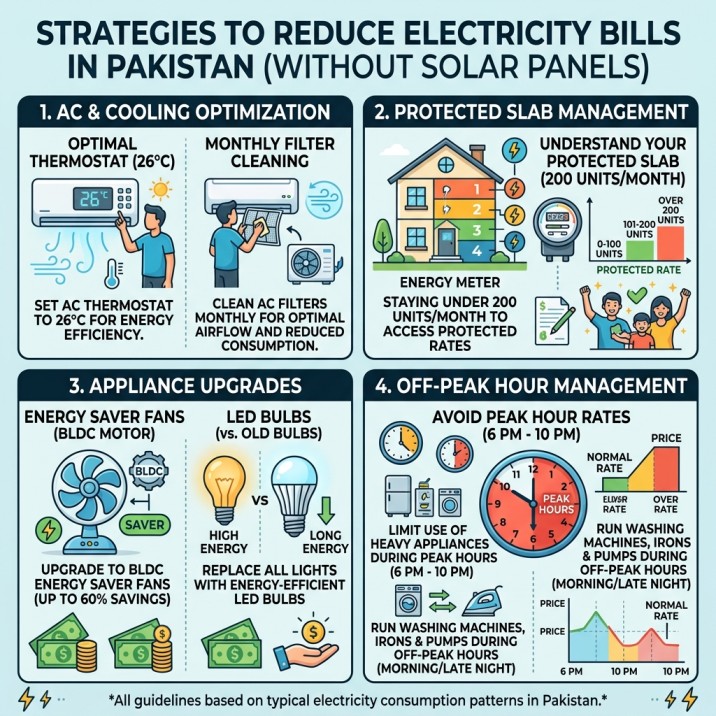
Electricity bills have become a major monthly expense for households across Pakistan. With air conditioners, refrigerators, water pumps, washing machines, fans, lights, TVs, computers and other appliances running regularly, electricity consumption can quickly increase—especially during the hot summer months.
The good news is that you do not always need to buy solar panels to reduce your electricity bill.
Before investing in a solar system, many households can lower their monthly electricity consumption simply by changing how they use appliances, improving energy efficiency and identifying unnecessary electricity usage.
This guide explains how to reduce your electricity bill in Pakistan without solar panels, using practical methods that can be applied in houses, apartments, shops and small offices.
Pakistan’s electricity tariff structure also makes reducing unnecessary units particularly important. NEPRA’s tariff documents show that residential electricity charges vary according to consumption slabs and tariff categories, while consumers with applicable Time-of-Use tariffs can face different peak and off-peak rates.
So, if your electricity bill is higher than expected, the first step should not necessarily be buying expensive equipment. The first step should be understanding where your electricity is being consumed and reducing waste.
Why Electricity Bills Are So High in Pakistan
There is no single reason behind a high electricity bill. In most homes, several factors work together.
Common reasons include:
- Excessive use of air conditioners
- Old or inefficient appliances
- Fans running unnecessarily
- Incandescent or inefficient lights
- Water pumps running longer than required
- Refrigerators with poor cooling efficiency
- Electric heaters and geysers
- Iron usage for long periods
- Appliances left on standby
- Poor insulation
- Incorrect AC temperature settings
- Electricity usage during expensive peak periods for applicable ToU consumers
- Faulty wiring or electrical equipment
- Increasing monthly electricity consumption into higher tariff slabs
The important point is that saving electricity is not the same as stopping the use of electricity.
The goal is to get the same comfort while consuming fewer units.
1. Start by Checking Your Electricity Bill
Before changing your appliances, understand your electricity bill.
Look at your previous three to six bills and note:
- Monthly units consumed
- Current meter reading
- Previous meter reading
- Billing period
- Tariff category
- Peak/off-peak information, if applicable
- Fixed charges
- Fuel adjustment or other applicable adjustments
- Total amount payable
Do not look only at the final rupee amount.
For example, if your bill increased from Rs. 18,000 to Rs. 25,000, the first question should be:
Did electricity consumption increase, or did the tariff/adjustments change?
These are two different problems.
NEPRA continues to issue tariff decisions and periodic adjustments during 2026, so the amount payable can change for reasons beyond simply using more appliances.
Check Your Monthly Units
Suppose your household used:
- January: 280 units
- February: 265 units
- March: 290 units
- April: 330 units
- May: 410 units
- June: 520 units
The increase itself tells you something important.
If consumption starts rising when temperatures increase, air conditioning, cooling fans and refrigeration may be major contributors.
2. Reduce Air Conditioner Electricity Consumption
For many Pakistani households, the air conditioner is one of the biggest electricity consumers.
You do not necessarily need to stop using AC. Instead, use it more efficiently.
Set the AC Temperature Properly
Avoid setting the AC unnecessarily low.
For example, continuously running an AC at 18°C can consume significantly more electricity than maintaining a comfortable temperature such as 24–26°C, depending on room conditions, AC efficiency and outdoor temperature.
A practical approach is:
Try 24–26°C and use the fan mode appropriately.
Every home and AC is different, so comfort should remain the priority.
Clean AC Filters
Dirty filters restrict airflow and can make the AC work harder.
During periods of frequent use:
- Check filters regularly
- Clean washable filters
- Keep the indoor unit unobstructed
- Ensure outdoor unit airflow is not blocked
A neglected AC can consume more electricity while providing poorer cooling.
Keep Doors and Windows Closed
If the AC is running, keep the cooled room properly closed.
Avoid:
- Frequently opening doors
- Leaving windows open
- Allowing hot outside air inside
- Running AC in an empty room
Cooling an empty room is one of the easiest forms of electricity waste to eliminate.
3. Use Inverter ACs Efficiently
If you already own an inverter AC, take advantage of its variable-speed operation instead of repeatedly switching it on and off.
An inverter AC can adjust compressor speed according to cooling demand.
However, an inverter AC does not mean unlimited electricity savings.
Its actual consumption depends on:
- AC capacity
- Room size
- Outdoor temperature
- Temperature setting
- Insulation
- Usage duration
- Maintenance
- Appliance efficiency
So simply purchasing an inverter AC does not automatically guarantee a low bill.
Proper sizing and usage matter.
4. Stop Cooling Empty Rooms
This sounds obvious, but it can make a noticeable difference.
If a room is not being used, turn off:
- AC
- Fans
- Lights
- Television
- Chargers
- Other unnecessary appliances
For example, if an AC is running for two hours every day in an empty room, those hours add up over an entire month.
A simple rule is:
No one in the room = no unnecessary cooling.
5. Replace Old Bulbs with LED Lights
Lighting is one of the easiest areas to improve.
If your home still uses old incandescent bulbs, replacing them with LED bulbs can reduce lighting electricity consumption.
LED lights generally provide more light for less electricity than traditional incandescent bulbs.
But there is another important rule:
The most efficient light is the one you don’t need to turn on.
During daytime:
- Open curtains
- Use natural sunlight
- Avoid switching on unnecessary lights
- Use task lighting instead of lighting an entire room
For example, if you are reading at a desk, you may not need several room lights switched on simultaneously.
6. Turn Off Fans When You Leave
Fans consume electricity even though their consumption is usually much lower than that of air conditioners.
The problem comes when multiple fans remain switched on in empty rooms.
Before leaving a room, develop a simple habit:
Lights off + fan off + AC off.
This takes only a few seconds but prevents unnecessary daily consumption.
7. Use Ceiling Fans Together with AC
Instead of lowering the AC temperature excessively, consider using the ceiling fan to improve air circulation.
For example:
Instead of setting the AC extremely low, keep the room at a comfortable temperature and use the fan to distribute cool air.
The exact electricity saving will depend on the appliances and room, but the principle is simple:
Improve air circulation rather than demanding excessive cooling from the AC.
8. Reduce Refrigerator Electricity Consumption
Your refrigerator operates for much of the day, so efficiency matters.
Avoid:
- Opening the door repeatedly
- Leaving the door open
- Putting very hot food directly inside
- Overloading the refrigerator
- Blocking internal air circulation
- Ignoring damaged door seals
Check the rubber gasket around the door.
If the door does not close properly, cold air escapes and the compressor may need to work harder.
Also make sure the refrigerator has adequate ventilation around it according to the manufacturer’s instructions.
9. Use the Washing Machine Efficiently
Washing machines can also contribute to monthly consumption.
To reduce unnecessary electricity usage:
- Run full loads when practical
- Avoid washing very small loads repeatedly
- Use appropriate washing programs
- Avoid unnecessary high-temperature washing
- Use shorter cycles when suitable
- Maintain the machine properly
You should not overload the machine simply to save electricity. Follow the manufacturer’s recommended load capacity.
10. Control Your Electric Geyser
Electric geysers can become major electricity consumers, particularly during winter.
Instead of keeping the geyser continuously switched on:
- Turn it on when hot water is needed
- Use a timer where appropriate
- Maintain a reasonable thermostat setting
- Insulate hot-water pipes where practical
- Repair leaking taps
- Avoid heating more water than necessary
If your geyser is old and inefficient, replacing it with a more efficient model may reduce electricity consumption over time.
11. Be Careful with Electric Heaters
Electric heaters can consume a substantial amount of electricity because heating requires considerable energy.
A heater rated at 2,000 watts, for example, uses approximately:
2 kW × hours of operation = electricity consumed
If operated for 5 hours:
2 kW × 5 hours = 10 kWh
That means approximately 10 units of electricity for that period, before considering the rest of the household load.
Actual billing cost depends on your applicable tariff and other charges.
This simple calculation demonstrates why high-power heating appliances deserve special attention.
12. Reduce Water Pump Running Time
Water pumps are another appliance worth checking.
A common mistake is allowing a pump to run longer than necessary.
Consider:
- Installing an automatic water-level controller
- Checking for leaking pipes
- Repairing faulty float switches
- Avoiding unnecessary repeated pumping
- Maintaining the pump
- Using an appropriately sized pump
If your pump automatically switches off when the tank is full, you can prevent accidental over-running.
13. Don’t Leave Chargers Plugged In Unnecessarily
Phone chargers and small electronic adapters generally consume relatively little electricity when compared with ACs or heaters.
However, the bigger issue is the number of devices connected throughout a home.
Examples include:
- Phone chargers
- Laptop chargers
- TV boxes
- Gaming consoles
- Wi-Fi equipment
- Speakers
- Computer accessories
Standby consumption from one device may be small, but eliminating unnecessary standby usage is still a good energy-saving habit.
Use a switched power strip for entertainment or computer setups where practical.
14. Use Washing, Ironing and Other Appliances Strategically
Some household appliances have high power ratings.
Examples include:
- Electric irons
- Hair dryers
- Electric kettles
- Microwave ovens
- Water heaters
- Room heaters
- Electric ovens
This does not mean you should stop using them.
Instead, avoid unnecessary repeated operation.
For example, rather than ironing one or two clothes multiple times throughout the week, many households can organize ironing into fewer sessions.
Similarly, use an electric kettle only for the amount of water actually needed.
15. Avoid Running Multiple High-Power Appliances at the Same Time
A home may have several high-power appliances:
- AC
- Geyser
- Iron
- Microwave
- Water pump
- Washing machine
- Heater
Running several of them simultaneously can create a high electrical load.
For households with applicable Time-of-Use tariffs, shifting flexible consumption away from peak periods can also be useful.
NEPRA tariff documents define peak and off-peak periods for applicable ToU consumers, with timings varying by season. For example, one notified schedule lists peak hours as 7 PM–11 PM during June–August and 6 PM–10 PM during September–November.
Always check the current tariff applicable to your own electricity connection rather than relying on an old schedule.
16. Understand Peak and Off-Peak Electricity Usage
If your connection is under a Time-of-Use tariff, the timing of electricity consumption can matter.
You may be able to shift flexible activities such as:
- Washing clothes
- Running certain pumps
- Charging compatible devices
- Using some appliances
to off-peak periods.
However, this strategy only applies where your tariff actually uses peak/off-peak pricing.
Do not assume every residential consumer in Pakistan automatically has the same ToU structure.
17. Improve Your Home’s Insulation
Electricity saving is not always about appliances.
Your building itself can affect energy consumption.
A poorly insulated room can become extremely hot during summer.
Practical improvements include:
- Curtains
- Window shades
- Roof insulation
- Reflective roof treatments where appropriate
- Sealing major air gaps
- Using suitable window coverings
- Preventing direct sunlight from entering rooms
If your room remains cooler naturally, your AC does not have to work as hard.
18. Use Curtains Strategically
In Pakistan’s hot climate, direct sunlight through windows can significantly increase indoor heat.
During the hottest part of the day:
- Close curtains on sun-facing windows
- Use blinds or shades
- Keep unnecessary sunlight out
- Open windows when outdoor conditions are suitable
At night, if outdoor air is cooler and safe ventilation is possible, natural ventilation can sometimes reduce the need for mechanical cooling.
19. Check Your Electrical Wiring
Sometimes an unexpectedly high electricity bill should not immediately be blamed on appliances.
Old or damaged electrical systems can create safety problems and require professional inspection.
If you notice:
- Burning smell
- Hot sockets
- Sparking
- Flickering lights
- Repeated breaker trips
- Damaged wires
- Unusual meter behavior
contact a qualified electrician.
Do not attempt unsafe electrical repairs yourself.
Also remember that electricity theft or unauthorized connections are completely different issues and should be handled through the relevant electricity distribution company.
20. Find Which Appliance Uses the Most Electricity
One of the smartest ways to reduce electricity consumption is to measure it.
You can use suitable energy-monitoring equipment to identify high-consumption appliances.
For example, compare:
- Refrigerator
- AC
- Water pump
- Geyser
- Iron
- Washing machine
- Freezer
A plug-in energy meter can be useful for compatible appliances, while larger loads may require professional measurement.
The objective is simple:
Don’t guess where your electricity is going—measure it.
21. Understand Watts, Units and Electricity Consumption
A basic understanding of electricity can help you control your bill.
The formula is:
Electricity consumed (kWh) = Power (kW) × Time (hours)
And:
1 kWh = 1 electricity unit
For example, a 1,000-watt appliance is equivalent to 1 kW.
If it operates for 3 hours:
1 kW × 3 hours = 3 units
Similarly, a 2 kW appliance running for 4 hours consumes approximately:
2 × 4 = 8 units
This is why appliances with high wattage and long operating hours deserve the most attention.
22. Calculate Your Appliance’s Monthly Consumption
Let’s take an example.
Suppose an appliance uses 1.5 kW and operates for 4 hours per day.
Daily consumption:
1.5 × 4 = 6 units
For 30 days:
6 × 30 = 180 units
That is a significant amount of electricity from just one appliance.
This calculation is especially useful for:
- ACs
- Electric heaters
- Geysers
- Water pumps
- Electric ovens
The actual cost depends on your tariff, taxes, adjustments and billing structure.
23. Don’t Focus Only on the Cheapest Appliances
When buying an appliance, people often compare only the purchase price.
A better approach is:
Purchase price + electricity consumption + maintenance + expected lifespan
An appliance that costs slightly more but consumes considerably less electricity may provide better value over several years.
Look for:
- Energy-efficient models
- Appropriate capacity
- Good warranty
- Reliable brand
- Efficient compressor/motor
- Correct sizing
Avoid buying an oversized appliance simply because it appears more powerful.
24. Choose the Correct AC Size
An oversized or undersized AC can both create problems.
The correct AC capacity depends on factors such as:
- Room size
- Ceiling height
- Number of occupants
- Sun exposure
- Insulation
- Windows
- Appliances generating heat
Instead of simply asking:
“Which AC has the most tonnage?”
ask:
“Which capacity is suitable for my room?”
Correct sizing can improve comfort and efficiency.
25. Use a Monthly Electricity-Saving Target
Instead of trying to cut your bill randomly, set a unit-based target.
For example:
Current consumption:
500 units/month
Target:
400 units/month
Potential reduction:
100 units/month
Then identify where those 100 units can come from.
You might target:
- 40 units from AC usage
- 15 units from lighting
- 15 units from water pumping
- 10 units from ironing
- 10 units from refrigerator efficiency
- 10 units from standby and miscellaneous usage
These figures are only an example, not a guaranteed saving. Actual results depend on your household.
26. Five Changes You Can Make Today
If you want immediate action, start with these five steps:
Step 1: Turn off unnecessary appliances
Check every room before leaving.
Step 2: Set AC temperature reasonably
Avoid unnecessarily low temperatures.
Step 3: Clean AC filters
Especially before and during heavy summer usage.
Step 4: Replace inefficient lights
Move toward LED lighting where suitable.
Step 5: Check your monthly units
Compare your current consumption with previous months.
These steps cost little or nothing.
27. How Much Can You Actually Save Without Solar?
There is no universal percentage.
One household may reduce consumption by 5%, another by 15%, while a home with significant waste may achieve a larger reduction.
The result depends on:
- Existing consumption
- Appliance efficiency
- AC usage
- Household size
- Weather
- Electricity tariff
- Insulation
- Daily habits
For this reason, be careful with claims such as “reduce your bill by 50% guaranteed.”
Energy savings should be based on actual consumption.
28. When Should You Consider Solar Panels?
This article is specifically about reducing electricity bills without buying solar panels.
However, there comes a point when efficiency improvements alone may not be enough.
If your household has:
- Consistently high electricity consumption
- Multiple ACs
- Large monthly bills
- Significant daytime electricity usage
- Long-term plans to remain in the property
then solar may become worth considering.
But the correct approach is:
First reduce unnecessary consumption, then size the solar system based on actual electricity usage.
This can prevent you from buying a larger system than necessary.
29. Energy Efficiency vs Solar Panels
These are not competing ideas.
They work together.
Energy efficiency
Reduces the amount of electricity you need.
Examples:
- Better AC usage
- LED lights
- Efficient appliances
- Reduced wastage
- Better insulation
Solar power
Generates electricity to offset grid consumption.
The best long-term strategy for many households can therefore be:
Reduce waste → improve efficiency → measure consumption → consider solar if necessary.
30. Common Electricity-Saving Mistakes
Many people try to save electricity but make mistakes.
Mistake 1: Turning off one small light while ignoring the AC
An AC generally deserves much more attention than a small LED bulb.
Mistake 2: Buying cheap appliances without considering efficiency
The lowest purchase price does not necessarily mean the lowest lifetime cost.
Mistake 3: Setting AC temperature extremely low
This can increase cooling demand without necessarily making the room comfortable faster.
Mistake 4: Running appliances in empty rooms
This is pure energy waste.
Mistake 5: Ignoring maintenance
Dirty filters, poor airflow and faulty equipment can reduce efficiency.
Mistake 6: Believing every electricity bill increase is caused by consumption
Tariff changes and adjustments can also affect the final bill. NEPRA’s 2026 notifications show that tariff adjustments continue to be issued during the year.
31. A Simple Electricity-Saving Routine for Pakistani Homes
You can create a daily routine.
Morning
- Turn off unnecessary lights
- Use natural daylight
- Check whether fans are needed
- Avoid leaving appliances switched on unnecessarily
Afternoon
- Close curtains on sun-facing windows
- Avoid unnecessary AC operation
- Use appliances efficiently
- Check water pump operation
Evening
- Avoid unnecessary lighting
- Use efficient fans
- If applicable, consider ToU peak periods before running flexible high-load appliances
Night
- Turn off unused appliances
- Check AC settings
- Turn off lights in empty rooms
- Disconnect unnecessary equipment where practical
A few simple habits repeated every day can make a bigger difference than occasional extreme efforts.
32. Can You Reduce Your Electricity Bill Without Changing Your Lifestyle?
Yes.
The goal is not to live uncomfortably.
You do not need to:
- Sit without fans
- Stop using AC completely
- Stop using refrigerators
- Avoid washing machines
- Stop using electronics
Instead, focus on efficiency.
For example:
Using an AC at a reasonable temperature in a properly closed room is more sensible than running it at an unnecessarily low temperature with doors open.
Similarly, using one efficient light where needed is better than keeping five lights on unnecessarily.
33. A Practical 30-Day Electricity Saving Challenge
If you want measurable results, try this.
Week 1: Track
Record your meter reading and daily usage if possible.
Week 2: Reduce waste
Turn off unused lights, fans, ACs and appliances.
Week 3: Improve efficiency
Clean AC filters, check refrigerator seals and improve ventilation/curtains.
Week 4: Compare
Compare your consumption with the previous month.
If your units have fallen, identify which changes made the biggest difference.
Then continue those habits.
Frequently Asked Questions
Can I reduce my electricity bill without installing solar?
Yes. You can reduce electricity consumption through efficient AC use, LED lighting, appliance maintenance, better insulation, reduced standby consumption and smarter usage habits.
What uses the most electricity in a Pakistani home?
For many households, air conditioning is a major electricity consumer, particularly during summer. Electric heaters, geysers, water pumps, refrigerators and other high-power appliances can also contribute significantly depending on usage.
Does turning off lights really reduce the electricity bill?
Yes, although the saving from a single LED light may be relatively small. The larger benefit comes from eliminating unnecessary usage across many appliances and many hours.
What is the best AC temperature for saving electricity?
A comfortable setting around 24–26°C is often a practical starting point, but actual efficiency depends on the AC, room, weather, insulation and personal comfort.
Should I turn my refrigerator off at night?
Generally, no. A refrigerator is designed to operate continuously. Instead, focus on proper temperature settings, good door seals, adequate ventilation and avoiding unnecessary door opening.
Does standby mode consume electricity?
Some electronic devices can consume electricity while in standby mode. Individually the amount may be small, but unnecessary standby consumption across many devices can add up.
Is an inverter AC always cheaper to run?
Not automatically. Inverter technology can improve efficiency under suitable operating conditions, but actual electricity consumption depends on AC size, efficiency, temperature, room conditions, maintenance and usage.
Should I use appliances during off-peak hours?
If your electricity connection is subject to a Time-of-Use tariff, shifting flexible loads to off-peak periods may help. Check your current tariff and applicable peak/off-peak schedule because it varies by tariff category and season.
How can I find which appliance is increasing my electricity bill?
Start by comparing appliance wattage and operating hours. For suitable appliances, an energy-monitoring meter can provide a more direct measurement. For larger electrical loads, professional assessment may be more appropriate.
Is solar the only solution for high electricity bills?
No. Energy efficiency should be considered first. However, if your electricity consumption remains high after reducing waste, solar can be evaluated as a longer-term option.
Final Thoughts
Reducing your electricity bill in Pakistan does not always require a solar panel system.
For many households, the first opportunity is simply using existing electricity more intelligently.
Start with the biggest consumers—especially air conditioners, heaters, geysers, water pumps and other high-power appliances. Then look at lighting, refrigeration, standby consumption and daily habits.
Most importantly, track your units, not just the rupee amount on the bill. Electricity tariffs and adjustments can change, so a higher bill does not always mean that your household suddenly consumed more electricity. NEPRA’s ongoing 2026 tariff notifications and adjustments make it particularly useful to distinguish between changes in consumption and changes in billing rates.
The simplest strategy is:
Measure your consumption → identify waste → improve appliance efficiency → change daily habits → compare your units → consider solar only when it makes financial sense.
You do not have to sacrifice comfort to save electricity. In many cases, smarter usage can help you get the same cooling, lighting and household convenience while using fewer units.
And when you eventually decide whether solar is right for your home, having a lower and more accurate electricity demand will make it much easier to choose the appropriate solar system size.