
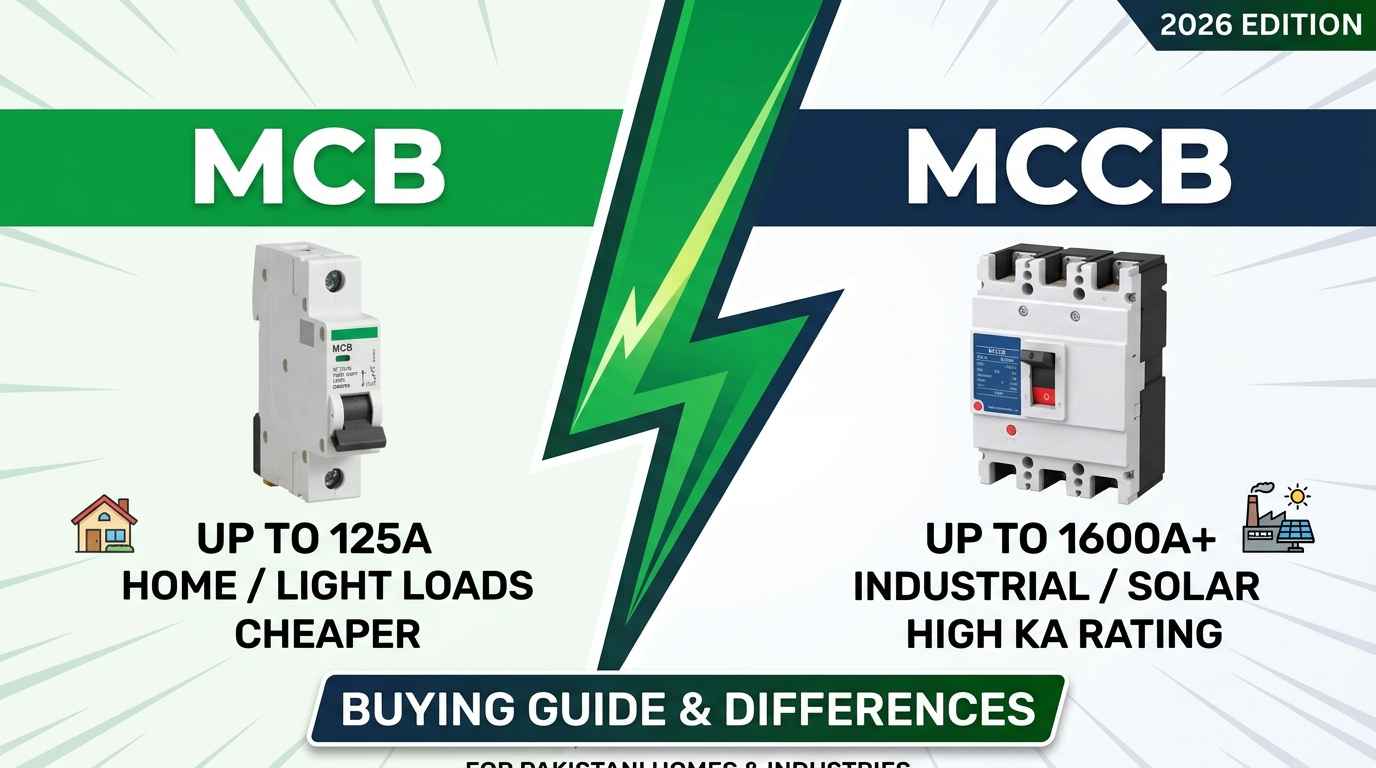
Electrical protection har home, shop, office aur commercial building ke liye important hai. Pakistan mein electrical systems mein voltage fluctuation, overload, short circuit aur heavy electrical loads common problems hain. Isi wajah se theek circuit breaker select karna sirf convenience ka matter nahi, balki electrical safety ka bhi important part hai.
Do commonly used circuit breakers MCB (Miniature Circuit Breaker) aur MCCB (Molded Case Circuit Breaker) hain. Dono ka basic purpose electrical circuits ko excessive current se protect karna hai, lekin unki capacity, applications, adjustment options aur physical size different hoti hai.
Agar aap home wiring, solar system, commercial setup, workshop ya industrial electrical installation ke liye breaker select kar rahe hain, to MCB aur MCCB ka difference samajhna useful hai.
What Is an MCB?
MCB stands for Miniature Circuit Breaker.
An MCB is a compact circuit protection device designed to automatically disconnect an electrical circuit when it detects conditions such as overload or short circuit.
MCBs are commonly installed in residential distribution boards and smaller electrical systems.
For example, separate MCBs can be used for:
- Lights
- Fans
- General sockets
- Kitchen appliances
- Air conditioners
- Water pumps
- Specific rooms or circuits
- Small solar-related circuits
Instead of replacing a fuse after every fault, an MCB can normally be reset after the electrical problem has been identified and resolved.
What Is an MCCB?
MCCB stands for Molded Case Circuit Breaker.
An MCCB is a larger and higher-capacity circuit breaker designed for electrical systems that require greater current handling and stronger protection.
MCCBs are commonly used in:
- Commercial buildings
- Factories
- Workshops
- Large electrical panels
- Solar installations
- Distribution systems
- Generators
- Heavy machinery
- Large pumps and motors
One important advantage of many MCCBs is that their protection settings can be adjustable, depending on the specific model.
This makes them more suitable for larger electrical systems where simply installing a fixed-rating breaker may not provide enough flexibility.
MCB vs MCCB – Main Difference
The simplest way to understand the difference is:
MCB is generally designed for smaller electrical circuits, while MCCB is designed for higher-current and larger electrical systems.
However, the exact current range depends on the manufacturer and model, so the product datasheet should always be checked before installation.
| Feature | MCB | MCCB |
|---|---|---|
| Full Form | Miniature Circuit Breaker | Molded Case Circuit Breaker |
| Typical Use | Homes and small circuits | Commercial and industrial systems |
| Physical Size | Smaller | Larger |
| Current Capacity | Generally lower | Generally higher |
| Protection | Overload & short circuit | Overload & short circuit |
| Protection Adjustment | Usually limited/fixed | Often adjustable |
| Installation | Easy for distribution boards | Used in larger panels |
| Cost | Generally lower | Generally higher |
| Applications | Lights, sockets, small appliances | Motors, machines, large loads, main distribution |
| Breaking Capacity | Generally lower | Generally higher options available |
These are general characteristics. The actual specifications vary between manufacturers.
Why Is a Circuit Breaker Important?
Electricity is useful, but an electrical fault can cause serious damage if excessive current is allowed to continue flowing.
A circuit breaker can disconnect the circuit when current exceeds the protection level.
This can help protect:
- Electrical cables
- Appliances
- Distribution boards
- Inverters
- Motors
- Electrical equipment
- Other connected components
A breaker should not be selected simply because its ampere rating is higher. The breaker must be compatible with the cable size, expected load, fault level and electrical system.
How Does an MCB Work?
An MCB generally uses thermal and magnetic protection mechanisms.
1. Overload Protection
When a circuit continuously draws more current than the MCB’s rated capacity, the thermal mechanism responds and trips the breaker.
For example, if several high-power appliances are connected to a circuit designed for a smaller load, the current may become excessive.
The MCB can disconnect the circuit to prevent prolonged overheating.
2. Short-Circuit Protection
A short circuit can cause a very large current to flow almost instantly.
The magnetic protection mechanism reacts quickly and trips the MCB.
This rapid disconnection is important because short circuits can produce intense heat and potentially damage wiring and equipment.
How Does an MCCB Work?
An MCCB provides similar fundamental protection but is designed for larger electrical systems.
Depending on the model, an MCCB may provide adjustable protection settings.
For example, a commercial electrical panel may require a breaker that can be configured according to the expected operating current and system requirements.
Some MCCBs also provide additional features such as:
- Adjustable overload protection
- Adjustable short-circuit protection
- Higher breaking capacity
- Auxiliary contacts
- Alarm contacts
- Shunt trip options
- Undervoltage accessories
The exact features depend on the particular MCCB model.
MCB Ratings – What Do the Numbers Mean?
You may see MCBs marked with ratings such as:
6A, 10A, 16A, 20A, 25A, 32A, 40A, 50A or 63A.
The number represents the nominal current rating of the breaker.
For example:
16A MCB
generally means the breaker is designed for a nominal current of 16 amperes under its specified operating conditions.
However, selecting a 16A MCB does not automatically mean you can connect any 16A load to any cable.
The complete circuit design matters.
What Is MCB Trip Curve?
MCBs can have different trip characteristics. Common types include:
- Type B
- Type C
- Type D
The trip characteristic affects how the breaker responds to short-duration current increases.
Type B
Often used for general residential loads where large starting currents are not expected.
Type C
Commonly used for circuits where moderate starting currents can occur, such as some motors and appliances.
Type D
Designed for applications with higher starting currents, typically associated with certain motors and industrial equipment.
The correct curve should be selected according to the connected load and manufacturer’s specifications.
What Are MCCB Ratings?
MCCBs are available in a wide range of current ratings.
Depending on the manufacturer and product series, they can be used for significantly larger electrical loads than typical residential MCBs.
Common MCCB ratings may include values such as:
- 63A
- 100A
- 125A
- 160A
- 250A
- 400A
- 630A
These are examples rather than a universal standard range.
For a particular installation, the correct rating should be calculated based on the electrical load and system design.
MCB vs MCCB for Solar Systems
Solar systems require proper DC and AC protection.
This is particularly important because DC and AC circuits are not protected in exactly the same way.
For a solar installation, protection may be required on:
- Solar panel strings
- DC combiner boxes
- Inverter input
- Inverter output
- AC distribution board
- Battery systems
- Main electrical distribution
The correct breaker must match the circuit type.
For example, a breaker intended specifically for DC applications should be used where DC protection is required. An ordinary AC MCB should not automatically be assumed suitable for a solar DC circuit.
For larger solar installations, MCCBs may be used on higher-current AC or DC portions of the system where the equipment specifications require them.
MCB or MCCB for a Home?
For most ordinary residential final circuits, an MCB is commonly used.
Examples include:
- Lighting circuits
- Fan circuits
- Socket circuits
- Individual appliance circuits
- Smaller AC circuits
- Water pump circuits
An MCCB may become relevant for a home’s main distribution when the electrical system has a significantly higher load or requires features provided by an MCCB.
The correct choice depends on the home’s total connected load, supply arrangement, cable sizing and electrical design.
MCB or MCCB for Commercial Buildings?
Commercial buildings generally have higher electrical loads and more complex distribution systems.
An MCCB may be used for:
- Main incoming protection
- Sub-distribution panels
- Large HVAC systems
- Pumps
- Machinery
- Generators
- Commercial solar systems
Smaller branch circuits within the same building can still use MCBs.
In other words, MCB and MCCB can be used together in the same electrical system.
MCB or MCCB for Industrial Applications?
Industrial systems often contain:
- Motors
- Pumps
- Compressors
- Machines
- Large transformers
- Generators
- Production equipment
These systems can require higher current capacity and more advanced protection settings.
MCCBs are therefore commonly found in industrial distribution panels.
For very large electrical installations, even larger protection equipment such as ACBs may be considered depending on the system design.
What Is Breaking Capacity?
One of the most important specifications of a circuit breaker is its breaking capacity.
Breaking capacity refers to the maximum fault current that the breaker is designed to safely interrupt under its specified conditions.
You may see ratings such as:
- 6kA
- 10kA
- 15kA
- 25kA
- 36kA
- 50kA
The required value depends on the prospective fault current of the installation.
A breaker should not be selected only according to its ampere rating. Its breaking capacity also needs to be suitable for the installation.
Common MCB and MCCB Buying Mistakes
Many electrical problems happen because the breaker is selected only by looking at its price or ampere number.
1. Choosing a Bigger Breaker to Stop Tripping
If an MCB keeps tripping, simply replacing it with a higher-rated breaker is not always the correct solution.
The circuit may have:
- Excessive load
- Undersized cable
- Short circuit
- Faulty appliance
- Loose connection
- Incorrect breaker selection
The actual cause should be investigated first.
2. Ignoring Cable Size
A breaker protects the circuit, including its wiring.
Installing a high-rated breaker on a cable that cannot safely carry the required current can create a dangerous situation.
3. Using AC Protection for DC Applications
Solar panels and batteries produce DC electricity.
DC protection equipment must be suitable for the voltage and current of the DC circuit.
4. Buying Only Based on Price
A cheaper breaker may not provide the same specifications, certification, breaking capacity or reliability as a properly selected product from a reputable manufacturer.
5. Installing Without Proper Calculation
Electrical protection should be selected based on actual load calculations and system requirements rather than guesswork.
How to Choose the Right MCB or MCCB
Before purchasing a breaker, consider the following:
Step 1 – Calculate the Load
Determine the expected electrical load.
For single-phase systems, a basic relationship is:
Current ≈ Power ÷ Voltage
For example, if a load is approximately 2,000 watts at 230 volts:
Current ≈ 2000 ÷ 230
Current ≈ 8.7A
This is only a basic calculation. Real installations require consideration of power factor, starting current, continuous load and other design factors.
Step 2 – Check Cable Size
The cable must be capable of safely carrying the expected current.
Step 3 – Select the Breaker Type
Decide whether the application requires an MCB, MCCB or another protection device.
Step 4 – Check AC or DC
Make sure the breaker is specifically suitable for the electrical system.
Step 5 – Check Voltage Rating
The breaker must be suitable for the system voltage.
Step 6 – Check Breaking Capacity
The breaking capacity should be appropriate for the expected fault current.
Step 7 – Consider the Application
A home lighting circuit and a commercial motor circuit have different protection requirements.
MCB vs MCCB Price in Pakistan
The price of MCBs and MCCBs in Pakistan varies depending on:
- Brand
- Current rating
- Number of poles
- Breaking capacity
- Voltage rating
- Protection features
- Product series
- Application
- Availability
Generally, MCCBs cost more than standard MCBs because they are larger and can provide higher current capacity and additional protection features.
Because electrical product prices change frequently, it is better to check the current market price before purchasing.
How Many Poles Do You Need?
MCBs and MCCBs can be available in different pole configurations.
Common examples include:
- 1 Pole
- 2 Pole
- 3 Pole
- 4 Pole
The required configuration depends on the electrical supply and installation design.
For example, single-phase and three-phase systems may require different arrangements.
A qualified electrician should confirm the correct configuration for the specific installation.
MCB and MCCB Maintenance
Circuit breakers generally require less routine maintenance than many other electrical components, but the electrical panel should still be inspected periodically.
Check for:
- Loose terminals
- Burn marks
- Unusual heating
- Damaged insulation
- Discoloration
- Repeated tripping
- Unusual smell
- Mechanical damage
If a breaker repeatedly trips, do not keep switching it back on without finding the cause.
Repeated tripping is a warning that something in the circuit may need attention.
When Should You Call an Electrician?
You should get professional electrical assistance when:
- An MCB repeatedly trips
- An MCCB trips unexpectedly
- Wires become hot
- You smell burning insulation
- You notice sparks
- The distribution board becomes unusually hot
- A circuit frequently overloads
- You are upgrading the electrical load
- You are installing a solar system
- You need to change the main breaker
Electrical panels can contain dangerous voltages even when some circuits appear to be switched off.
MCB vs MCCB – Quick Summary
The main difference is application and capacity.
MCB is generally suitable for smaller electrical circuits such as residential lighting, sockets and individual appliances.
MCCB is generally used for larger electrical systems such as commercial distribution, industrial equipment, large solar installations and higher-current circuits.
Neither is universally “better.” The correct breaker depends on the electrical design and protection requirements.
Frequently Asked Questions
What is the difference between MCB and MCCB?
MCB is generally used for smaller electrical circuits, while MCCB is designed for higher-current applications and larger electrical systems. MCCBs also commonly provide more adjustable protection options.
Can I use an MCCB instead of an MCB?
Technically, an MCCB may be suitable for some applications where an MCB would otherwise be used, but the protection device must match the circuit design, cable, fault level and installation requirements. Bigger does not automatically mean better.
Is MCB suitable for a house?
Yes. MCBs are commonly used for residential branch circuits such as lighting, sockets, fans and individual appliances.
Is MCCB used in solar systems?
Yes. MCCBs can be used in larger solar electrical systems where their current capacity and protection features are appropriate. The exact breaker must be selected according to the solar system design and manufacturer specifications.
What does 63A MCB mean?
A 63A MCB has a nominal current rating of 63 amperes. However, the complete circuit—including cable size, load and fault conditions—must be considered before using it.
Why does my MCB keep tripping?
Possible causes include overload, short circuit, faulty appliances, wiring problems or an incorrectly selected breaker. Repeated tripping should be investigated rather than simply replacing the breaker with a larger one.
Which is more expensive, MCB or MCCB?
MCCBs are generally more expensive because they are designed for higher-current applications and may provide additional protection and adjustment features.
Can an AC MCB be used for solar panels?
Not automatically. Solar panels produce DC electricity, so the protection device must be specifically suitable for the DC voltage and current of the solar circuit.
Does a higher-rated MCB protect my appliances better?
Not necessarily. An incorrectly oversized breaker can reduce the protection provided to the wiring. Breaker selection should be coordinated with the cable and electrical load.
What should I check before buying an MCB or MCCB?
Check the current rating, voltage rating, AC/DC application, number of poles, breaking capacity, trip characteristics, manufacturer specifications and compatibility with the electrical system.
Final Thoughts
Choosing between an MCB and MCCB is not simply a matter of selecting the breaker with the highest ampere rating. The correct choice depends on the electrical load, cable size, system voltage, fault current, application and required protection.
For ordinary residential circuits, MCBs are commonly used because they are compact and suitable for smaller loads. For larger commercial, industrial and high-current installations, MCCBs can provide the higher capacity and protection flexibility required by the system.
If you are upgrading your home electrical system or installing a solar system in Pakistan, make sure the protection equipment is selected according to the actual electrical design rather than price alone.
Need help with solar products, electrical protection or solar system installation in Bahawalpur?
Punjab Solar Bahawalpur provides solar system design, installation, inspection, repair, upgrades and solar product solutions for residential and commercial customers.