
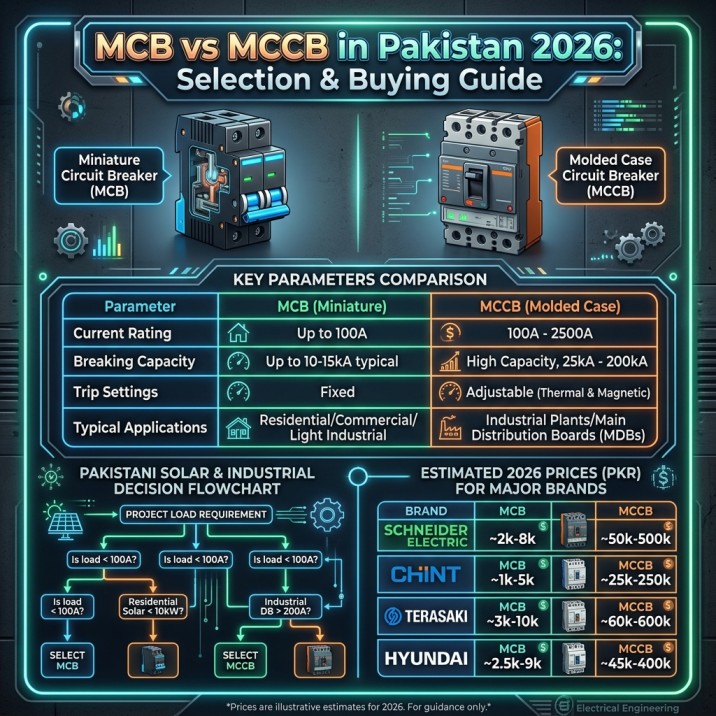
When it comes to electrical safety, choosing the right circuit breaker is just as important as selecting the right cable, inverter, distribution board, or electrical appliance. Two of the most commonly used protection devices are MCB and MCCB.
Although both devices are designed to protect electrical circuits from problems such as overload and short circuits, they are not interchangeable in every situation. Their current ratings, physical size, breaking capacity, trip settings, applications, and installation requirements can be quite different.
For homeowners, electricians, solar installers, businesses, and industrial users in Pakistan, understanding the difference between MCB vs MCCB can help avoid incorrect installations and unnecessary expenses.
In this complete guide, we will explain what an MCB is, what an MCCB is, their major differences, ratings, applications, breaking capacity, trip characteristics, use in solar systems, and how to choose the right breaker for your application in Pakistan in 2026.
What Is an MCB?
MCB stands for Miniature Circuit Breaker.
An MCB is a compact automatic circuit protection device commonly installed in residential buildings, offices, shops, and smaller electrical installations.
Its primary purpose is to automatically disconnect a circuit when the current becomes excessive because of an overload or short circuit.
Instead of replacing a fuse every time a fault occurs, an MCB can normally be reset after the fault has been identified and corrected.
Modern MCBs commonly use thermal and magnetic tripping mechanisms. The thermal mechanism responds to sustained overloads, while the magnetic mechanism responds rapidly to significant short-circuit currents.
MCBs are available in different current ratings, pole configurations, voltage ratings, breaking capacities, and trip curves. For example, ABB lists MCB products with rated currents up to 100 A and breaking capacities reaching 25 kA in some product ranges.
Common MCB applications
MCBs are commonly used for:
- Home lighting circuits
- Fans
- General socket circuits
- Small air-conditioning circuits
- Kitchen appliances
- Small pumps
- Office circuits
- Small commercial installations
- Individual solar AC circuits where the selected breaker is suitable
The exact MCB should always be selected according to the circuit’s current, cable capacity, voltage, fault level, and manufacturer’s specifications.
What Is an MCCB?
MCCB stands for Molded Case Circuit Breaker.
An MCCB is a larger and generally more capable circuit breaker designed for higher-current and more demanding electrical applications.
Like an MCB, an MCCB can provide protection against overloads and short circuits. However, MCCBs can offer substantially higher current ratings, higher interrupting capacities, and more sophisticated protection options depending on the model.
Schneider Electric describes MCCBs as protection devices for heavy-current circuits and lists applications including motors, generators, welding machines, capacitor banks, and electrical feeders.
Some MCCB product families also support adjustable trip settings and electronic trip units, allowing engineers to configure protection more precisely for larger electrical systems.
Common MCCB applications
MCCBs are often used for:
- Main electrical feeders
- Large commercial buildings
- Industrial machinery
- Large motors
- Generators
- Distribution panels
- High-current AC systems
- Large solar installations
- Commercial battery systems
- Industrial electrical distribution
MCB vs MCCB – Quick Difference
The simplest way to understand the difference is:
MCB = smaller, simpler circuit protection
MCCB = higher-current, higher-capacity and more configurable circuit protection
However, current rating alone should never be the only selection criterion.
A breaker must also be suitable for the system voltage, fault current, cable size, load characteristics, number of poles, installation conditions, and required coordination with other protective devices.
MCB vs MCCB Comparison Table
| Feature | MCB | MCCB |
|---|---|---|
| Full Form | Miniature Circuit Breaker | Molded Case Circuit Breaker |
| Typical Application | Homes and smaller circuits | Commercial & industrial systems |
| Physical Size | Smaller | Larger |
| Current Capacity | Generally lower | Generally much higher |
| Breaking Capacity | Lower to high depending on model | Often significantly higher |
| Trip Settings | Usually fixed | Often adjustable depending on model |
| Installation | Usually DIN-rail mounted | Panel-mounted or other mounting systems |
| Pole Options | 1P, 1P+N, 2P, 3P, 3P+N, 4P depending on range | 2P, 3P, 4P and other configurations depending on model |
| Cost | Usually lower | Usually higher |
| Heavy Loads | Limited by rating/model | Better suited |
| Industrial Feeders | Limited applications | Commonly used |
| Motors/Generators | Small applications | Common |
| Maintenance/Configuration | Relatively simple | More configuration options |
The table is a general comparison. Actual specifications vary considerably between manufacturers and product families. Schneider Electric, for example, offers MCCBs ranging into thousands of amperes, while its MCB product families cover much smaller circuit applications.
What Is the Main Difference Between MCB and MCCB?
There are several important differences.
1. Current Rating
One of the most obvious differences is current capacity.
MCBs are generally intended for lower-current circuits. Many common residential MCBs are found in ratings such as 6A, 10A, 16A, 20A, 25A, 32A, 40A, 50A and 63A, although product ranges can extend higher.
MCCBs are available for much higher currents. Depending on the manufacturer and model, MCCBs can range from relatively modest ratings to hundreds or even thousands of amperes.
Schneider Electric currently lists MCCB solutions up to 3200 A in some product families.
This does not mean that an MCCB should automatically be used whenever the load is large. The breaker must be correctly coordinated with the cable and system design.
2. Breaking Capacity
Breaking capacity is one of the most important specifications when choosing a circuit breaker.
It refers to the maximum fault current that the breaker is designed to safely interrupt under specified conditions.
For example, you may see an MCB marked:
6 kA
This means its specified short-circuit breaking capability is 6 kiloamperes under the relevant test conditions.
Some MCB product ranges offer much higher values. ABB, for example, lists certain high-performance MCBs with breaking capacities up to 50 kA.
MCCBs can offer substantially higher interrupting capacities, making them suitable for installations where prospective short-circuit current is significantly higher.
Schneider Electric’s MCCB ranges include models with very high breaking capacities depending on the product and voltage.
Why does breaking capacity matter?
Imagine a commercial electrical installation where a fault could produce a very high short-circuit current.
If the installed breaker has insufficient breaking capacity, it may not be suitable for safely interrupting that fault.
Therefore:
Higher load current does not automatically mean “buy a bigger breaker.”
You must also consider the prospective short-circuit current and the breaker’s rated breaking capacity.
3. Trip Settings
Another major difference is how the protection settings can be configured.
Most standard MCBs have predetermined trip characteristics. Common trip curves include:
- Type B
- Type C
- Type D
The appropriate curve depends on the application and expected inrush current.
Schneider Electric’s MCB selection guidance specifically asks users to consider the number of poles, curve code, ampere rating, breaking capacity and operating voltage when selecting an MCB.
MCCBs, on the other hand, may provide adjustable thermal and magnetic trip settings. More advanced MCCBs can use electronic trip units.
This flexibility is particularly useful in larger electrical distribution systems where protection coordination is important.
4. Physical Size
An MCB is compact and normally fits easily inside a residential distribution board.
An MCCB is generally much larger because it is designed to handle higher currents and provide more substantial protection.
This is one reason why you will commonly see MCBs inside home DB boxes while larger MCCBs are installed in main distribution panels, commercial buildings, factories, generators and larger energy systems.
5. Price
In general:
MCB = cheaper
MCCB = more expensive
However, the price difference depends heavily on:
- Brand
- Current rating
- Number of poles
- Breaking capacity
- Trip unit
- Voltage rating
- Accessories
- Electronic protection features
- Product series
A basic MCB can be relatively inexpensive, while a sophisticated MCCB with electronic protection and accessories can cost considerably more.
Therefore, choosing an MCCB when an MCB is completely adequate can unnecessarily increase project costs.
At the same time, using a cheap MCB where an MCCB is required can create a serious safety problem.
MCB vs MCCB for Home Use
For a normal Pakistani house, MCBs are generally the more common choice for individual circuits.
For example, a home distribution board may contain separate breakers for:
- Lights
- Fans
- General sockets
- Kitchen
- Air conditioner
- Water pump
- Washing machine
- Outdoor circuits
The exact rating depends on the circuit design and cable size.
Example
Suppose a house has a dedicated circuit for a particular appliance.
An electrician may select a suitable MCB based on:
- Expected operating current
- Cable size
- Starting/inrush current
- Circuit voltage
- Short-circuit level
- Required trip curve
- Local electrical installation requirements
The breaker should not simply be selected because someone says:
“Use a 32A breaker; it will handle more load.”
A larger breaker can actually be dangerous if the cable is not designed to carry that current.
Why You Should Not Oversize an MCB
This is a common mistake.
Suppose a cable is designed for a particular current under the installation conditions.
If you install a much higher-rated breaker, the breaker may allow excessive current to flow for longer than the cable can safely handle.
The result can be:
- Excessive heating
- Cable insulation damage
- Fire risk
- Equipment damage
The purpose of a circuit breaker is not simply to keep the electricity running.
Its job is to protect the circuit.
Therefore:
Breaker rating + cable capacity + load requirements must be considered together.
When Should You Use an MCCB?
An MCCB becomes more relevant when you have a higher-current or more complex installation.
Examples include:
Commercial buildings
A commercial building may have multiple high-power loads, larger feeders and greater fault levels.
Industrial equipment
Factories often operate:
- Motors
- Compressors
- Pumps
- Welding machines
- Large machinery
MCCBs are commonly used in such systems. Schneider Electric specifically lists motors, welding machines, capacitor banks, generators and feeders among MCCB applications.
Generators
Large generators can require higher-capacity protective devices.
Large solar installations
Large commercial solar systems can also use MCCBs at suitable points in the AC distribution system.
MCB vs MCCB in Solar Systems
This is particularly important for solar installers.
A solar installation can contain both DC and AC protection, and the correct protective device depends on the part of the system.
For example:
Solar panels → DC protection → inverter → AC protection → distribution board → loads
The specific protection design depends on the inverter, PV array configuration, voltage, current, fault characteristics and applicable standards.
Where can MCBs be used?
Suitable MCB products may be used in certain AC or DC applications when the specific breaker is rated for the circuit.
Not every ordinary AC MCB should automatically be installed on a solar PV DC circuit.
DC circuits can require breakers specifically designed and rated for DC because interrupting DC current has different arc-extinguishing requirements.
ABB, for example, offers MCB ranges specifically designed for DC applications with defined voltage and breaking-capacity specifications.
Where can MCCBs be used?
MCCBs may be suitable for larger solar installations, particularly where the AC output or feeder current is high.
For example:
- Commercial solar systems
- Industrial solar plants
- Large hybrid systems
- Generator/solar integration
- Large battery systems
Again, the exact breaker should be selected from the equipment manufacturer’s specifications and the electrical design.
MCB vs MCCB for AC and DC
This is an area where buyers need to be careful.
A breaker is not automatically suitable for both AC and DC simply because the current and voltage numbers appear similar.
The manufacturer must specify the breaker for the intended application.
AC circuit
Alternating current naturally crosses zero during each cycle, which helps interrupt an electrical arc.
DC circuit
Direct current does not naturally pass through zero in the same way.
Consequently, interrupting DC can require specific breaker construction and arc-extinguishing arrangements.
This is why a breaker marked for a specific DC voltage should be used for a DC application.
For solar installations, always verify the DC voltage rating, current rating and breaking capacity of the selected protection device.
What Do B, C and D Curves Mean on an MCB?
You may have seen markings such as:
B16
C16
D16
The number generally represents the rated current, while the letter identifies the trip characteristic.
Type B
Type B breakers generally trip magnetically at a lower multiple of rated current and are commonly associated with circuits having relatively low inrush current.
Type C
Type C breakers tolerate a higher short-duration inrush and are commonly used for many general commercial and residential applications.
Type D
Type D breakers tolerate higher inrush currents and can be suitable for certain loads such as motors and transformers when the application is properly designed.
However, the trip curve should not be selected randomly.
A motor application does not automatically mean “always use Type D.”
The actual starting current, cable, fault level and coordination should be evaluated.
What Is Icu and Ics in an MCCB?
When researching MCCBs, you may encounter terms such as:
- Icu
- Ics
These are important short-circuit performance specifications.
Icu – Ultimate Short-Circuit Breaking Capacity
Icu indicates the maximum short-circuit breaking capacity under the manufacturer’s specified test conditions.
Ics – Service Short-Circuit Breaking Capacity
Ics represents the service-level short-circuit breaking capability under the specified standard and test conditions.
Schneider Electric explains Icu and Ics as key MCCB specifications alongside rated current, frame current, working voltage and insulation voltage.
For larger commercial or industrial systems, these specifications should be evaluated by a qualified electrical professional rather than chosen simply from a product advertisement.
How to Choose the Right MCB
Before purchasing an MCB, consider these factors:
1. Load current
Determine the expected operating current.
2. Cable size
The breaker must coordinate with the cable’s current-carrying capacity.
3. Voltage
Check the operating voltage.
4. Number of poles
Depending on the system, you may need:
- 1P
- 1P+N
- 2P
- 3P
- 3P+N
- 4P
Available configurations vary by product range. ABB, for example, lists multiple pole configurations in its MCB range.
5. Breaking capacity
Check the prospective fault current and select an adequate breaking capacity.
6. Trip curve
Select the appropriate B, C, D or other characteristic according to the load.
7. Brand and certification
Avoid unknown products where safety-critical performance cannot be verified.
How to Choose the Right MCCB
For an MCCB, you should evaluate:
- Rated current
- Frame size
- Number of poles
- Rated operational voltage
- Breaking capacity
- Icu
- Ics
- Trip unit
- Thermal protection
- Magnetic protection
- Electronic protection where required
- Adjustable settings
- Accessories
- Installation environment
- Coordination with upstream/downstream breakers
Schneider Electric’s MCCB documentation identifies rated current, frame current, working voltage, insulation voltage, impulse withstand voltage, Icu and Ics among important specifications.
MCB or MCCB – Which One Is Better?
There is no universal winner.
It depends on the application.
Choose an MCB when:
- The circuit is relatively small.
- You are protecting individual household circuits.
- Space is limited.
- Fixed protection characteristics are acceptable.
- The required current and breaking capacity fall within the MCB’s specifications.
Consider an MCCB when:
- Current requirements are significantly higher.
- You are protecting a major feeder.
- The system has a higher fault level.
- Adjustable protection is needed.
- You are dealing with large motors, generators or industrial equipment.
- A commercial or industrial distribution system requires more advanced protection.
The correct question is not:
“Is MCB better than MCCB?”
The better question is:
“Which breaker is correctly rated for my circuit?”
Common MCB and MCCB Buying Mistakes in Pakistan
Mistake 1: Choosing only by ampere rating
A 63A breaker is not automatically better than a 32A breaker.
The rating must match the circuit design.
Mistake 2: Ignoring breaking capacity
A breaker with insufficient breaking capacity may be unsuitable for the installation’s prospective short-circuit current.
Mistake 3: Using an AC breaker on a DC circuit
This is particularly dangerous in solar installations.
Always check the manufacturer’s DC rating.
Mistake 4: Installing an oversized breaker
A larger breaker does not necessarily mean better protection.
It can reduce the protection provided to the cable.
Mistake 5: Buying only because the product is cheap
Circuit protection is not an area where the cheapest product should automatically win.
Mistake 6: Ignoring cable size
The breaker and cable should be coordinated.
Mistake 7: Choosing the trip curve randomly
B, C and D curves have different characteristics.
Mistake 8: Installing without considering fault level
The available short-circuit current matters when selecting breaking capacity.
How Much Does an MCB or MCCB Cost in Pakistan?
There is no single fixed price for MCBs and MCCBs in Pakistan.
Prices can vary according to:
- Brand
- Ampere rating
- Pole configuration
- Breaking capacity
- AC/DC rating
- Product series
- Trip unit
- Availability
- Local distributor
- Imported vs locally available products
A basic residential MCB can cost considerably less than a high-current MCCB.
An advanced MCCB with an electronic trip unit, accessories and high breaking capacity can be substantially more expensive.
For this reason, instead of relying on one online price, buyers should compare the complete specification of the breaker.
A cheap breaker with the wrong rating is not a bargain.
Practical Example: Choosing Protection for a Home
Suppose a Pakistani house has:
- Lighting circuits
- Fan circuits
- Socket circuits
- Kitchen appliances
- Air conditioners
- Water pump
Instead of installing one huge breaker for everything, the electrical system can be divided into appropriate circuits.
Individual circuits can have correctly selected MCBs, while the main distribution arrangement may require a different protective device depending on the total load and system design.
This approach makes troubleshooting easier and can improve protection and circuit organization.
The actual ratings should be calculated by a qualified electrician based on the installation.
Practical Example: Commercial Building
Now consider a commercial building with:
- Multiple air conditioners
- Pumps
- Elevators
- Motors
- Large lighting loads
- Multiple distribution boards
The electrical system may require larger feeders and higher fault protection.
In such a situation, MCCBs may be appropriate for major feeders, while MCBs can still be used for smaller downstream circuits.
This creates a coordinated protection system rather than using the same breaker everywhere.
MCB vs MCCB for a Solar Installer
If you are installing solar systems, do not treat MCB and MCCB as interchangeable accessories.
The protection system should be designed around:
PV array → DC protection → inverter → AC protection → main distribution → loads
Depending on system size, inverter output and installation architecture, different protective devices may be required.
For a small residential system, compact protective devices may be sufficient at appropriate locations.
For a larger commercial system, MCCBs may be required for high-current feeders.
Always check the inverter manufacturer’s installation manual and the breaker manufacturer’s ratings before installation.
MCB vs MCCB: Pros and Cons
MCB Advantages
- Compact
- Generally affordable
- Easy to install
- Convenient for household circuits
- Resettable
- Available in different trip curves
- Suitable for many low-current applications
MCB Disadvantages
- Lower current capability than many MCCBs
- Limited adjustability on standard models
- Lower breaking capacity on many common models
- Not suitable for every high-current application
MCCB Advantages
- Higher current ratings
- Higher breaking capacity options
- Suitable for large feeders
- Adjustable protection on many models
- Suitable for industrial applications
- Can support advanced trip units
- Useful for generators, motors and large distribution systems
MCCB Disadvantages
- Larger physical size
- More expensive
- More complicated selection
- Installation may require professional electrical design
- Advanced models can require configuration and maintenance
Frequently Asked Questions
Is MCCB better than MCB?
Not necessarily. MCBs are generally appropriate for smaller circuits, while MCCBs are designed for higher-current and more demanding applications. The correct breaker depends on the electrical system.
Can I use an MCCB in a house?
Yes, an MCCB can be used in a residential installation where the electrical design requires it, such as for a main feeder or a particular high-current application. However, an MCCB is not automatically necessary for a normal household circuit.
Can I replace an MCB with an MCCB?
Not simply as a direct upgrade. The replacement must match the system design, cable, voltage, current, breaking capacity, mounting arrangement and protection requirements.
Which is cheaper, MCB or MCCB?
Generally, MCBs are cheaper. MCCB prices increase with current rating, breaking capacity, trip unit and accessories.
Which has higher breaking capacity?
MCCBs generally offer higher breaking-capacity options, although the exact value depends on the model. Some high-performance MCBs can also have very high breaking capacities.
Can an MCB be used for solar?
Yes, but only when the particular MCB is correctly rated for the circuit. For DC solar circuits, the breaker must specifically be suitable for the DC voltage and current involved.
What does C16 mean on an MCB?
Usually, “C” refers to the trip characteristic and “16” indicates a 16A rated current. Always confirm the exact marking and specifications from the manufacturer’s documentation.
Is a 32A MCB suitable for every 32A load?
No. The breaker must be selected according to the load, cable capacity, voltage, fault level and application.
Why does my MCB keep tripping?
Possible causes include:
- Overloading
- Short circuit
- Faulty appliance
- Incorrect breaker selection
- Wiring problems
- Excessive starting current
- Damaged cable
Repeated tripping should not simply be solved by installing a higher-rated breaker. The underlying fault should be investigated.
Which breaker is better for a large solar system?
A large solar system may require MCCBs at certain points, but the correct selection depends on inverter output, AC/DC configuration, voltage, current, fault level and manufacturer requirements.
Final Verdict: MCB vs MCCB in Pakistan 2026
The difference between MCB and MCCB is much more than physical size.
An MCB is generally a compact solution for lower-current circuits and is widely suitable for residential and smaller commercial applications.
An MCCB is designed for more demanding applications where higher current ratings, higher breaking capacities, adjustable protection or advanced trip functions may be required.
For a typical Pakistani home, properly selected MCBs are usually sufficient for individual circuits. For large commercial buildings, industrial equipment, generators, high-current feeders and larger energy installations, MCCBs can provide the additional capacity and configuration options required.
The most important lesson is this:
Never select a circuit breaker only by its ampere rating.
Before installing an MCB or MCCB, consider the load current, cable size, voltage, number of poles, trip characteristic, breaking capacity, fault level and application.
If you are working on a solar, commercial or industrial installation, also make sure the breaker is specifically rated for the type of current involved, particularly when dealing with DC circuits.
A correctly selected circuit breaker is not an unnecessary expense. It is an essential part of protecting your wiring, appliances, inverter, equipment, property and people.
For safety-critical electrical work, breaker selection and installation should be carried out or verified by a qualified electrician or electrical engineer.