
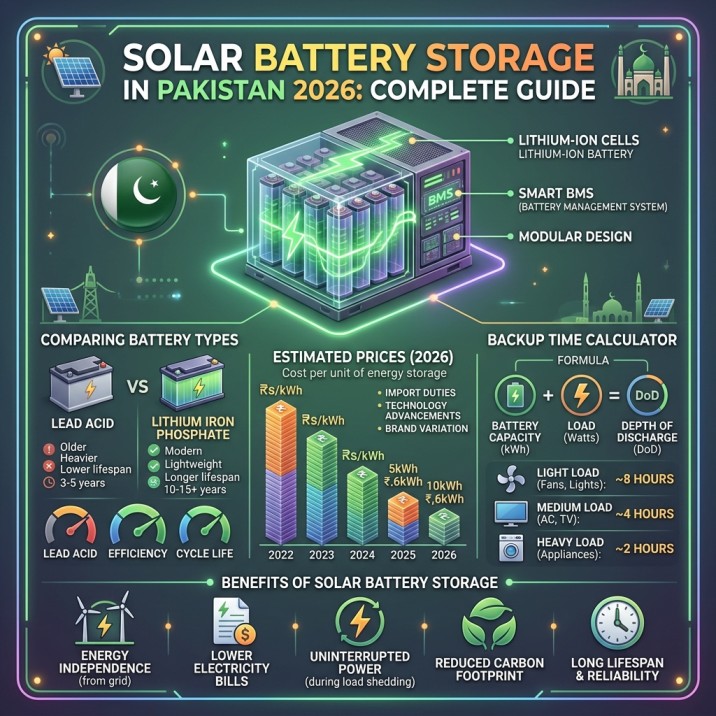
Solar battery storage in Pakistan is becoming one of the most important parts of a modern solar energy system in 2026. In the past, most homeowners focused mainly on solar panels and inverters. Today, the conversation has changed. People are increasingly asking how they can store extra solar electricity during the day and use it at night, during power outages, or when electricity from the grid becomes expensive.
This is where a solar battery comes in.
A solar battery allows a solar system to store electricity instead of using all of the generated power immediately. During sunny hours, solar panels can produce more electricity than a home needs. Instead of wasting that surplus or exporting it, a battery can store a portion of it for later use.
This can be particularly useful for homes, offices, shops, farms and small businesses that consume significant electricity after sunset.
Pakistan’s rapidly expanding solar market is also creating a stronger demand for energy storage. Recent market analysis has highlighted a substantial increase in lithium-ion battery imports, reflecting the country’s growing interest in battery-backed solar systems.
In this guide, we will explain what solar battery storage is, why it matters, who needs it, how it works, lithium vs lead-acid batteries, battery capacity, backup calculations, expected costs, important buying factors, common mistakes, and the latest solar battery trends in Pakistan in 2026.
What Is Solar Battery Storage?
Solar battery storage is a system that stores electrical energy generated by solar panels so that the energy can be used later.
A typical solar battery setup works like this:
Solar Panels → Hybrid Inverter → Battery → Home Appliances
During the day, solar panels generate electricity. The inverter supplies electricity to the appliances operating in the house. If there is additional solar energy available, the system can use it to charge the battery.
When solar production decreases in the evening, the stored energy can be supplied from the battery to the home.
For example, imagine a house where solar panels generate 6 kW during the afternoon while the household is using only 2 kW.
The remaining available solar power can potentially be used to charge the battery, depending on the inverter configuration and system conditions.
Later, after sunset, the battery can provide electricity for selected appliances.
This makes battery storage particularly useful for people who want to increase solar self-consumption.
Why Are Solar Batteries Becoming Popular in Pakistan?
There isn’t just one reason behind the growing interest in solar batteries. Several factors are contributing to this trend.
1. Solar Power Is Generated Mainly During the Day
Solar panels cannot produce meaningful electricity after sunset.
This creates a simple problem.
Many households generate the most solar electricity around midday, while their electricity consumption may increase in the evening.
For example:
Daytime:
- Solar production: High
- Household consumption: Moderate
Evening:
- Solar production: Very low or zero
- Household consumption: High
A battery helps connect these two periods.
Instead of using solar energy only when the sun is shining, homeowners can store part of their daytime generation and use it later.
2. Increasing Interest in Energy Independence
Many Pakistani consumers want greater control over their electricity supply.
A solar system with battery storage can reduce dependence on the grid for certain loads.
This does not necessarily mean a home will become completely independent from the grid. Rather, the battery can reduce the amount of electricity purchased from the grid and provide backup when the grid is unavailable.
For many households, this combination is more practical than relying exclusively on either solar or the grid.
3. Electricity Bills Remain a Major Concern
Electricity costs are one of the biggest reasons people invest in solar energy.
Installing panels can significantly reduce daytime grid consumption, but without storage, a household may still need grid electricity after sunset.
A battery can allow some of the solar energy generated during the day to be used during evening hours.
The actual financial savings depend on:
- Solar system size
- Battery size
- Household consumption
- Electricity tariff
- Solar generation
- Inverter efficiency
- Battery efficiency
- Grid availability
- System installation cost
Therefore, consumers should calculate their actual energy profile before purchasing a battery.
Latest Solar Battery Trends in Pakistan 2026
The Pakistani solar industry is moving beyond traditional panel-only systems.
The market is increasingly shifting toward:
Solar + Hybrid Inverter + Battery Storage
Recent industry reporting has shown strong growth in lithium-ion battery imports into Pakistan, indicating rapidly increasing interest in energy storage.
According to Renewables First, lithium-ion battery energy-storage imports increased sharply in 2025, reaching around 4.6 GWh.
Business Recorder has also reported substantial growth in Pakistan’s lithium battery imports, showing that battery storage is becoming an increasingly important part of the country’s energy landscape.
This trend is important because Pakistan already has a large and rapidly expanding distributed solar market.
As more solar systems are installed, consumers naturally begin looking for ways to use more of their own solar electricity.
That creates a strong case for energy storage.
What Is a Lithium Solar Battery?
A lithium solar battery is a rechargeable battery designed to store electrical energy using lithium-based battery chemistry.
One of the most common technologies used in modern solar storage is:
Lithium Iron Phosphate (LiFePO4 or LFP).
LFP batteries have become popular for solar applications because they can offer:
- Long cycle life
- Good safety characteristics
- High usable capacity
- Low maintenance
- Compact design
- Efficient charging and discharging
- Good suitability for frequent cycling
However, battery quality still matters.
Two batteries may both be advertised as “lithium batteries” while offering very different performance, warranty conditions, cell quality, battery management systems and expected lifespans.
Therefore, buyers should never choose a battery based only on its advertised capacity.
Lithium Battery vs Lead-Acid Battery
One of the most common questions among solar buyers is:
Which is better: lithium or lead-acid?
The answer depends on your budget and requirements.
| Feature | Lithium Battery | Lead-Acid Battery |
|---|---|---|
| Initial Cost | Higher | Lower |
| Lifespan | Generally longer | Generally shorter |
| Cycle Life | Higher | Lower |
| Maintenance | Low | Higher in many types |
| Weight | Lighter | Heavier |
| Size | More compact | Larger |
| Usable Capacity | Generally higher | Usually lower |
| Charging | Faster/more efficient | Comparatively slower |
| Frequent Cycling | Excellent | Less ideal |
| Long-Term Value | Often better | Budget-friendly |
Which One Should You Choose?
If your priority is low initial cost, lead-acid batteries can still be considered.
But if you plan to use the battery regularly for years and want better usable capacity and cycle performance, an LFP lithium battery can be a more suitable choice.
The best decision should be based on the total cost of ownership rather than simply the purchase price.
How Does a Solar Battery System Work?
The process is relatively simple.
Step 1: Solar Panels Generate Electricity
Solar panels convert sunlight into DC electricity.
Step 2: The Inverter Converts and Manages the Power
A hybrid inverter manages electricity coming from:
- Solar panels
- Battery
- Grid
- Household loads
Step 3: Your Appliances Use Solar Electricity
The available solar power is first used according to the system’s configured priorities.
Step 4: Extra Energy Charges the Battery
If solar generation exceeds current consumption and the system is configured for battery charging, excess energy can be directed toward the battery.
Step 5: Battery Supplies Power Later
When solar production drops, stored battery energy can be used to operate selected household loads.
This entire process is managed automatically by the inverter and battery management system.
How Much Backup Can a 5kWh Solar Battery Provide?
This is one of the most searched questions about solar batteries.
The simple formula is:
Backup Time = Usable Battery Energy ÷ Load
Suppose you have a 5 kWh battery and your average load is 1 kW.
Theoretical calculation:
5 kWh ÷ 1 kW = 5 hours
However, real-world backup will usually be different because of inverter losses, battery discharge limits, appliance variations and other system factors.
Example
Suppose your essential load is approximately:
- 4 fans = 280W
- 6 LED bulbs = 60W
- Wi-Fi router = 15W
- LED TV = 100W
- Refrigerator average consumption = 150W
Total approximate load:
605W
At approximately 605W average consumption, a 5kWh battery could theoretically provide several hours of backup, but the actual result depends on the battery’s usable capacity and the complete system efficiency.
This is why simply saying “5kWh battery gives X hours” can be misleading.
What Does kWh Mean in a Solar Battery?
Consumers often confuse kW and kWh.
They are not the same thing.
kW = Power
kW tells you how much power a device or system can deliver at a particular moment.
kWh = Energy
kWh tells you how much energy can be stored or consumed over time.
For example, a battery advertised as 5kWh describes its energy storage capacity.
A battery’s ability to handle a particular load also depends on its power rating.
This is why you should consider both:
Battery Energy Capacity + Battery Power Capability
when designing a solar storage system.
How Big a Solar Battery Do You Need?
There is no universal battery size that works for every home.
The correct battery depends on your electricity usage pattern.
Small Household
A smaller battery may be suitable if you only want backup for:
- Lights
- Fans
- Wi-Fi
- TV
- Small refrigerator load
Medium Household
A larger battery may be needed for:
- Fans
- Lights
- Refrigerator
- TV
- Computers
- Washing machine at selected times
- Other essential appliances
Large Household
A larger storage system may be considered if the goal is to operate multiple heavy loads during evening hours.
However, running air conditioners, electric heaters, water pumps and other high-power appliances from batteries can significantly increase the required battery capacity.
Can a Solar Battery Run an Air Conditioner?
Yes, but the system must be designed correctly.
Air conditioners can consume substantial power, especially during startup and depending on their efficiency.
If you want battery backup for an AC, you need to consider:
- AC capacity
- Inverter rating
- AC efficiency
- Starting/current requirements
- Battery power output
- Battery capacity
- Other household loads
A small battery that works perfectly for lights and fans may not be suitable for running an air conditioner for several hours.
For heavy loads, professional system sizing is strongly recommended.
Benefits of Solar Battery Storage
1. Night-Time Solar Usage
One of the biggest advantages is using stored solar energy after sunset.
2. Backup During Power Outages
A properly configured hybrid solar system can keep selected appliances running during outages.
3. Better Solar Self-Consumption
Instead of depending heavily on the grid after sunset, you can use stored solar energy.
4. Reduced Grid Dependence
Battery storage can reduce reliance on grid electricity for selected loads.
5. Automatic Operation
Modern hybrid inverters can automatically manage charging, discharging and power sources.
6. Low Maintenance
Modern lithium batteries generally require considerably less routine maintenance than many traditional battery technologies.
7. Long-Term Energy Storage
A good-quality battery can provide many years of service when properly installed and operated.
Disadvantages of Solar Batteries
Battery storage also has disadvantages.
Higher Initial Investment
A complete solar battery system can be significantly more expensive than a panel-only system.
Battery Degradation
All rechargeable batteries gradually lose capacity over time.
Limited Capacity
A battery cannot provide unlimited electricity.
Installation Requirements
The battery needs suitable ventilation, protection and installation conditions.
Replacement Cost
Eventually, batteries may need replacement depending on technology, usage and condition.
Therefore, battery storage should be purchased according to actual requirements rather than simply because it is trending.
Solar Battery Price in Pakistan 2026
The solar battery price in Pakistan in 2026 varies considerably.
There is no single fixed market price because batteries differ in:
- Capacity
- Brand
- Chemistry
- Cell quality
- Warranty
- Cycle rating
- Communication protocol
- BMS
- Inverter compatibility
- Installation requirements
Lithium batteries are generally more expensive initially than conventional lead-acid batteries.
For an accurate purchase decision, compare the cost per usable kWh, warranty and expected cycle life instead of looking only at the upfront price.
A cheaper battery is not necessarily cheaper over its lifetime.
Important Factors Before Buying a Lithium Solar Battery
Before buying a battery, check these factors carefully.
1. Battery Capacity
Look at the kWh rating.
Ask yourself:
How much electricity do I actually need during the evening or an outage?
2. Usable Capacity
The advertised capacity and usable energy may not be exactly the same.
Always check the manufacturer’s specifications.
3. Cycle Life
Cycle life indicates how many charge/discharge cycles the battery is designed to handle under specified conditions.
4. Warranty
Check:
- Warranty years
- Cycle limitations
- Capacity retention terms
- Conditions that may void warranty
5. Battery Management System
A quality BMS is extremely important.
It helps monitor and protect the battery from abnormal operating conditions.
6. Inverter Compatibility
Not every battery works with every inverter.
Always verify compatibility before purchase.
7. Communication
Some batteries communicate with compatible inverters through protocols such as CAN or RS485.
This allows the inverter and battery to exchange information about:
- State of charge
- Voltage
- Current
- Temperature
- Battery limits
8. Brand Reputation
Do not purchase a battery only because its price is attractive.
Consider manufacturer reputation, warranty support and availability of technical assistance.
Common Mistakes People Make When Buying Solar Batteries
Mistake 1: Choosing Only by Price
The cheapest battery may not provide the best long-term value.
Mistake 2: Ignoring Inverter Compatibility
A battery should be compatible with the inverter and system architecture.
Mistake 3: Buying Too Small a Battery
If your evening consumption is high, an undersized battery will provide disappointing backup.
Mistake 4: Buying Too Large a Battery
Oversizing the battery can unnecessarily increase the system cost.
Mistake 5: Ignoring Warranty
Always understand the warranty conditions before purchasing.
Mistake 6: Not Calculating the Load
Battery sizing should start with your actual electricity consumption.
Mistake 7: Expecting the Battery to Run Everything
A battery backup system is not automatically capable of running every appliance in your home.
Who Should Consider Installing a Solar Battery?
Solar batteries can be particularly useful for:
Homeowners
Especially those who use substantial electricity after sunset.
Homes With Frequent Power Outages
Battery storage can provide backup for essential appliances.
Offices
Businesses can use batteries to maintain important equipment during outages.
Shops
Retail businesses can keep lights, computers, internet equipment and other essential systems operating.
Small Businesses
Battery storage can help maintain continuity during grid interruptions.
Solar Users With High Evening Consumption
If most of your electricity consumption occurs after sunset, battery storage may be worth considering.
Who May Not Need a Solar Battery?
A battery may not be necessary for everyone.
If your solar system already matches your daytime consumption well and you have reliable grid electricity at night, adding a battery may not provide enough financial benefit to justify the additional cost.
Similarly, if your primary objective is simply to reduce daytime electricity consumption, solar panels alone may be sufficient depending on your circumstances.
The right approach is to calculate your electricity profile first.
Solar Battery Maintenance Tips
Lithium batteries generally require limited maintenance, but that does not mean they should be ignored.
Follow these basic practices:
- Keep the battery installation area clean.
- Avoid excessive heat.
- Follow the manufacturer’s temperature requirements.
- Use the recommended inverter settings.
- Do not modify battery wiring without professional guidance.
- Monitor battery status through the inverter or battery monitoring system.
- Use appropriate electrical protection.
- Have the installation checked by a qualified professional.
Proper installation can have a major impact on system performance and safety.
Is Solar Battery Storage Worth It in Pakistan in 2026?
For many consumers, yes — but it depends on their electricity usage and objectives.
Battery storage becomes particularly attractive when you:
- Have high evening consumption
- Want backup power
- Want greater solar self-consumption
- Experience frequent outages
- Want to reduce grid dependence
- Have a suitable hybrid inverter
However, battery economics should always be calculated before making a purchase.
The most important question isn’t:
“Is a battery good?”
The better question is:
“Does a battery make financial and practical sense for my specific electricity usage?”
Solar Battery vs UPS – What’s the Difference?
A traditional UPS is primarily designed to provide backup power when the grid fails.
A modern solar battery system can do much more.
It can potentially:
- Store solar electricity
- Provide backup
- Work with a hybrid inverter
- Increase solar self-consumption
- Manage charging from solar
- Coordinate with grid electricity
In other words, a solar battery can become part of an overall energy management system, rather than simply being an emergency backup device.
How to Choose the Right Battery for Your Solar System
Use this simple process.
Step 1: Calculate Your Essential Load
List the appliances you want to operate during an outage or after sunset.
Step 2: Calculate Your Required Backup Time
For example:
If your essential load is 1kW and you want approximately 5 hours of backup:
1kW × 5 hours = 5kWh
You would then need to account for usable capacity and system losses.
Step 3: Check Your Inverter
Make sure your hybrid inverter can support the battery.
Step 4: Compare Battery Specifications
Check:
- Capacity
- Voltage
- Maximum charge current
- Maximum discharge current
- Cycle life
- Warranty
- Communication
- BMS
Step 5: Compare Total Cost
Don’t compare only purchase prices.
Consider expected lifespan, warranty and usable energy.
Step 6: Get Professional Installation
Battery systems involve high electrical energy. Proper installation and protection are essential.
Future of Solar Battery Storage in Pakistan
The future of solar storage in Pakistan looks increasingly important.
The country already has strong solar potential, while consumers are becoming more interested in energy independence and self-consumption.
As battery technology improves and competition increases, the market could offer more choices across different price and capacity levels.
Future solar systems are likely to become increasingly integrated.
Instead of thinking about:
Solar Panels
and
Battery
as separate products, consumers will increasingly look at:
Complete Energy Systems
that combine:
- Solar panels
- Hybrid inverter
- Battery storage
- Smart energy management
- Grid connection
- Backup circuits
This approach can provide greater flexibility and control over household electricity.
Frequently Asked Questions About Solar Batteries in Pakistan
What is a solar battery?
A solar battery stores electricity generated by solar panels so that it can be used later, including during evening hours or power outages.
Which solar battery is best in Pakistan?
There is no single best battery for everyone. Lithium LFP batteries are a popular option because of their cycle life, usable capacity and low-maintenance characteristics, but the right battery depends on budget, load, inverter compatibility and usage.
Is lithium better than lead-acid?
For frequent solar cycling and long-term use, lithium is generally more advantageous. Lead-acid can still be useful where initial budget is the primary concern.
How long does a lithium solar battery last?
Battery lifespan varies according to chemistry, quality, usage, temperature, charging conditions and depth of discharge. Always check the manufacturer’s specified cycle life and warranty.
How much backup does a 5kWh battery provide?
It depends on your load. A 1kW load could theoretically consume 5kWh in five hours, but actual backup will be lower or different depending on usable capacity and system losses.
Can a solar battery run an AC?
Yes, if the battery, inverter and overall system are appropriately sized. AC units can require substantial power, so they need careful system design.
Can solar batteries be used at night?
Yes. That’s one of their primary purposes. Energy stored during the day can be used after sunset.
Do lithium batteries need maintenance?
They generally require much less routine maintenance than traditional lead-acid batteries, but correct installation, temperature management and monitoring are still important.
Can I add a battery to my existing solar system?
Sometimes, yes. It depends mainly on the type and capabilities of your existing inverter. A compatible hybrid or storage-capable system may be required.
Is a solar battery worth buying in 2026?
For households with high evening consumption, backup requirements or a desire for greater solar self-consumption, it can be a valuable investment. However, users should calculate their specific requirements before purchasing.
Final Verdict: Is Solar Battery Storage the Next Big Step for Pakistan?
Pakistan’s solar market is entering a new phase.
The first major step was the rapid adoption of solar panels. The next step is energy storage.
Solar batteries give consumers the ability to store surplus solar energy and use it when solar production is unavailable. This makes them especially useful for evening consumption, backup power and greater control over household electricity.
Lithium LFP batteries are becoming an increasingly popular option because they can offer long cycle life, good usable capacity and low maintenance when properly designed and installed.
However, buying the biggest or most expensive battery is not necessarily the right solution.
The smartest approach is to start with your actual electricity consumption.
Calculate your load → determine your required backup → choose the appropriate battery → verify inverter compatibility → compare warranty and lifecycle value → install the system properly.
For homeowners and businesses considering solar in 2026, the future is increasingly moving from solar-only systems toward complete solar-plus-storage solutions.
If you are planning a new solar installation or upgrading an existing system, understanding battery storage now can help you make a much more informed decision and get greater value from your solar investment.