
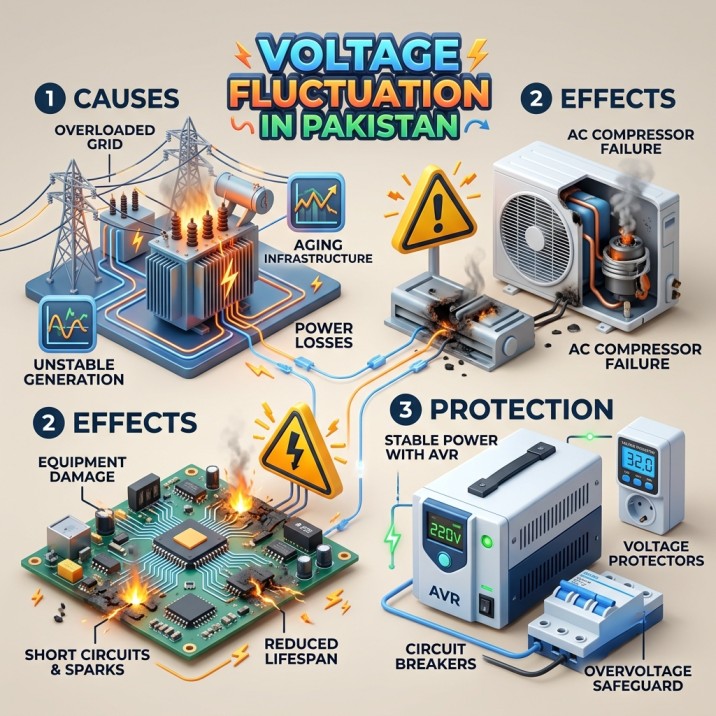
Voltage fluctuation is one of the most common electrical problems faced by homes, shops, offices and businesses in Pakistan. You may notice lights becoming unusually bright or dim, fans changing speed, air conditioners struggling to start, refrigerators making unusual sounds, or electronic devices restarting unexpectedly.
These problems are often described simply as “voltage up down” or “bijli ka voltage kam zyada hona.”
Although a small variation may not immediately damage an appliance, repeated or severe voltage fluctuations can affect sensitive electronics, motors, compressors and other electrical equipment. In serious cases, unstable voltage can contribute to overheating, malfunction or premature equipment failure.
Pakistan’s electrical system is monitored and regulated by the National Electric Power Regulatory Authority (NEPRA), and its safety and performance documents specifically address voltage variations. NEPRA’s Power Safety Code states that distribution companies should adjust transformer output to provide 220 volts ±5% to consumers, meaning the normal range referenced there is approximately 209–231 volts.
This makes voltage stability an important issue for Pakistani electricity consumers.
In this guide, we will explain:
- What voltage fluctuation is
- Why voltage goes up and down
- Common causes in Pakistan
- How to identify voltage problems
- Effects on appliances
- Low voltage vs high voltage
- Voltage fluctuation and load shedding
- Voltage fluctuation in summer
- Protection methods
- Voltage stabilizers
- Surge protectors
- MCBs and MCCBs
- Over-voltage and under-voltage protection
- UPS and inverter protection
- Solar system protection
- When to contact your electricity company
- Common mistakes
- Frequently asked questions
What Is Voltage Fluctuation?
Voltage fluctuation means the electrical supply voltage changes from its expected level.
For a typical household supply in Pakistan, the nominal voltage is commonly treated as around 220–230 volts, depending on the applicable standard and system conditions.
For example, imagine a household measuring:
- 220 V
- 214 V
- 205 V
- 228 V
- 240 V
- 250 V
The voltage is moving significantly instead of remaining close to the expected supply level.
This is what consumers commonly call voltage fluctuation.
A brief change may not cause an obvious problem. However, frequent or extreme changes can be more concerning, especially for equipment containing motors, compressors, transformers, power supplies or sensitive electronic components.
What Voltage Should You Get at Home in Pakistan?
NEPRA’s Power Safety Code states that the distribution company should adjust transformer output to provide 220 V ±5% to the consumer, and specifically says voltage should not fall below 209 V under the cited requirement.
Using the ±5% range around 220 V:
Lower limit = 220 − 11 = 209 V
Upper limit = 220 + 11 = 231 V
So, under that reference:
209 V to 231 V
is the approximate permissible range.
However, actual voltage at a consumer’s premises can vary due to network conditions, distance from the transformer, local loading, wiring condition and other factors.
If you are regularly measuring voltage substantially outside the expected range, the issue should be investigated rather than ignored.
Why Does Voltage Fluctuate in Pakistan?
There is no single cause of voltage fluctuation.
Several factors can contribute to unstable voltage.
1. Heavy Electrical Load
One of the most common reasons for low voltage is heavy demand on the local distribution network.
During hot weather, thousands of households may simultaneously use:
- Air conditioners
- Refrigerators
- Fans
- Water pumps
- Freezers
- Electric appliances
When demand becomes high, parts of the distribution system can experience voltage drops.
This is one reason voltage problems may become more noticeable during summer.
2. Overloaded Transformers
A distribution transformer supplies electricity to multiple consumers.
If too many consumers are connected to a transformer or demand becomes higher than its practical capacity, voltage quality can suffer.
You may notice:
- Low voltage during evening hours
- Fans running slowly
- AC compressors struggling
- Lights becoming dim
- Voltage improving when overall demand decreases
If the problem affects many houses in the same area, the transformer or distribution network may need inspection.
3. Long Distance from Transformer
The distance between your house and the distribution transformer can also influence voltage.
Electrical conductors have resistance.
When current flows through a conductor, some voltage is lost along the way.
This is commonly referred to as voltage drop.
Longer distribution lines can therefore experience greater voltage drop, particularly under heavy load.
This can be more noticeable in areas with:
- Long feeder lines
- High electricity demand
- Undersized conductors
- Poor distribution infrastructure
4. Loose or Poor Electrical Connections
Voltage problems do not always originate from the electricity distribution network.
Your home’s own electrical wiring can also cause problems.
Possible issues include:
- Loose terminals
- Damaged wires
- Poor connections
- Burnt sockets
- Weak joints
- Corroded terminals
- Undersized wiring
These conditions can create voltage drop, overheating and serious electrical safety risks.
NEPRA advises consumers to have internal wiring inspected regularly by a qualified/licensed electrician and to repair defective wiring promptly.
5. Unbalanced Loads
In electrical distribution systems, improper load distribution can contribute to voltage problems.
This is particularly relevant to larger buildings, shops, workshops and three-phase installations.
If loads are not properly distributed across phases, one phase may experience greater loading than another.
For residential consumers, this is something that should be assessed by a qualified electrician rather than attempting to change connections yourself.
6. Faulty Transformer Equipment
Transformers use equipment such as tap changers and voltage regulation mechanisms to maintain suitable output.
NEPRA’s Power Safety Code specifically addresses transformer output adjustment and says distribution companies should adjust transformer tap changers to provide the specified consumer voltage.
A faulty or improperly adjusted transformer can therefore contribute to voltage problems.
7. Grid and Transmission Problems
Voltage variation can also occur at higher levels of the electricity network.
NEPRA’s performance reports have documented voltage violations in the transmission system and highlighted cases where recorded voltages exceeded permitted limits.
This demonstrates that voltage-quality problems are not necessarily limited to an individual house.
The electricity network operates through multiple levels:
Generation → Transmission → Grid Station → Distribution → Transformer → Consumer
A problem at one stage can potentially affect downstream consumers.
8. Weather and Environmental Conditions
Extreme weather can also affect electrical infrastructure.
Heavy rain, storms, strong winds and other environmental conditions can contribute to:
- Line faults
- Transformer problems
- Short circuits
- Equipment damage
- Temporary supply instability
Consumers should never attempt to repair damaged electrical infrastructure themselves.
Low Voltage vs High Voltage
Voltage fluctuation can occur in both directions.
Low Voltage
Low voltage means the supply falls below the expected operating range.
For example:
220 V → 205 V → 195 V
Possible symptoms include:
- Fans running slowly
- Lights becoming dim
- AC struggling to start
- Motors overheating
- Water pumps losing performance
- Refrigerators struggling to operate normally
High Voltage
High voltage means the supply rises above the expected range.
For example:
220 V → 240 V → 250 V
High voltage can be particularly dangerous for sensitive electronics.
Possible effects include:
- Electronic power-supply failure
- LED driver damage
- TV damage
- Router or computer adapter failure
- Appliance overheating
- Reduced equipment lifespan
Severe over-voltage conditions should not be ignored.
What Are the Effects of Voltage Fluctuation on Appliances?
Different appliances respond differently to unstable voltage.
1. Air Conditioner
Air conditioners contain compressors and electronic control systems.
Voltage problems can cause:
- Difficulty starting
- Compressor stress
- Protection trips
- Reduced cooling performance
- Electronic control problems
Modern inverter ACs also contain sensitive electronic components.
2. Refrigerator
A refrigerator compressor requires proper electrical conditions to start and operate.
Repeated low voltage can place additional stress on compressor operation.
Possible symptoms include:
- Compressor struggling to start
- Clicking sounds
- Poor cooling
- Frequent protection trips
3. Water Pump
Water pumps use electric motors.
Low voltage can affect motor performance and increase the possibility of overheating, particularly when the pump is operating under load.
4. Fans
Fans may show the problem immediately.
During low voltage, you may notice:
- Reduced speed
- Weak airflow
- Motor humming
- Difficulty starting
5. LED Bulbs
LED lights can react visibly to unstable supply.
You may see:
- Flickering
- Dimming
- Sudden brightness changes
- Premature failure
The exact response depends on the quality and design of the LED driver.
6. TVs and Computers
Modern electronics usually use switching power supplies, which can tolerate a certain input range.
However, severe voltage disturbances, surges or poor-quality power can still damage electronic components.
This is particularly important for:
- Desktop computers
- Monitors
- Gaming consoles
- Smart TVs
- Wi-Fi routers
- CCTV systems
- Networking equipment
7. Washing Machines
Modern washing machines contain electronic control boards and motors.
Voltage instability can cause:
- Unexpected shutdowns
- Error messages
- Control-board problems
- Motor issues
How Can You Tell If Your Home Has Voltage Fluctuation?
You can look for common signs.
Sign 1: Lights repeatedly become dim or bright
This is one of the easiest signs to notice.
Sign 2: Fans change speed
If fan speed changes without adjusting the regulator, investigate the supply.
Sign 3: AC struggles to start
A compressor that repeatedly attempts to start can indicate a supply issue, although other faults can cause similar symptoms.
Sign 4: Appliances restart
TVs, routers and computers may restart when supply voltage changes significantly.
Sign 5: MCB or protection devices trip
Repeated tripping should be investigated rather than simply resetting the breaker repeatedly.
Sign 6: Voltage readings are consistently abnormal
A properly used multimeter or suitable voltage monitoring device can provide more useful information than visual symptoms alone.
How to Measure Voltage at Home
The safest approach is to have voltage checked by a qualified electrician using an appropriate meter.
If you have professional electrical knowledge and suitable equipment, voltage can be monitored at different times.
For example, record readings:
- Morning
- Afternoon
- Evening
- During AC usage
- During peak household demand
Suppose you record:
| Time | Voltage |
|---|---|
| 9 AM | 224 V |
| 1 PM | 216 V |
| 5 PM | 207 V |
| 8 PM | 198 V |
| 11 PM | 219 V |
This pattern suggests the problem may become worse during periods of higher demand.
These numbers are only an illustrative example, not a claim about a particular Pakistani area.
Voltage Stabilizer: Does It Solve the Problem?
A voltage stabilizer can help protect certain appliances from unsuitable voltage.
Its basic purpose is to maintain a more stable output voltage when the input voltage varies within its operating range.
Voltage stabilizers are commonly used for:
- ACs
- Refrigerators
- Freezers
- TVs
- Computers
- Other sensitive equipment
However, a stabilizer is not a magic solution.
It cannot correct every electrical problem.
For example, if there is:
- Severe wiring damage
- Loose neutral
- Extremely low supply
- Major electrical fault
- Overloaded distribution transformer
a stabilizer should not be treated as a replacement for fixing the underlying problem.
What Is a Voltage Protector?
A voltage protection device monitors the incoming voltage and disconnects the load when voltage becomes too high or too low.
Once the voltage returns to a safe range, the device can reconnect the load after an appropriate delay, depending on its design and settings.
These devices are useful for protecting appliances from abnormal voltage conditions.
They may be installed:
- For individual appliances
- At selected circuits
- At the main distribution board
Correct sizing and installation are important.
Voltage Stabilizer vs Voltage Protector
These devices perform different jobs.
| Feature | Voltage Stabilizer | Voltage Protector |
|---|---|---|
| Main purpose | Regulates voltage | Disconnects unsafe voltage |
| Output regulation | Yes | Usually no |
| Low voltage protection | Depends on model | Yes |
| High voltage protection | Depends on model | Yes |
| Appliance protection | Yes | Yes |
| Correct sizing required | Yes | Yes |
In simple terms:
Stabilizer = tries to regulate
Protector = disconnects when voltage becomes unsafe
Some modern protection equipment can combine multiple functions.
What About Surge Protection?
Voltage fluctuation and electrical surge are related but not exactly the same thing.
A surge is generally a short-duration increase in voltage.
Surges can occur because of:
- Lightning
- Switching events
- Utility disturbances
- Electrical equipment switching
For suitable installations, a Surge Protective Device (SPD) can provide protection against transient over-voltage.
SPDs are commonly considered for:
- Main distribution boards
- Solar systems
- Sensitive electronics
- Communication equipment
The correct SPD type and installation arrangement depend on the electrical system.
Can an MCB Protect Against Voltage Fluctuation?
This is a common misunderstanding.
An MCB primarily provides protection against conditions such as:
- Overcurrent
- Short circuits
An ordinary MCB should not be considered a dedicated voltage stabilizer or over-voltage/under-voltage protection device.
If voltage protection is required, appropriate voltage-monitoring/protection equipment should be considered separately.
Can an MCCB Protect Against Voltage Fluctuation?
An MCCB is also primarily an overcurrent protection device.
MCCBs are commonly used for larger electrical systems and higher current ratings.
But again:
MCCB ≠ voltage stabilizer
and
MCCB ≠ dedicated voltage protection relay
For voltage problems, the correct protection device must be selected based on the actual electrical system.
Under-Voltage and Over-Voltage Relay
A voltage protection relay can monitor the electrical supply.
Depending on the device, it may provide:
- Under-voltage protection
- Over-voltage protection
- Adjustable delay
- Voltage display
- Automatic reconnection
- Phase monitoring
- Additional electrical protection functions
These devices can be especially useful for installations where voltage quality is a recurring problem.
Selection should be based on:
- Single-phase or three-phase supply
- Voltage range
- Current/load
- Required protection functions
- Contactor/relay capacity
- Installation method
A qualified electrician should handle the installation.
Protecting Your AC from Voltage Fluctuation
Air conditioners are among the appliances that homeowners are most concerned about.
A suitable protection strategy can include:
- Correctly sized circuit breaker
- Proper wiring
- Good earthing
- Suitable voltage protection
- Surge protection where appropriate
- Proper maintenance
- Correct installation
For some AC installations, a dedicated stabilizer may be appropriate.
However, the stabilizer must be selected according to the AC’s electrical characteristics and starting requirements.
Do not select a stabilizer only by looking at the number printed on the front.
Protecting a Refrigerator
A refrigerator may benefit from appropriate voltage protection, particularly in areas with frequent voltage problems.
A suitable refrigerator protection device may provide:
- High-voltage cutoff
- Low-voltage cutoff
- Delay before restart
The restart delay can be useful because compressors should not necessarily restart immediately after a power interruption.
Always follow the appliance manufacturer’s requirements.
Voltage Fluctuation and Solar Systems
Voltage stability is also important for solar installations.
A solar system may include:
- Solar panels
- Hybrid inverter
- Grid connection
- Battery
- AC protection
- DC protection
Protection equipment may include:
- DC breakers
- AC breakers
- SPDs
- Earthing
- Appropriate disconnects
- Voltage monitoring
Solar inverters have their own operating voltage limits and protection mechanisms.
If grid voltage is outside the inverter’s acceptable operating range, the inverter may disconnect from the grid.
This can sometimes look like an inverter fault even though the underlying issue is poor grid voltage.
Can a UPS Protect Against Voltage Fluctuation?
A UPS can provide backup power and, depending on its design, may also provide some degree of voltage regulation or conditioning.
However, not every UPS provides the same level of protection.
Before buying one, check:
- Input voltage range
- Output waveform
- AVR functionality
- Capacity
- Battery type
- Transfer time
- Protection features
Do not assume that every UPS automatically stabilizes every voltage problem.
What Should You Do If Your Area Has Low Voltage?
If the problem affects your entire house and appears to originate from the utility supply:
Step 1: Check safely
Have a qualified electrician verify the voltage.
Step 2: Check internal wiring
Make sure the problem is not caused by your home’s wiring.
Step 3: Ask neighbors
If several nearby houses have the same issue, the problem may be related to the local distribution network.
Step 4: Record the problem
Keep notes of:
- Date
- Time
- Voltage reading
- Duration
- Appliances affected
Step 5: Contact your distribution company
Report recurring voltage problems through the appropriate channel.
Step 6: Escalate if necessary
NEPRA provides consumer complaint mechanisms, including its Asaan Approach system for urgent consumer complaints and tracking.
NEPRA’s consumer affairs records also show that complaints concerning electricity supply problems, including low voltage, are handled through regulatory processes.
How to Protect Your Home from Voltage Fluctuation
A practical protection system can include several layers.
Basic Protection
- Quality MCBs
- Proper wiring
- Proper earthing
- Correct sockets
- Avoiding overloaded extension boards
Better Protection
Add:
- Voltage protection relay
- Appliance-specific stabilizer where needed
- Surge protection
Advanced Protection
For larger homes or businesses:
- Main distribution board
- Properly coordinated protection
- Voltage monitoring
- SPDs
- Appropriate breakers
- Phase protection
- Professional electrical inspection
Protection should be designed as a complete electrical system rather than simply installing the cheapest stabilizer available.
Why Earthing Is Important
Earthing is an important part of electrical safety.
NEPRA’s public safety guidance specifically recommends earthing systems and proper electrical installation practices.
A good earthing system can help provide a safer path for fault currents and support the operation of appropriate protection devices.
However:
Earthing does not stabilize voltage.
It is a safety measure, not a substitute for a voltage stabilizer or voltage protection relay.
Common Mistakes People Make
Mistake 1: Buying the Cheapest Stabilizer
Price should not be the only consideration.
Check:
- Capacity
- Input range
- Output regulation
- Protection
- Warranty
- Installation requirements
Mistake 2: Using an Undersized Stabilizer
An undersized stabilizer can become overloaded.
This is particularly important for compressors and motor-driven appliances.
Mistake 3: Assuming MCB Protects Against Everything
An MCB is not designed to solve every electrical problem.
Mistake 4: Ignoring Loose Connections
Loose connections can create heat and electrical hazards.
They require professional inspection.
Mistake 5: Repeatedly Resetting a Tripping Breaker
If a breaker keeps tripping, do not repeatedly reset it without identifying the cause.
There may be:
- Overload
- Short circuit
- Faulty appliance
- Wiring problem
Mistake 6: Doing Electrical Repairs Yourself
Electricity can be dangerous.
NEPRA explicitly advises the public not to perform electrical repairs themselves and recommends using a qualified/licensed electrician.
Voltage Fluctuation During Summer in Pakistan
Summer is often the most difficult period for household electrical systems.
Air conditioners and cooling equipment increase electricity demand.
This can place additional stress on distribution equipment.
You may notice voltage problems particularly during:
- Afternoon
- Evening
- Very hot days
- Heavy AC usage periods
If your voltage becomes significantly abnormal every day during these periods, record the readings and report the problem rather than simply accepting it as normal.
Does Low Voltage Increase Electricity Consumption?
This depends on the appliance.
For some resistive loads, power behavior is relatively straightforward. Motors and compressors behave differently, and low voltage can cause poor performance and potentially increased heating/stress.
Therefore, it is incorrect to say universally that:
“Low voltage always makes your electricity bill higher.”
The more important concern is that prolonged abnormal voltage can affect equipment performance and reliability.
Is Voltage Fluctuation Dangerous?
It can be.
The risk depends on:
- Magnitude of the voltage change
- Duration
- Frequency
- Appliance type
- Wiring condition
- Protection installed
A small temporary variation may not cause noticeable damage.
Repeated severe fluctuations deserve attention.
If you notice burning smells, hot sockets, sparks, smoke or damaged wiring, disconnect power safely where possible and seek professional assistance immediately.
NEPRA warns consumers not to overload sockets and recommends replacing defective switches, plugs, sockets and wires because these can create serious hazards.
A Simple Protection Setup for a Pakistani Home
For a typical home, a qualified electrician can assess whether the following arrangement is appropriate:
Utility Supply
↓
Main Breaker
↓
Voltage Protection / Monitoring
↓
Surge Protection
↓
Distribution Board
↓
Individual MCBs
↓
Home Appliances
This is only a conceptual example.
The actual protection arrangement depends on the home’s supply, load, wiring, earthing system and equipment.
When Should You Call an Electrician?
Contact a qualified electrician if you notice:
- Frequent voltage changes
- Burning smell
- Hot sockets
- Sparks
- Flickering lights
- Repeated breaker trips
- AC compressor problems
- Refrigerator clicking repeatedly
- Damaged wires
- Loose connections
- Unusual buzzing
- Electrical shocks from appliances
Do not open electrical panels or modify wiring if you are not trained to do so.
When Should You Contact Your Electricity Company?
Contact your electricity distribution company when:
- The entire neighborhood experiences low voltage
- Voltage drops mainly during certain hours
- Multiple homes experience the same problem
- The issue continues despite your internal wiring being checked
- The transformer or distribution line appears overloaded
NEPRA’s monitoring and regulatory framework includes voltage performance, and its reports document voltage violations and monitoring of system conditions.
Voltage Fluctuation Protection: Quick Comparison
| Protection Method | Main Purpose | Best Use |
|---|---|---|
| MCB | Overcurrent/short-circuit protection | Individual circuits |
| MCCB | Higher-current protection | Larger electrical installations |
| Voltage Protector | Disconnects during abnormal voltage | Homes/appliances |
| Stabilizer | Regulates voltage | Sensitive appliances |
| SPD | Transient surge protection | Electrical/electronic systems |
| UPS | Backup power and, depending on model, conditioning | Computers/electronics |
| Earthing | Electrical safety/fault path | Entire installation |
No single device replaces every other protection method.
Final Tips to Deal With Voltage Fluctuation in Pakistan
If your home regularly experiences voltage fluctuations, follow these practical steps:
- Measure the voltage rather than guessing.
- Record the time and severity of the problem.
- Check your home’s wiring through a qualified electrician.
- Make sure proper earthing is installed.
- Use correctly rated MCBs.
- Consider a voltage protector for sensitive appliances.
- Use a stabilizer where the appliance and supply conditions justify it.
- Consider surge protection for suitable installations.
- Do not overload sockets or extension boards.
- Report persistent utility-side voltage problems.
- Do not repeatedly reset a tripping breaker.
- Never perform unsafe electrical repairs yourself.
Frequently Asked Questions
What causes voltage fluctuation in Pakistan?
Common causes include heavy electricity demand, overloaded transformers, long distribution lines, voltage drop, faulty equipment, poor connections, network problems and issues within a home’s own wiring.
What is normal household voltage in Pakistan?
NEPRA’s Power Safety Code references consumer supply at 220 volts ±5%, corresponding approximately to 209–231 volts.
Is 250 volts dangerous for home appliances?
250 V is significantly above the 220 V ±5% range referenced by NEPRA for consumer supply. Persistent readings at that level should be investigated, especially if sensitive appliances are connected.
Is 180 volts safe for an AC?
You should not assume that it is safe simply because the AC still operates. Check the AC manufacturer’s specified operating range and have the supply investigated if the voltage is repeatedly that low.
Can a stabilizer solve low voltage?
A suitable stabilizer can regulate voltage within its specified input range, but it cannot fix every underlying electrical problem. Severe or persistent low voltage should be investigated at the electrical-network and wiring level.
Does an MCB protect appliances from high voltage?
A normal MCB is primarily an overcurrent and short-circuit protection device. It should not be treated as dedicated over-voltage protection.
Should I install a voltage protector for my refrigerator?
It may be useful in areas experiencing recurring voltage problems, particularly if the device provides appropriate high/low-voltage cutoff and compressor restart delay. Choose a suitable product based on the refrigerator and electrical supply.
Can voltage fluctuation damage an inverter?
Yes, abnormal grid voltage can affect inverter operation. Many modern inverters have built-in protection and may disconnect when grid conditions fall outside their permitted operating range.
Why do lights become bright and then dim?
This can indicate supply-voltage variation, although faulty wiring or loose connections can also produce similar symptoms. A qualified electrician should investigate recurring changes.
Can voltage fluctuation cause a high electricity bill?
Voltage fluctuation itself does not automatically mean a higher bill. Electricity consumption, tariff rates and billing adjustments are separate factors. However, abnormal voltage can affect the performance of some electrical equipment.
What should I do if my whole neighborhood has low voltage?
Record the voltage and timing, ask neighbors whether they are experiencing the same problem, and report the issue to your electricity distribution company. If the problem remains unresolved, NEPRA provides consumer complaint and tracking mechanisms.
Conclusion
Voltage fluctuation is more than an annoying problem that makes lights flicker or fans change speed. Persistent low or high voltage can affect electrical appliances, motors, compressors and sensitive electronics, while faulty wiring and overloaded electrical systems can also create serious safety risks.
For Pakistani households, the first step is to identify the actual problem.
Do not immediately buy a stabilizer simply because your lights are flickering.
First determine whether the problem is coming from:
- The utility supply
- Transformer or distribution network
- Your home’s wiring
- A particular appliance
- Loose connections
- Excessive electrical loading
NEPRA’s Power Safety Code provides a consumer-voltage reference of 220 V ±5% and places responsibility on distribution companies to maintain suitable transformer output.
At the household level, proper wiring, earthing, correctly rated breakers, suitable voltage protection and surge protection can improve electrical safety and equipment protection.
Most importantly, never attempt dangerous electrical repairs yourself. NEPRA recommends that electrical installation and repair work be handled by qualified/licensed professionals.
A properly designed electrical protection system is not just about protecting expensive appliances—it is also about protecting the people living and working around the electrical installation.