
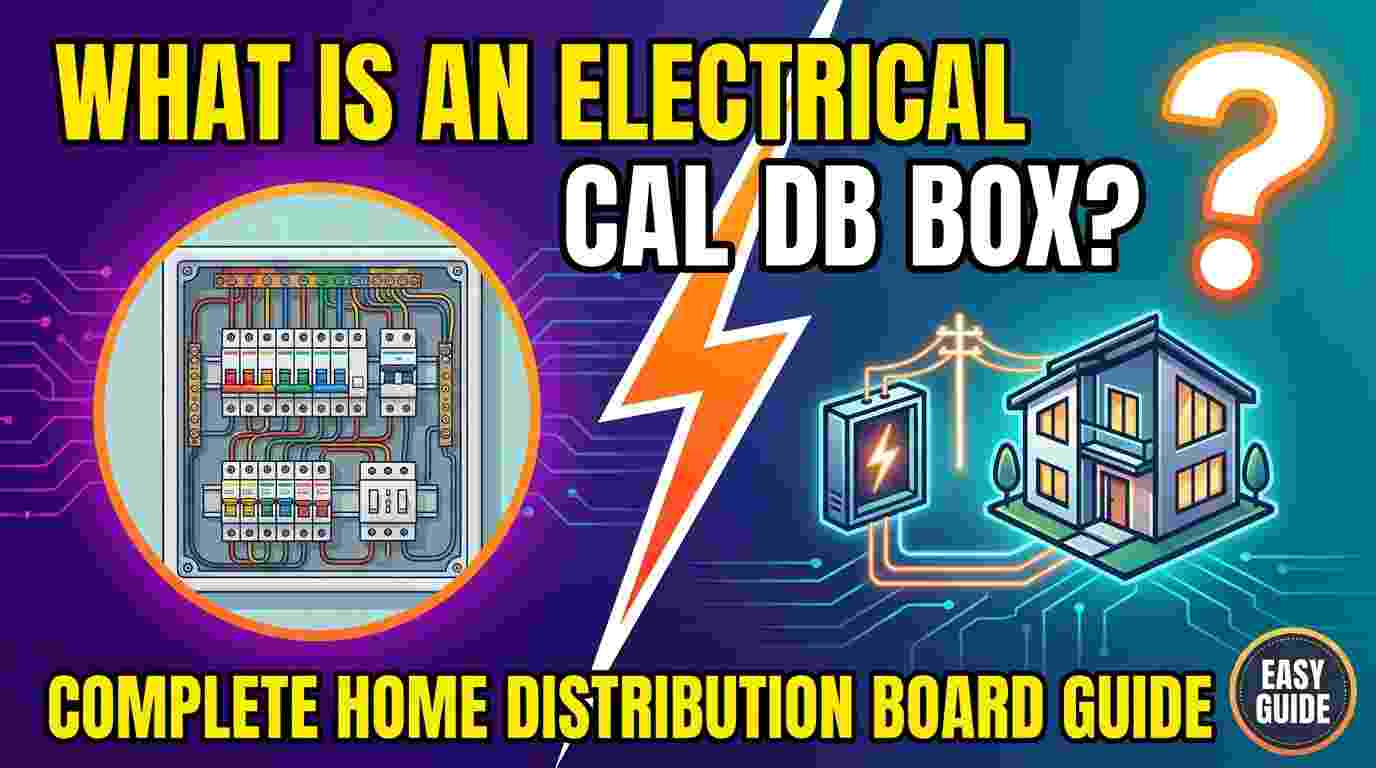
An electrical DB box, commonly called a Distribution Board (DB), is one of the most important parts of a home’s electrical system. It is the point where incoming electrical power is distributed into different circuits throughout the house and protected using devices such as MCBs, RCCBs, RCBOs and, where appropriate, surge protection devices.
You may have seen a rectangular metal or plastic box installed near the entrance, staircase, garage, utility area or another accessible location in a house. Inside it, there are several switches or circuit breakers. This is the home’s distribution board.
Although many homeowners simply call it a “breaker box,” a properly designed DB does much more than provide switches. It helps organize electrical circuits, isolate faulty circuits and provide protection against certain types of electrical faults.
For homes in Pakistan, a properly planned DB is especially important because electrical systems may experience heavy appliance loads, voltage fluctuations, overloaded circuits and varying power-quality conditions. NEPRA’s safety guidance emphasizes proper internal wiring inspection, earthing, safe wiring practices and the use of trained electricians for electrical work.
This complete guide explains what an electrical DB box is, how it works, its components, types, MCBs, RCCBs, RCBOs, SPDs, single-phase and three-phase DBs, solar DBs, sizing considerations, installation tips, common mistakes, maintenance and how to choose the right DB for your home in Pakistan in 2026.
What Is an Electrical DB Box?
An electrical Distribution Board (DB) is an enclosure that receives electrical power from the main incoming supply and distributes it to multiple outgoing circuits.
In simple words:
Electricity enters the house → reaches the main DB → gets distributed to individual circuits → appliances receive power.
A typical home may have separate circuits for:
- Lights
- Ceiling fans
- General sockets
- Kitchen sockets
- Air conditioners
- Refrigerator
- Washing machine
- Water pump
- Electric oven
- Water heater
- Outdoor circuits
- Garage
- Solar system
- Other heavy appliances
Each circuit can have its own protective device.
This makes the electrical installation easier to control and troubleshoot.
Why Is a DB Box Important?
Imagine a house without properly separated electrical circuits.
If a fault occurs in one appliance, the entire house might lose power, and finding the problem could be difficult.
A properly designed DB helps divide the electrical installation into manageable circuits.
For example:
Circuit 1 → Lights
Circuit 2 → Fans
Circuit 3 → Bedrooms sockets
Circuit 4 → Kitchen
Circuit 5 → AC
Circuit 6 → Water pump
If the water-pump circuit develops an overcurrent fault, its protective device can operate without necessarily shutting down every other circuit.
This is one of the major benefits of proper circuit separation.
How Does an Electrical DB Work?
The basic electrical flow looks like this:
Utility Supply → Energy Meter → Main Incoming Protection → Distribution Board → Individual Circuit Breakers → Appliances
The DB receives the incoming supply and distributes it through busbars and protective devices to individual circuits.
A simplified single-phase arrangement may look like:
Phase → Main Breaker → Busbar → MCBs → Individual Circuits
Neutral → Neutral Bar → Individual Circuits
Earth → Earth Bar → Protective Earth Conductors
The exact arrangement depends on the electrical system, equipment and applicable installation standards.
A qualified electrician should design and install the DB rather than treating it as a simple collection of switches.
Main Components Inside an Electrical DB Box
A residential DB may contain several different components.
The exact combination depends on the home’s electrical design.
Common components include:
- Main switch
- Main MCB or MCCB
- MCBs
- RCCB
- RCBO
- Surge Protection Device
- Phase busbar
- Neutral bar
- Earth bar
- DIN rail
- Enclosure
- Cable glands or entry arrangements
- Labels
- Spare ways for future expansion
Let’s understand each one.
1. Main Switch
The main switch allows the home’s electrical supply to be switched off from one location.
It is useful when:
- Performing maintenance
- Working on the electrical system
- Leaving the house for an extended period
- Isolating the installation during an emergency
A main switch is primarily an isolation/control device. Its exact protective function depends on the device selected.
2. Main MCB
An MCB (Miniature Circuit Breaker) is a protective device designed to interrupt a circuit when excessive current occurs.
MCBs commonly protect against conditions such as:
- Overload
- Short circuit
For example, if a circuit is designed for a certain current but a fault causes current to rise significantly, the MCB can trip.
The correct MCB rating must be selected according to the circuit, conductor capacity, installation method and expected load.
A common mistake is to think:
“A bigger MCB is always better.”
It isn’t.
Installing a higher-rated breaker without considering the cable and circuit design can create a dangerous situation.
3. RCCB
An RCCB (Residual Current Circuit Breaker) detects residual/leakage current and can disconnect the supply when the leakage exceeds its operating threshold.
Its main purpose is protection against electric shock and certain leakage-related hazards.
An RCCB is different from an MCB.
MCB
Primarily protects against:
- Overload
- Short circuit
RCCB
Primarily detects:
- Residual/leakage current
An RCCB generally needs appropriate overcurrent protection in the installation because it is not simply a replacement for every MCB function.
Electrical safety guidance identifies RCCBs as a type of residual-current protective device used in consumer units/distribution boards.
4. RCBO
An RCBO combines overcurrent protection and residual-current protection in one device.
In simplified terms:
RCBO = MCB-type overcurrent protection + RCD-type residual-current protection
This can be useful when you want individual circuits to have their own combined protection.
For example:
- Kitchen circuit → RCBO
- Washing machine → RCBO
- Outdoor sockets → RCBO
- Water heater → RCBO
The exact configuration should be designed according to the installation requirements.
5. Surge Protection Device (SPD)
An SPD, or Surge Protection Device, helps protect electrical equipment from transient overvoltage events.
Surges can potentially damage sensitive equipment such as:
- TVs
- Computers
- Routers
- Inverters
- Solar equipment
- Refrigerators
- Electronic appliances
However, an SPD is not the same thing as a voltage stabilizer.
SPD
Deals primarily with short-duration transient surges.
Voltage Protector/Relay
Can monitor abnormal supply voltage and disconnect equipment when voltage becomes too high or too low, depending on the device.
Stabilizer/AVR
Attempts to regulate voltage within a specified range.
These devices solve different problems.
6. Busbar
A busbar is a conductive component used to distribute electrical power within the DB.
Instead of running separate incoming wires to every MCB, a properly designed busbar arrangement can distribute the phase supply to multiple protective devices.
For example:
Incoming Phase → Busbar → MCB 1 + MCB 2 + MCB 3 + MCB 4
Busbars need to be properly rated and installed.
7. Neutral Bar
The neutral bar provides a common termination point for neutral conductors where appropriate.
Individual circuits can have their neutral conductors connected through the designated neutral arrangement.
The exact neutral arrangement depends on whether the DB uses an RCCB/RCBO system and the relevant wiring configuration.
Neutral conductors should never be randomly mixed between circuits or protective devices.
8. Earth Bar
The earth bar provides a termination point for protective earth conductors.
Proper earthing is an essential part of electrical safety.
NEPRA’s public safety guidance specifically recommends installing an earthing system and using proper three-pin plugs and sockets for appliances such as refrigerators, washing machines and irons.
A DB without proper protective-earth arrangements is not a properly completed electrical installation.
9. DIN Rail
A DIN rail is a standardized metal mounting rail used to install modular electrical devices inside the DB.
Devices such as:
- MCBs
- RCCBs
- RCBOs
- SPDs
- Contactors
- Relays
can be mounted on DIN rails.
This makes the DB more organized and easier to maintain.
10. DB Enclosure
The enclosure protects the internal electrical equipment and helps prevent accidental contact with live components.
DB boxes can be made from materials such as:
- Metal
- ABS/plastic
- Other suitable electrical enclosure materials
The enclosure should be appropriate for the installation environment.
For example, an indoor residential DB and an outdoor installation may have different enclosure requirements.
Types of Electrical DB Boxes
There are several ways to classify distribution boards.
The most common residential categories are:
- Single-phase DB
- Three-phase DB
- Main DB
- Sub-DB
- Solar AC DB
- Solar DC DB
- Outdoor DB
- Indoor DB
Single-Phase DB Box
A single-phase DB is designed for a single-phase residential electrical supply.
It is common in:
- Small houses
- Apartments
- Small offices
- Shops
- Normal residential installations
A typical arrangement may include:
- Main switch
- RCCB/RCBO
- Several MCBs
- Neutral bar
- Earth bar
- SPD where appropriate
Example circuits:
| MCB | Circuit |
|---|---|
| 1 | Lights |
| 2 | Fans |
| 3 | Bedroom sockets |
| 4 | Kitchen sockets |
| 5 | AC |
| 6 | Water pump |
| 7 | Washing machine |
The exact breaker ratings must be calculated rather than copied from a generic table.
Three-Phase DB Box
A three-phase DB is used with three-phase electrical supply.
The three phases are commonly designated:
L1 / L2 / L3
or equivalent local identification.
Loads can be distributed across the phases.
For example:
| Phase | Possible Loads |
|---|---|
| L1 | Lights + Bedroom AC |
| L2 | Kitchen + Living Room AC |
| L3 | Pump + Other Heavy Load |
This is only an illustrative example.
Actual phase distribution should be based on load calculations and equipment requirements.
For more information about the difference between single-phase and three-phase systems, see our related guide on Single Phase vs Three Phase Electricity – Which One Is Better for Your Home?
What Is a Main DB?
The main distribution board is the primary board from which electrical circuits or sub-distribution boards are supplied.
A large house may have:
Utility Supply → Main DB → Sub-DB 1 → Ground Floor
Main DB → Sub-DB 2 → First Floor
Main DB → Sub-DB 3 → Outdoor/garage
This arrangement can make large electrical installations easier to organize.
What Is a Sub-DB?
A sub-distribution board, or sub-DB, receives power from the main DB and distributes it to a particular area.
For example, a large home might have:
- Main DB
- Ground-floor DB
- First-floor DB
- Garage DB
- Outdoor DB
Sub-DBs are especially useful when a building has multiple floors or physically separated areas.
What Is a Solar DB Box?
A solar system may require dedicated protection and isolation equipment.
Depending on the system design, there may be:
DC Side
Solar Panels → DC Protection → Solar Inverter
AC Side
Solar Inverter → AC Protection → Home DB/Grid
A solar installation may therefore use dedicated:
- DC isolators
- DC breakers/fuses
- DC surge protection
- AC breakers
- AC isolators
- AC surge protection
The exact configuration depends on the inverter, PV array, system architecture and applicable standards.
A normal household DB should not be modified casually to accommodate solar equipment.
AC DB vs DC DB in Solar Systems
This distinction is important.
AC DB
Handles alternating-current circuits.
It may contain:
- AC MCB
- RCCB/RCBO
- AC SPD
- AC isolator
DC DB
Used on the solar panel side where DC protection is required.
It may contain:
- DC isolator
- DC fuse
- DC SPD
- DC circuit protection
AC and DC protective devices are not automatically interchangeable.
A breaker designed for AC should not simply be substituted into a DC circuit unless it is specifically rated and approved for that DC application.
How Many MCBs Should a Home DB Have?
There is no universal number.
It depends on:
- Number of circuits
- House size
- Appliance load
- Number of AC units
- Kitchen requirements
- Water pumps
- Electric heaters
- Solar system
- Future expansion
- Electrical design
A small house might require relatively few outgoing circuits.
A larger house may need many.
The goal should not be to install the maximum number of breakers.
The goal is to create safe, logical and appropriately protected circuits.
Should Every AC Have a Separate MCB?
In many residential installations, dedicated circuits are appropriate for higher-power appliances such as air conditioners.
This makes it easier to:
- Isolate the AC
- Protect its wiring
- Troubleshoot faults
- Prevent unnecessary interaction with other circuits
However, the exact breaker and cable selection must be based on the AC’s electrical characteristics and installation design.
Should a Refrigerator Have a Separate MCB?
A refrigerator doesn’t necessarily require a dedicated MCB in every home.
However, dedicated circuits can sometimes be beneficial for important or high-demand appliances.
The decision depends on:
- Appliance rating
- Existing circuit load
- Wiring
- Number of sockets
- Protection arrangement
- Installation design
A qualified electrician can determine the appropriate configuration.
How to Select the Correct MCB Rating
One of the most important rules is:
Never select an MCB only according to the appliance’s nameplate power.
The protective device must be coordinated with the:
- Cable size
- Circuit design
- Installation method
- Expected load
- Ambient conditions
- Fault conditions
- Equipment requirements
For example, if a circuit uses a particular conductor size, installing a much higher-rated breaker simply to prevent nuisance tripping can defeat the protection that the cable needs.
If a breaker keeps tripping, investigate the reason rather than immediately replacing it with a higher rating.
MCB B, C and D Curves: What Do They Mean?
MCBs can have different instantaneous tripping characteristics.
Common types include:
- Type B
- Type C
- Type D
They respond differently to short-duration high currents.
This matters particularly for loads with higher starting currents, such as certain motors and compressors.
For example, an appliance with a motor may have a startup current significantly higher than its normal operating current.
However, selecting a C-curve or D-curve breaker simply because an appliance sometimes trips should not be done without proper assessment.
The breaker characteristic must match the circuit and installation.
What Is the Difference Between MCB and MCCB?
MCB
Generally used for smaller circuits and residential/light commercial applications.
MCCB
A Moulded Case Circuit Breaker is generally used for higher-current applications and installations requiring more substantial protection and adjustment options, depending on the model.
For an ordinary home, MCBs are commonly sufficient for individual final circuits.
MCCBs may be used in larger systems, main incoming sections or specialized applications where their ratings and features are appropriate.
MCB vs RCCB vs RCBO
This is one of the most important comparisons.
| Device | Main Function |
|---|---|
| MCB | Overload and short-circuit protection |
| RCCB | Residual/leakage current protection |
| RCBO | Overcurrent + residual-current protection |
| SPD | Transient surge protection |
| Main switch | Isolation/control |
These devices are not interchangeable.
For example, an RCCB should not be considered a replacement for all MCBs.
Likewise, an SPD doesn’t replace an MCB or RCCB.
A properly designed DB may use several of these devices together.
What Is RCD Protection?
RCD stands for Residual Current Device.
RCCB and RCBO are examples of RCD-type protection.
RCD protection is designed to detect an imbalance between current flowing out and current returning through the intended conductors.
If leakage occurs through an unintended path, such as through a person or faulty insulation to earth, the device can disconnect the circuit when its operating conditions are met.
Electrical Safety First notes that RCD protection in a consumer unit can help protect against electric shock from faulty products.
Why Does an MCB Keep Tripping?
A repeatedly tripping MCB should not simply be reset again and again without finding the cause.
Possible reasons include:
1. Overload
Too many appliances may be operating on the same circuit.
2. Short Circuit
A wiring or appliance fault may create a very high current.
3. Faulty Appliance
One appliance may be causing the breaker to trip.
4. Wiring Problem
Damaged or improperly connected wiring can cause faults.
5. Incorrect Breaker Selection
The breaker may not be suitable for the circuit.
6. Loose Connection
Loose electrical connections can generate heat and potentially cause dangerous conditions.
If an MCB repeatedly trips, have the circuit checked by a qualified electrician.
Why Does an RCCB Keep Tripping?
An RCCB may trip because of leakage current.
Possible causes include:
- Damaged appliance insulation
- Moisture
- Faulty water heater
- Washing machine leakage
- Outdoor equipment
- Wiring insulation problems
- Incorrect neutral/earth arrangement
- Multiple circuits with cumulative leakage
Do not permanently bypass the RCCB just because it is inconvenient.
Repeated tripping is a warning that requires investigation.
Can a DB Protect Against Voltage Fluctuation?
A standard DB does not automatically regulate incoming voltage.
The DB primarily provides distribution, isolation and circuit protection.
Additional equipment may be required depending on the problem:
For Overcurrent
MCB/MCCB
For Leakage
RCCB/RCBO
For Transient Surges
SPD
For High/Low Voltage
Voltage monitoring/protection relay
For Voltage Regulation
Suitable AVR/stabilizer
Therefore:
DB ≠ Voltage Stabilizer
A DB organizes and protects circuits, but it does not automatically fix poor utility voltage.
Where Should the DB Box Be Installed?
A residential DB should be installed in a location that is:
- Accessible
- Dry
- Properly ventilated where required
- Protected from unnecessary moisture
- Away from obvious physical damage
- Convenient for emergency isolation
- Suitable for the enclosure’s environmental rating
It should not be hidden behind furniture or installed somewhere that makes emergency access difficult.
The exact installation location should follow applicable electrical requirements.
Can a DB Box Be Installed Outside?
Yes, but the enclosure and installation need to be suitable for the environment.
An outdoor DB may face:
- Rain
- Dust
- Humidity
- Sunlight
- Temperature changes
- Physical damage
Therefore, the enclosure’s environmental/IP rating and installation method become particularly important.
A basic indoor DB should not automatically be used outdoors.
Electrical DB Box for a New House
If you are building a new house, don’t treat the DB as an afterthought.
Plan it before the electrical wiring is completed.
Discuss:
- Number of rooms
- Number of ACs
- Kitchen appliances
- Pumps
- Geysers
- Solar
- Battery
- EV charger
- Generator/UPS
- Future expansion
This allows the electrician to create appropriate circuits from the beginning.
How to Design a Home DB
A basic planning process is:
Step 1: List All Appliances
Write down every major appliance.
Step 2: Record Their Ratings
Check their wattage, current and voltage requirements.
Step 3: Group Appliances Into Circuits
Separate lighting, sockets and heavy loads logically.
Step 4: Calculate Expected Demand
Don’t simply add every appliance’s maximum rating without considering realistic simultaneous use.
Step 5: Select Cable Sizes
Cable selection must be based on proper electrical calculations and installation conditions.
Step 6: Select Protective Devices
Choose MCBs, RCCBs, RCBOs, SPDs and other equipment appropriately.
Step 7: Plan the DB Layout
Leave enough space for equipment and future expansion.
Step 8: Label Everything
Clearly identify each circuit.
Step 9: Test the Installation
The completed installation should be properly inspected and tested by a qualified professional.
Example Home DB Layout
A simplified single-phase home DB might look like this:
| Position | Device | Circuit |
|---|---|---|
| Main | Main isolator | Whole house |
| Protection | RCCB/RCBO arrangement | Safety protection |
| 1 | MCB/RCBO | Lighting |
| 2 | MCB/RCBO | Fans |
| 3 | MCB/RCBO | Bedroom sockets |
| 4 | MCB/RCBO | Kitchen sockets |
| 5 | MCB/RCBO | AC 1 |
| 6 | MCB/RCBO | AC 2 |
| 7 | MCB/RCBO | Water pump |
| 8 | MCB/RCBO | Washing machine |
| 9 | Spare | Future circuit |
This is only an example.
The actual breaker ratings, number of circuits and protection arrangement must be calculated for the specific installation.
Why Should You Leave Spare Space in a DB?
One of the smartest things you can do when installing a new DB is to leave some spare ways.
Why?
Because your home’s electrical requirements may increase.
You might later install:
- Another AC
- Solar
- Battery
- EV charger
- Electric oven
- Additional pump
- Outdoor lighting
If the DB is already completely full, modifications become more difficult.
A slightly larger, properly planned DB can provide useful flexibility.
Electrical DB Box and Solar System
For a solar-powered home, the DB becomes even more important.
A typical hybrid solar installation may involve:
Solar Panels
↓
DC Protection
↓
Hybrid Inverter
↓
AC Protection
↓
Home DB
↓
Household Loads
↓
Grid
↓
Battery
The actual topology varies depending on the inverter and system design.
A solar system may require separate AC and DC protection equipment.
Do not assume that your existing household DB is automatically ready for solar simply because it has spare breaker spaces.
DB Box and Generator/UPS
Homes with a generator or UPS may have additional switching and protection requirements.
A system may need:
- Changeover switch
- Manual/automatic transfer arrangement
- Generator protection
- UPS input/output protection
- Dedicated circuits
- Proper neutral handling
Improper generator connections can create serious safety hazards.
Never connect a generator directly to a household circuit using an improvised cable or “backfeeding” arrangement.
A properly designed changeover/transfer system should be used.
Common DB Box Installation Mistakes
1. Oversized MCBs
Using a larger breaker simply to stop nuisance tripping can leave wiring inadequately protected.
2. No Proper Earthing
Earthing is an essential safety feature.
3. Poor Labelling
Unlabeled breakers make troubleshooting difficult.
4. Mixing Neutrals Incorrectly
Improper neutral arrangements can cause RCD/RCCB/RCBO problems.
5. Loose Terminals
Loose connections can cause overheating and arcing.
6. Overcrowding
Trying to fit too many devices into an unsuitable enclosure can make maintenance difficult.
7. No Spare Capacity
A completely full DB can make future upgrades unnecessarily difficult.
8. Using Incorrect AC/DC Devices
AC and DC protection devices must be suitable for their intended circuit.
9. Bypassing Protection
Never permanently bypass an MCB, RCCB or other protective device because it trips.
10. Poor Quality Components
Very cheap breakers and accessories from unreliable sources can compromise the installation.
How to Maintain Your Home DB Box
A DB does not require homeowners to open it regularly.
In fact, homeowners should not open or work inside a live DB unless properly qualified and equipped to do so.
Instead, watch for warning signs.
Look for:
- Burning smell
- Discoloration
- Melted plastic
- Buzzing
- Crackling
- Excessive heat
- Repeated breaker trips
- Loose or damaged covers
- Water/moisture
- Unexpected power interruptions
Electrical Safety First advises taking signs such as burn marks, arcing sounds, repeated breaker/fuse problems or hot electrical components seriously and seeking qualified assistance.
How Often Should a Home DB Be Inspected?
There is no single universal interval that applies to every residential installation.
Inspection frequency depends on:
- Age of wiring
- Building condition
- Electrical load
- Previous faults
- Renovations
- Solar installation
- Environmental conditions
- Local electrical requirements
An inspection is particularly worthwhile when:
- Buying an old house
- Renovating
- Adding several ACs
- Installing solar
- Installing an EV charger
- Repeated breakers are tripping
- You notice burning smells
- Wiring has been modified several times
NEPRA’s public safety guidance recommends having internal wiring inspected regularly by trained electricians and stresses the importance of proper earthing and safe wiring.
How Much Does a DB Box Cost in Pakistan?
There is no single fixed price for an electrical DB box because the total cost depends heavily on its size and the components installed.
The cost can vary based on:
- Number of ways
- Single-phase or three-phase
- Enclosure material
- Brand
- MCB quantity
- MCB ratings
- RCCB/RCBO
- SPD
- Main breaker
- Busbars
- Wiring accessories
- Installation labor
A basic enclosure with a few breakers will naturally cost much less than a complete three-phase DB containing multiple branded protective devices.
For this reason, it is better to compare complete DB specifications rather than asking only:
“How much is a DB box?”
Two DB boxes with the same number of ways can have very different prices because the protective devices inside may differ substantially in quality and specification.
How Many Ways Should You Buy?
A DB’s “ways” generally refer to the available module positions/circuit capacity for mounting devices.
For example, you may see:
- 6-way DB
- 8-way DB
- 12-way DB
- 18-way DB
- 24-way DB
- 36-way DB
The required size depends on the electrical design.
For a new house, don’t select the smallest DB simply to save money.
Leave reasonable room for future expansion.
Plastic vs Metal DB Box
Both types can be found in electrical installations.
Plastic/Insulated DB
Advantages may include:
- Lightweight
- Corrosion resistance
- Easy installation
- Suitable for many indoor applications
Metal DB
Advantages may include:
- Mechanical strength
- Durability
- Suitability for certain installations
- Robust enclosure
The correct choice depends on the installation environment, applicable standards and enclosure requirements.
The material alone does not determine whether a DB is safe.
What Should a Good Home DB Include?
A well-planned home DB should generally provide:
- Correct enclosure
- Proper main isolation
- Correct overcurrent protection
- Appropriate residual-current protection
- Proper earthing
- Correct neutral arrangement
- Suitable busbars
- Proper cable termination
- Circuit labels
- Adequate physical space
- Appropriate surge protection where required
- Spare capacity where practical
Not every DB will have exactly the same components.
The design should match the home’s electrical system.
DB Box Safety Rules for Homeowners
Follow these basic rules:
Never touch exposed live conductors.
Never bypass a breaker that keeps tripping.
Never replace an MCB with a larger rating without investigating the circuit.
Never ignore burning smells or buzzing.
Keep water away from the DB.
Keep the DB accessible.
Don’t store items directly in front of it.
Have electrical modifications performed by a qualified electrician.
Make sure the home has proper earthing.
Use suitable protection for solar, generator and other additional systems.
NEPRA explicitly advises the public not to carry out electrical repairs themselves and recommends trained electricians for electrical work.
Electrical DB Box vs Meter Box
These two are often confused.
Meter Box
The electricity meter measures electrical energy consumption and is generally associated with the utility’s metering arrangement.
DB Box
The DB distributes and protects the electrical circuits within the premises.
A simplified arrangement is:
Utility Supply → Meter → Main Protection/Isolation → Home DB → Circuits → Appliances
The exact physical arrangement varies by installation and utility requirements.
Electrical DB Box vs Fuse Box
Older homes may use fuse-based distribution systems.
Modern installations commonly use circuit breakers such as MCBs and residual-current protection such as RCCBs/RCBOs.
A DB can therefore be thought of as the modern distribution and protection center of the electrical installation.
Can I Install a DB Box Myself?
It is strongly recommended that electrical DB installation and internal wiring work be performed by a qualified electrician.
The reason is simple: a DB contains potentially lethal electrical energy.
Incorrect work can result in:
- Electric shock
- Fire
- Equipment damage
- Short circuits
- Incorrect protection
- Dangerous touch voltages
- Damage to solar equipment
NEPRA’s public safety material specifically advises against carrying out electrical repairs yourself and recommends trained electricians.
Frequently Asked Questions About Electrical DB Boxes
What does DB stand for in electrical systems?
DB stands for Distribution Board.
It is used to distribute electrical power to different circuits and house protective devices.
What is the purpose of a DB box?
Its main purposes are electrical distribution, circuit isolation and protection through appropriate protective devices.
What is inside a DB box?
Depending on the design, it may contain a main switch, MCBs, RCCB, RCBOs, SPD, busbars, neutral bar, earth bar and other electrical devices.
Is an MCB enough for a house?
An MCB provides overcurrent protection, but it does not provide all types of electrical protection. A complete installation may also require residual-current protection, earthing and other protective measures.
What is the difference between MCB and RCCB?
An MCB primarily protects against overcurrent such as overload and short circuits. An RCCB primarily detects residual/leakage current.
What is an RCBO?
An RCBO combines overcurrent protection and residual-current protection in one device.
Do I need an SPD in my DB?
An SPD may be appropriate depending on the installation, exposure to transient overvoltages, equipment and applicable electrical design requirements. A qualified electrician should assess the need and correct configuration.
Can a DB stop voltage fluctuations?
No. A standard DB does not regulate voltage. Separate voltage monitoring/protection or regulation equipment may be required.
Can I use the same DB for solar?
A household DB can be part of a solar installation, but solar systems may require additional dedicated AC and DC protection and isolation equipment.
How many MCBs does a house need?
There is no fixed number. The number depends on the number of circuits, appliance loads, building layout and electrical design.
Why is my DB breaker tripping?
Possible causes include overload, short circuit, faulty appliance, wiring fault, leakage or incorrect protection selection. The cause should be investigated instead of simply installing a larger breaker.
Is a three-phase DB different from a single-phase DB?
Yes. A three-phase DB is designed to distribute and protect circuits across three phases, while a single-phase DB is designed around one phase and neutral arrangement.
How long does an electrical DB last?
There is no universal lifespan. Quality, environment, loading, maintenance, component condition and installation quality all affect service life.
Should I leave spare space in my DB?
Yes, where practical. Spare capacity can make future additions such as solar, an EV charger, another AC or other circuits easier to accommodate.
Final Thoughts
An electrical DB box is the control and protection center of your home’s electrical distribution system.
It takes incoming electrical power and divides it into individual circuits while providing a place for appropriate protective and isolation devices.
A good DB is not simply a box filled with MCBs.
It should be designed around:
- The home’s electrical load
- Cable sizes
- Circuit arrangement
- Earthing
- Residual-current protection
- Overcurrent protection
- Surge protection where appropriate
- Solar requirements
- Generator/UPS requirements
- Future expansion
For a modern Pakistani home, investing in a properly designed DB can make the electrical system more organized, easier to troubleshoot and safer.
If you are building a new house, renovating an old electrical system or installing solar, don’t choose the DB only by its number of ways or price. Consider the complete protection system and quality of installation.
Most importantly, electrical work inside a DB should not be treated as a DIY project. NEPRA’s safety guidance recommends trained electricians for electrical repair and emphasizes proper internal wiring inspection and earthing.
A properly designed DB gives you something very important: controlled, organized and protected electrical distribution throughout your home.