
Electricity makes modern life easier, but even a small electrical fault can become dangerous when current travels somewhere it should not.
A damaged appliance, wet socket, broken wire, faulty water pump or insulation failure can allow electricity to leak toward the earth. In some situations, a person can become part of that unintended path and receive an electric shock.
This is where an RCCB can provide an important additional layer of protection.
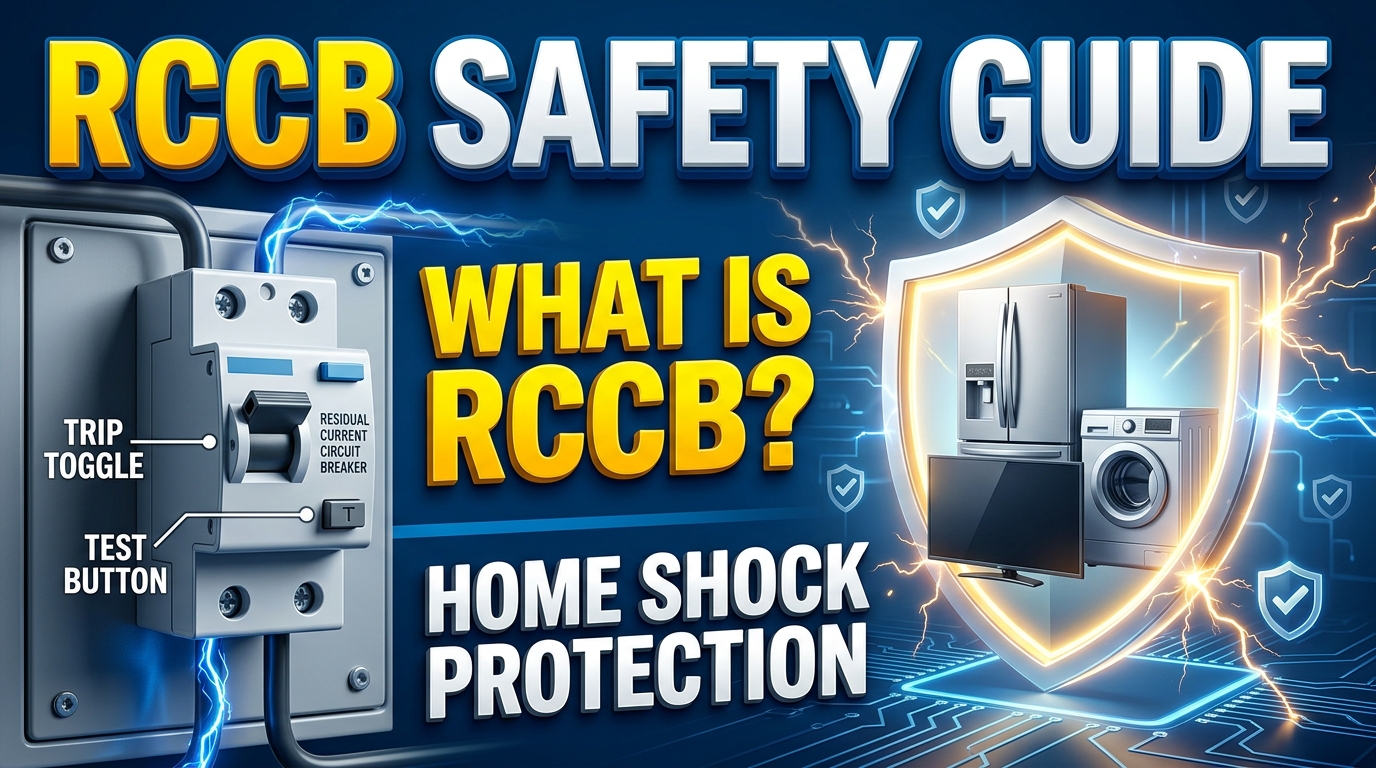
RCCB stands for Residual Current Circuit Breaker. It monitors the current flowing through a circuit and disconnects the supply when it detects a potentially dangerous difference between the current going out and the current returning.
Unlike a normal MCB, an RCCB is primarily designed to detect residual or leakage current, rather than protect the circuit against ordinary overload and short circuit.
NEPRA’s Power Safety Code recommends installing an RCCB or RCD for human protection and explains that these devices can detect leakage current, including situations where electricity flows through a person because of a fault. The same guidance notes that 30 mA sensitivity is commonly used for household protection.
For homeowners in Pakistan, understanding RCCBs is particularly useful because modern houses increasingly contain:
- Solar inverters
- Lithium batteries
- Air conditioners
- Washing machines
- Water pumps
- Refrigerators
- Electric geysers
- Computers
- Kitchen appliances
- Outdoor electrical equipment
This guide explains what an RCCB is, how it works, why your home may need one, what 30 mA means, the difference between RCCB and MCB, RCCB vs RCBO, where it should be used, common installation mistakes, testing, and important safety considerations.
What Is an RCCB?
An RCCB (Residual Current Circuit Breaker) is an electrical protection device that detects an imbalance between current flowing through the live conductor and current returning through the neutral conductor.
Under normal conditions:
Current going out ≈ Current coming back
If some current takes another path—for example, through a damaged appliance to its metal body and then to earth—the current returning through the neutral can be lower than the current leaving through the live conductor.
The RCCB detects this difference.
If the residual current reaches the device’s operating threshold, it trips and disconnects the circuit.
Schneider Electric describes an RCCB as a device that provides residual-current/ground-fault protection but does not include thermal-magnetic overcurrent protection.
This distinction is extremely important.
An RCCB is not simply a replacement for an MCB.
How Does an RCCB Work?
The working principle is relatively simple.
Imagine a normal household circuit.
Electricity leaves the distribution board through the live wire.
It travels through the appliance.
It then returns through the neutral wire.
If:
10 A leaves
and:
10 A returns
the currents are balanced.
The RCCB remains switched on.
Now imagine that an insulation fault causes:
10 A to leave
but only:
9.97 A returns
The missing:
0.03 A = 30 mA
has taken another path.
That path could potentially involve:
- Earth
- A metal appliance body
- Moisture
- A person
- Damaged insulation
The RCCB can detect the imbalance and disconnect the circuit.
Schneider Electric explains the same basic principle: the RCCB compares current flowing through the live and neutral conductors and trips when an imbalance indicates leakage.
Why Is an RCCB Important for Home Safety?
An MCB primarily protects wiring and circuits against overload and short circuit.
An RCCB provides a different type of protection by detecting residual current/leakage.
This difference matters because an electrical shock does not necessarily create the kind of large current that would cause a normal MCB to trip quickly.
For example, if a person accidentally touches a live conductor and current flows through their body to earth, the current may be enough to cause serious harm while remaining below the MCB’s normal overcurrent threshold.
An RCCB is designed specifically to respond to this type of current imbalance.
This is why residual-current protection is considered an important additional layer of electrical safety.
NEPRA specifically recommends RCCB/RCD protection for human protection in residential and other installations.
RCCB vs MCB – What Is the Difference?
This is one of the most important things homeowners should understand.
| Feature | MCB | RCCB |
|---|---|---|
| Full name | Miniature Circuit Breaker | Residual Current Circuit Breaker |
| Main purpose | Overload and short-circuit protection | Leakage/residual-current protection |
| Detects overload | Yes | No |
| Detects short circuit | Yes | Not as its primary function |
| Detects earth leakage | Not its primary function | Yes |
| Shock protection | Limited/not its primary purpose | Yes, where correctly selected |
| Works alone as complete protection? | No | No |
| Usually paired with | RCCB/RCBO as appropriate | MCB or RCBO arrangement |
The simplest way to remember it is:
MCB protects the circuit from overcurrent.
RCCB detects leakage current.
They perform different jobs.
Does an RCCB Replace an MCB?
No.
This is a common mistake.
An RCCB normally does not provide the same overload and short-circuit protection as an MCB.
Schneider Electric explicitly distinguishes an RCCB from an RCBO by noting that an RCCB does not have integral thermal-magnetic overcurrent protection.
A residential installation may therefore use:
MCB + RCCB
or individual:
RCBOs
depending on the electrical design.
The correct arrangement depends on the installation and applicable requirements.
What Is an RCBO?
An RCBO stands for:
Residual Current Breaker with Overcurrent Protection
It combines two functions:
- Residual-current protection
- Overcurrent protection
In simple terms:
RCCB + MCB functions → RCBO
An RCBO can therefore provide leakage protection along with overload/short-circuit protection for an individual circuit, when correctly selected.
Schneider Electric describes RCBOs as devices combining residual-current protection with integral overcurrent protection.
RCCB vs RCBO
| Feature | RCCB | RCBO |
|---|---|---|
| Leakage protection | Yes | Yes |
| Overload protection | No | Yes |
| Short-circuit protection | No | Yes |
| Works with MCB | Usually yes | Integrated |
| Protection for individual circuit | Possible with suitable arrangement | Yes |
| Installation complexity | Can be simpler centrally | More devices may be required |
| Main advantage | Residual-current protection | Combined protection |
Neither is automatically the right choice for every home.
The electrical designer should decide based on the circuit arrangement, required protection, available DB space and applicable standards.
What Does 30 mA Mean on an RCCB?
You may see an RCCB marked:
30 mA
The “mA” means milliamperes.
30 mA is:
0.03 A
The number represents the residual current at which the device is designed to operate according to its specified characteristics.
NEPRA’s Power Safety Code states that 30 mA sensitivity is commonly used for household protection because it can detect relatively small leakage currents and disconnect the supply to reduce the risk of electric shock.
However, homeowners should not choose an RCCB solely by looking at the 30 mA number.
Other specifications matter too.
What Does the Ampere Rating of an RCCB Mean?
An RCCB can also have a current rating such as:
- 25 A
- 40 A
- 63 A
- 80 A
This is different from the residual-current sensitivity.
For example, an RCCB might be marked:
63 A / 30 mA
These two numbers have different meanings.
63 A
Relates to the device’s rated current.
30 mA
Relates to its residual-current operating sensitivity.
Do not confuse:
63 A
with:
30 mA
They are measuring completely different things.
Why Do Homes Need RCCB Protection?
Modern homes contain many potential leakage sources.
Examples include:
- Damaged appliance cables
- Wet sockets
- Faulty washing machines
- Damaged heaters
- Water pumps
- Refrigerators
- Air conditioners
- Geysers
- Outdoor lighting
- Extension boards
- Old wiring
- Damaged insulation
A fault may allow current to escape from the intended electrical path.
An RCCB can detect the resulting imbalance and disconnect the supply.
This can provide an additional layer of protection against electric shock.
RCCB Protection in Bathrooms
Bathrooms deserve particular attention because water and electricity create a particularly dangerous combination.
Electrical equipment near bathrooms should be installed according to the applicable electrical requirements and appropriate protection zones.
Residual-current protection can provide an important additional safety layer.
However:
An RCCB does not make an unsafe bathroom installation safe.
You still need:
- Proper wiring
- Correct equipment placement
- Suitable IP-rated equipment where required
- Proper earthing
- Appropriate isolation
- Correct circuit protection
- Professional installation
Never assume:
“There is an RCCB, so I can safely install any electrical appliance anywhere in the bathroom.”
RCCB for Washing Machines
Washing machines are a good example of why residual-current protection matters.
A washing machine combines:
- Electricity
- Water
- Metal components
- Motors
- Electronic controls
If insulation becomes damaged or moisture enters an electrical component, leakage can occur.
NEPRA’s public safety guidance specifically recommends three-pin plugs and sockets for appliances including washing machines, refrigerators and irons.
A properly installed protective-earth system and appropriate residual-current protection provide additional safety.
RCCB for Water Pumps
Water pumps should also receive particular attention.
A pump may operate:
- Outdoors
- In wet environments
- Near water tanks
- Near underground water
- In areas exposed to moisture
A leakage fault can therefore create a dangerous situation.
The pump circuit should be designed with suitable:
- Cable
- MCB
- RCCB/RCBO
- Earthing
- Isolation
- Environmental protection
The exact arrangement should be determined by a qualified electrician.
RCCB for Air Conditioners
An air conditioner can have:
- Compressor
- Fan motor
- Electronic control board
- Outdoor unit
- Metal enclosure
- Long cable run
An RCCB may be part of the overall protection arrangement, but the correct type and configuration must be compatible with the appliance and electrical system.
Modern inverter ACs can contain power electronics, so the appropriate residual-current device type should be selected according to the manufacturer’s requirements and the applicable electrical standard.
RCCB and Solar Inverters
Solar systems make the topic even more important.
A modern solar installation can contain:
PV panels → DC protection → inverter → AC protection → home DB
and possibly:
Battery → DC protection → hybrid inverter
The inverter contains power electronics that can affect the characteristics of residual currents.
Therefore, you should never simply buy the cheapest RCCB and assume it is appropriate for every solar inverter.
The inverter manufacturer’s documentation should be checked for:
- RCCB/RCD requirements
- Compatible RCD type
- Maximum residual current
- DC leakage characteristics
- Neutral-earth arrangement
- Backup output requirements
A solar professional should design the protection system around the actual inverter.
Can an RCCB Protect a Solar Inverter?
An RCCB is not primarily an inverter-protection device.
Its main purpose is residual-current protection.
Solar inverters can require other protection such as:
- MCB
- DC protection
- AC isolation
- Surge protection
- Earthing
- Appropriate residual-current protection
An RCCB should therefore be viewed as one component in the overall electrical protection system, not as a complete solar protection solution.
RCCB and Earthing – Do You Need Both?
Yes, they serve different roles.
Earthing
Provides a protective path for fault current and helps keep exposed conductive parts at a safer potential.
RCCB
Detects an imbalance caused by residual/leakage current and disconnects the circuit.
The two systems can work together.
A simple example:
Fault → current flows to exposed metal → protective earth provides a fault path → residual current is detected → RCCB trips
The exact behavior depends on the system design.
NEPRA’s Power Safety Code addresses both protective earthing and residual-current devices as parts of electrical safety.
Does an RCCB Prevent All Electric Shocks?
No.
This is an important limitation.
An RCCB is an additional protective device, not a guarantee that nobody can ever receive an electric shock.
For example, touching both live and neutral conductors may create current that flows through the body without producing the type of imbalance the RCCB is designed to detect.
The RCCB therefore should never be treated as permission to touch live electrical conductors.
The safest rule is:
Never intentionally test an RCCB by touching electricity.
What Does the TEST Button Do?
Most RCCBs have a TEST button.
Pressing it creates a simulated residual-current condition inside the device.
The RCCB should trip.
This allows the user to verify that the mechanism is capable of operating.
If pressing the test button does not cause the RCCB to trip, the device should not simply be ignored.
Have the installation checked by a qualified electrician.
Follow the manufacturer’s instructions regarding testing frequency and procedure.
How Often Should an RCCB Be Tested?
Testing requirements can vary by device, manufacturer and installation.
Some manufacturers recommend regular testing using the test button.
NEPRA’s Power Safety Code also emphasizes periodic inspection and testing of protective mechanisms by qualified electricians.
For a homeowner, the important point is:
Do not install an RCCB and then forget about it for years.
Keep the test button accessible and follow the manufacturer’s instructions.
What If the RCCB Keeps Tripping?
Repeated RCCB trips should not simply be ignored.
It means the device is detecting a residual-current condition or another issue affecting the protection system.
Possible causes include:
- Faulty appliance
- Water/moisture
- Damaged cable
- Insulation breakdown
- Leakage from an appliance
- Wiring fault
- Incorrect neutral connection
- Neutral-earth fault
- Inverter-related leakage
- Multiple appliances contributing leakage
The first step is to identify the source rather than repeatedly resetting the RCCB.
RCCB Trips When One Appliance Is Connected
Suppose everything works normally until you connect a particular appliance.
Then the RCCB trips.
That appliance becomes a strong suspect.
For example:
RCCB ON → normal
Washing machine connected → RCCB trips
This could indicate leakage associated with the washing machine or its circuit.
However, it should be professionally tested rather than assumed.
Why Does an RCCB Trip Even When the MCB Does Not?
Because they are monitoring different conditions.
The MCB asks, essentially:
“Is the current too high for this circuit?”
The RCCB asks:
“Is some current escaping from the intended circuit path?”
A leakage current can be relatively small.
It may not be enough to trigger the MCB but can still be enough to trigger a suitably sensitive RCCB.
This is exactly why both types of protection can be important.
Common RCCB Types
RCCBs can be classified according to the types of residual current they can detect.
Common categories include:
- Type AC
- Type A
- Type F
- Type B
The correct type depends on the equipment and waveform characteristics expected in the circuit.
Modern homes contain more electronic equipment than in the past.
Examples include:
- Inverter ACs
- Solar inverters
- Variable-speed drives
- EV chargers
- Washing machines with electronic controls
- Computers
- LED drivers
Therefore, choosing an RCCB type should not be based simply on price.
Schneider Electric’s current technical guidance describes Type AC, A, F and B residual-current device categories and notes that the appropriate type depends on the expected residual-current waveform.
Type AC vs Type A RCCB
A simplified explanation:
Type AC
Designed for certain sinusoidal AC residual currents.
Type A
Designed to detect AC residual current plus certain pulsating DC residual currents.
This distinction can matter with modern electronic equipment.
However, the exact RCD type should be selected according to the equipment and applicable standards.
For solar inverters, EV chargers or other power-electronic equipment, follow the manufacturer’s requirements.
What Is the Difference Between RCCB and ELCB?
You may see both terms used in Pakistan:
- RCCB
- RCD
- ELCB
They are sometimes used casually as though they mean exactly the same thing.
Technically, however, these names can refer to different technologies and generations of earth-leakage protection.
Modern residential installations commonly use RCCB/RCD-type residual-current devices.
The important thing is not simply the label on the device.
Check:
- Operating principle
- Residual-current sensitivity
- Rated current
- Device type
- Standard/certification
- Manufacturer specifications
Can an RCCB Protect Against Overload?
No, not by itself.
This is one of the biggest misconceptions.
Suppose a circuit is overloaded because several high-power appliances are connected.
The RCCB is not primarily designed to respond to ordinary overload.
An MCB or RCBO provides the appropriate overcurrent protection.
Schneider Electric explicitly states that an RCCB does not include thermal-magnetic overcurrent protection.
Can an RCCB Protect Against a Short Circuit?
Not as its primary protective function.
Short-circuit protection normally comes from an appropriately rated:
- MCB
- MCCB
- Fuse
- RCBO
The RCCB and overcurrent protection should be coordinated as part of the complete installation.
RCCB vs Fuse
A fuse and an RCCB perform different functions.
Fuse
Protects against excessive current by melting when the current becomes too high.
RCCB
Detects residual/leakage current and disconnects the circuit.
A modern home may need both overcurrent and residual-current protection.
Where Should an RCCB Be Installed?
An RCCB is commonly installed within the home’s distribution board.
A simplified arrangement might look like:
Electricity Meter
↓
Main Isolator
↓
RCCB
↓
MCBs
↓
Individual Circuits
However, actual distribution-board architecture varies.
Some installations may instead use:
Main protection → multiple RCBOs
This can provide residual-current and overcurrent protection separately for individual circuits.
The arrangement should be designed by a qualified professional.
Whole-House RCCB vs Individual RCBOs
There are two broad approaches.
Whole-House RCCB
One RCCB can protect several downstream circuits.
Advantage
It can provide broad residual-current protection with relatively simple equipment.
Possible disadvantage
If one circuit develops a leakage fault, the RCCB may disconnect multiple circuits.
For example:
Fault in kitchen → entire house loses power
depending on the arrangement.
Individual RCBOs
Each circuit can have its own residual-current and overcurrent protection.
For example:
- Kitchen RCBO
- Bathroom RCBO
- AC RCBO
- Washing machine RCBO
- Outdoor RCBO
Advantage
A fault on one circuit can be isolated more selectively.
Disadvantage
It can require more space and higher equipment cost.
There is no universal “one size fits all” arrangement.
RCCB for Wet Areas and Outdoor Circuits
Residual-current protection is particularly relevant where electrical equipment is exposed to:
- Water
- Moisture
- Outdoor conditions
- Plumbing
- Metal structures
- Ground contact
Examples include:
- Bathrooms
- Kitchens
- Washing areas
- Water pumps
- Outdoor sockets
- Garden equipment
The exact protection and equipment requirements depend on the installation.
Common RCCB Installation Mistakes
Mistake 1: Installing an RCCB Without MCB Protection
An RCCB does not replace overcurrent protection.
Mistake 2: Connecting Neutral Incorrectly
Incorrect neutral connections can cause nuisance tripping or compromise protection.
Mistake 3: Mixing Neutral Conductors
If multiple circuits are protected separately, their neutral conductors must be arranged correctly according to the protective-device configuration.
Mistake 4: Choosing Only by Ampere Rating
A device marked:
63 A
may still be the wrong RCCB if its residual-current type or sensitivity is unsuitable.
Mistake 5: Choosing the Wrong RCD Type
Modern electronic loads can require a different residual-current detection capability.
Mistake 6: Ignoring the Test Button
An RCCB should be periodically tested according to the manufacturer’s instructions.
Mistake 7: Repeatedly Resetting a Tripping RCCB
If it keeps tripping, investigate the cause.
Mistake 8: Using a Cheap Unknown Device
Protection equipment should be sourced from a reputable manufacturer and supplier with verifiable specifications.
Mistake 9: Assuming RCCB Fixes Bad Earthing
It does not.
A complete electrical safety system still needs proper earthing and correctly designed wiring.
Mistake 10: Installing It Without Checking the Solar Inverter
Some inverter systems have specific residual-current protection requirements.
Always check the inverter manual.
How to Choose an RCCB for Your Home
Before purchasing one, check the following.
1. Rated Current
Examples:
- 25 A
- 40 A
- 63 A
Choose according to the installation design.
2. Residual-Current Sensitivity
For household personal protection, 30 mA is commonly used, as noted by NEPRA.
However, don’t assume every application should use exactly the same sensitivity.
3. Type
Determine whether the circuit requires:
- Type AC
- Type A
- Type F
- Type B
based on the connected equipment and applicable requirements.
4. Number of Poles
Common arrangements include:
- 2-pole
- 4-pole
The choice depends on the electrical system.
5. Breaking/Short-Circuit Coordination
The RCCB arrangement must be coordinated with upstream/downstream overcurrent protection.
6. Manufacturer
Use a reputable manufacturer with clear technical documentation.
7. Compatibility
For solar, inverter and electronic loads, check manufacturer compatibility.
Example of a Home Protection Setup
A simplified single-phase home might have:
Meter
↓
Main Isolator
↓
RCCB – residual-current protection
↓
MCB 1 – Lights
MCB 2 – Fans
MCB 3 – Sockets
MCB 4 – Kitchen
MCB 5 – AC
MCB 6 – Water Pump
The actual ratings and arrangement must be calculated according to the home’s electrical design.
A more selective installation might use individual RCBOs instead.
RCCB and Solar: What Homeowners Should Ask
If you have solar or plan to install it, ask your installer:
- What type of RCCB/RCD is required?
- Does the inverter manufacturer specify an RCD type?
- Is the inverter internally monitoring residual current?
- What is the neutral-earth arrangement?
- Is the AC output protected correctly?
- Is the PV DC side protected separately?
- Is the battery side protected?
- Is proper earthing installed?
- Are AC and DC surge-protection requirements addressed?
- Has the complete system been tested?
This is especially important with hybrid inverters.
Does Every Home in Pakistan Need an RCCB?
NEPRA’s Power Safety Code recommends RCCB/RCD installation for human protection and specifically notes 30 mA sensitivity as commonly used for household protection.
The exact protective arrangement for a particular home depends on its electrical design and applicable requirements.
For an existing house with old wiring, an electrician should inspect the installation before simply adding an RCCB.
An RCCB cannot correct:
- Damaged wiring
- Missing earthing
- Incorrect neutral connections
- Overloaded circuits
- Poor-quality sockets
- Unsafe concealed joints
Those problems need to be addressed separately.
What If Your Old House Has No RCCB?
If your house has only:
- Main switch
- MCBs
it may be worth having the electrical installation assessed by a qualified electrician to determine whether residual-current protection should be added.
The electrician should check:
- Earthing
- Wiring
- DB arrangement
- Neutral connections
- Circuit separation
- MCB ratings
- Appliance loads
- Solar inverter connections
- Existing leakage problems
Do not simply purchase an RCCB and install it without checking the existing system.
How Much Does an RCCB Cost in Pakistan?
RCCB prices vary considerably based on:
- Brand
- Rated current
- Number of poles
- Sensitivity
- Type
- Certification
- Product series
- Local dealer
- Genuine vs counterfeit product
A basic household RCCB may cost substantially less than a premium industrial or advanced electronic-compatible model.
Because this is a safety device, comparing only the lowest price is not recommended.
When comparing products, compare the same specifications:
63 A / 30 mA / 2P / Type A
for example, rather than comparing two devices only by their price.
Why You Should Avoid Counterfeit RCCBs
A protective device is supposed to disconnect power during a dangerous condition.
If a counterfeit or poor-quality device does not operate according to its claimed specifications, the entire purpose of installing it is compromised.
When buying an RCCB:
- Buy from a reputable electrical supplier
- Check packaging
- Check model number
- Verify manufacturer documentation
- Check technical ratings
- Avoid suspiciously cheap products
- Ask for an authentic product
RCCB Maintenance Tips
An RCCB is not a “fit and forget” device.
Regularly inspect the DB
Look for:
- Heat marks
- Burning smell
- Loose connections
- Damaged insulation
- Moisture
- Corrosion
Test the RCCB
Use the test button according to manufacturer instructions.
Investigate repeated trips
Don’t repeatedly reset it without finding the cause.
Keep the DB accessible
Do not block it behind furniture or construction.
Have old wiring inspected
NEPRA recommends regular inspection of internal wiring by qualified/licensed electricians.
Important Safety Rules
Never:
- Touch exposed live wires
- Bypass an RCCB
- Lock an RCCB in the ON position
- Replace an RCCB with a larger-rated device without proper design
- Connect neutral and earth incorrectly
- Remove the earth pin from appliances
- Ignore repeated RCCB trips
- Work inside a live distribution board
- Test electrical safety by touching wires
NEPRA advises the public not to perform electrical repairs themselves and recommends trained/licensed electricians for inspection and repair.
Frequently Asked Questions
What does RCCB stand for?
RCCB stands for Residual Current Circuit Breaker.
What does an RCCB protect against?
It primarily detects residual/leakage current and disconnects the circuit when the detected imbalance reaches its operating threshold.
Does an RCCB protect against overload?
No. An RCCB normally does not provide integral overcurrent protection. An MCB or RCBO arrangement is required for overload and short-circuit protection.
Is RCCB better than MCB?
They are not direct alternatives. An MCB and RCCB perform different protective functions and may be used together.
What is the difference between RCCB and RCBO?
An RCCB provides residual-current protection, while an RCBO combines residual-current protection with overcurrent protection.
Is 30 mA RCCB suitable for a home?
30 mA sensitivity is commonly used for household human protection, and NEPRA specifically identifies 30 mA as a common household sensitivity. The final selection should still follow the electrical design and applicable requirements.
Why does my RCCB keep tripping?
Possible causes include appliance leakage, damaged insulation, moisture, wiring faults, neutral-earth problems or inverter-related leakage. The source should be professionally investigated.
Can an RCCB prevent electric shock?
It can reduce the risk and duration of some leakage-related shocks by disconnecting the circuit, but it cannot guarantee that a person will never receive a shock.
Does RCCB replace earthing?
No. Earthing and residual-current protection perform different functions and should be treated as complementary parts of a properly designed electrical system.
Does a solar inverter need an RCCB?
The appropriate residual-current protection for a solar inverter depends on the inverter design, manufacturer’s requirements and the electrical installation. Do not install an arbitrary RCCB without checking compatibility.
Can I install an RCCB myself?
Working inside a distribution board can expose you to dangerous voltages. Installation and testing should be carried out by a qualified electrician.
Why does the RCCB trip when I turn on my washing machine?
The washing machine or its circuit may have leakage current, moisture, insulation damage or another electrical fault. Have it inspected rather than repeatedly resetting the RCCB.
Final Conclusion
An RCCB is an important part of modern electrical safety because it addresses a type of fault that an ordinary MCB is not primarily designed to detect.
An MCB protects against conditions such as:
Overload + Short Circuit
An RCCB focuses on:
Residual/Leakage Current
And an RCBO can combine:
Residual-Current Protection + Overcurrent Protection
This distinction is particularly important in homes containing washing machines, water pumps, geysers, air conditioners, kitchen appliances, computers and solar inverter systems.
For household protection, NEPRA’s Power Safety Code specifically recommends RCCB/RCD protection and identifies 30 mA sensitivity as commonly used for household protection.
However, an RCCB is not a replacement for:
- Proper earthing
- Correct wiring
- Correct MCB protection
- Suitable cables
- Safe sockets
- Proper isolation
- Surge protection where required
- Professional inspection
Think of electrical safety as a system of multiple layers rather than one device.
Proper wiring + earthing + overcurrent protection + residual-current protection + appropriate surge protection + regular inspection = a much safer electrical installation.
If your home does not currently have residual-current protection, especially if the wiring is old or the property contains water-related appliances, outdoor circuits or a solar inverter, have the distribution board and electrical installation assessed by a qualified electrician.
A small protection device inside the DB can provide an important additional layer of protection between an electrical fault and a serious accident.