
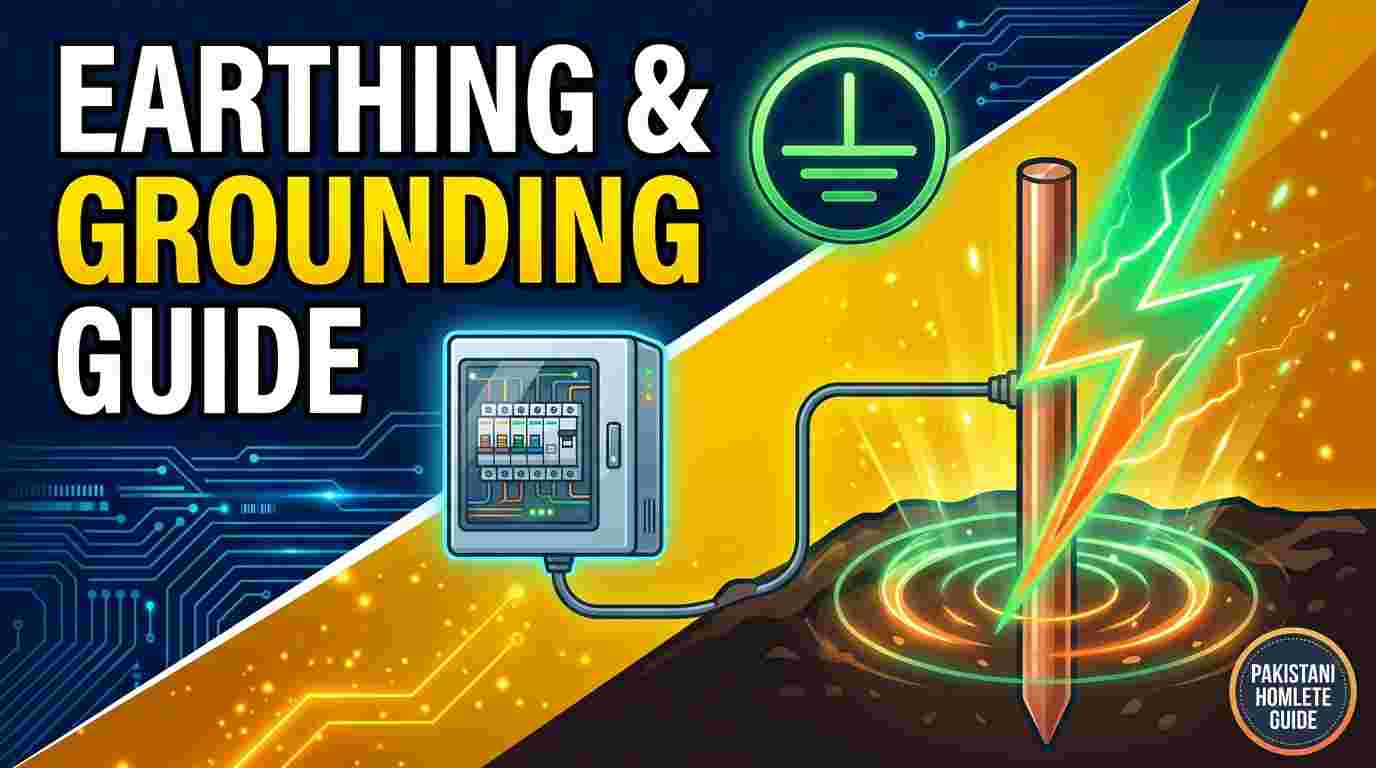
Electricity makes modern homes comfortable, but it can also become extremely dangerous when electrical faults are not properly controlled. One of the most important safety systems in a house is earthing, also commonly called grounding.
You may have seen an electrician install an earth rod, earth electrode or an earthing pit outside a house. You may also have noticed that many appliances use a three-pin plug instead of a two-pin plug.
But what exactly does earthing do?
Why is earthing important?
How does an earthing system work?
What happens if a refrigerator, washing machine, water pump, inverter or metal appliance develops a fault?
And does installing an earth rod automatically mean that a house has proper earthing?
The answer is no.
A proper electrical earthing system is designed to provide a low-impedance path for fault current, helping protective devices operate and reducing the risk of electric shock, fire and equipment damage.
Pakistan’s National Electric Power Regulatory Authority (NEPRA) specifically recommends installing a permanent earthing system and using three-pin plugs for appliances. Its safety guidance explains that earthing provides a path for fault current to flow toward ground and works together with protective devices such as fuses and circuit breakers.
This guide explains what earthing is, how it works, why every Pakistani home needs it, different types of earthing, earth wires, earth rods, earthing pits, testing, solar earthing, common mistakes and practical safety tips.
What Is Earthing?
Earthing is the intentional connection of exposed conductive parts of an electrical installation to the earth through a suitable protective conductor and earthing system.
In simple words:
Earthing provides a safe path for dangerous fault current so that exposed metal parts of electrical equipment do not remain dangerously energized.
For example, imagine a washing machine has an internal insulation failure.
A live conductor accidentally touches the washing machine’s metal body.
Without proper protective earthing, the metal body could become energized.
If a person touches the washing machine while standing on a conductive surface, their body could become part of the fault-current path.
With a properly designed protective earth connection, the fault current can flow through the protective path, helping the appropriate protective device disconnect the faulty circuit.
That is why earthing is fundamentally a life-safety system, not simply an accessory.
Earthing vs Grounding: Are They the Same?
In everyday electrical discussions, earthing and grounding are often used interchangeably.
In many contexts:
- Earthing = connection to the earth
- Grounding = establishing a reference or connection to ground
The exact technical meaning can depend on the electrical system and applicable standards.
For homeowners, however, the important concept is simple:
A properly designed protective earth system helps keep exposed conductive parts at a safer potential and provides a path for fault current.
Why Is Earthing Important in a Pakistani Home?
Electrical faults can happen because of:
- Damaged insulation
- Loose connections
- Water entering equipment
- Broken wires
- Appliance faults
- Incorrect wiring
- Aging cables
- Overheating
- Damaged plugs
- Faulty motors
- Internal component failure
Without effective protective measures, a fault can create:
- Electric shock
- Electrical fire
- Equipment damage
- Dangerous touch voltage
- Circuit overheating
- Damage to electronic equipment
NEPRA’s current safety guidance specifically tells consumers to install earthing systems, use three-pin plugs and have internal wiring inspected by trained electricians.
How Does Earthing Work?
Let’s use a simple example.
Suppose you have a metal-body refrigerator.
Normally:
Live → Appliance → Neutral
The refrigerator operates normally.
Now imagine the insulation around a live conductor becomes damaged and the live conductor touches the metal body.
The metal body could become electrically dangerous.
With protective earthing:
Fault → Metal body → Earth conductor → Earthing system → Fault path
The fault current can flow through the intended protective path.
This helps the protective device disconnect the faulty circuit.
The exact behavior depends on the earthing arrangement, fault impedance and protective device.
This is why proper earthing should be designed together with:
- MCBs
- RCCBs/RCDs
- RCBOs
- Fuses
- Main switches
- Bonding
- Appropriate conductors
Does Earthing Prevent Electric Shock Completely?
No.
This is a very important point.
Earthing reduces electrical risk, but it does not make electricity harmless.
A person can still receive a shock if:
- They touch a live conductor.
- Wiring is defective.
- Earthing is missing or defective.
- An appliance is faulty.
- Protective devices fail.
- Water is present.
- The electrical installation is incorrectly designed.
Earthing is one part of a complete electrical safety system.
NEPRA’s safety guidance also warns people not to touch electrical appliances with wet hands or bare feet because doing so can be dangerous.
Main Components of a Home Earthing System
A residential earthing arrangement can include several components.
1. Earth Electrode
This is the conductive element installed in contact with the soil.
It may be a suitable:
- Rod
- Pipe
- Plate
- Other approved electrode arrangement
2. Earth Conductor
This conductor connects the electrical installation to the earthing electrode or earthing system.
3. Earth Bar
The distribution board may have an earth bar where protective earth conductors are terminated.
4. Earth Connections
These connect exposed conductive parts and protective conductors to the earthing system.
5. Protective Devices
MCBs, RCDs/RCCBs and RCBOs can work alongside the earthing system to disconnect faulty circuits.
6. Inspection/Test Point
A suitable arrangement may be provided to allow inspection and testing of the earthing system.
The exact configuration should follow the electrical design and applicable standards.
What Is an Earth Rod?
An earth rod is a conductive electrode installed into the ground to establish an electrical connection with the soil.
It is one of the common approaches used in grounding/earthing systems.
The rod is connected to the electrical installation using a suitable earthing conductor.
However, simply putting a metal rod into the ground does not automatically create a satisfactory earthing system.
The complete system must have:
- Suitable electrode
- Suitable conductor
- Correct connections
- Appropriate installation
- Appropriate resistance/impedance
- Testing
What Is an Earthing Pit?
An earthing pit is an arrangement around an earth electrode that provides access and an installation environment for the earthing system.
People in Pakistan commonly use the term “earthing pit” for the complete grounding arrangement installed outside or near a building.
Depending on the design, an earthing system may use:
- Earth electrode
- Conductive backfill or surrounding soil
- Earth conductor
- Inspection arrangement
Older installations may use traditional materials and methods, while modern installations can use engineered electrodes and purpose-designed systems.
The important thing is not simply the appearance of the pit.
Electrical performance must be tested.
Does an Earthing Pit Need Water?
You may hear electricians say:
“Put water in the earthing pit.”
This is not a substitute for proper earthing design.
Soil moisture can affect electrical resistance, which is one reason earthing performance can vary with soil conditions.
But continuously pouring water into a pit should not be considered a universal solution for poor earthing.
A properly designed system should be selected according to:
- Soil conditions
- Electrode type
- Electrode dimensions
- Required performance
- Local conditions
- Applicable standards
If an existing earthing system has poor test results, the solution should be determined by a qualified electrician or electrical engineer rather than simply adding water.
Why Does Soil Matter for Earthing?
The earth electrode interacts electrically with the surrounding soil.
Soil characteristics can influence earthing performance.
Important factors include:
- Soil resistivity
- Moisture
- Temperature
- Soil composition
- Electrode depth
- Electrode arrangement
For example, dry and highly resistive soil can make achieving a low-resistance grounding system more difficult.
This is one reason an earthing design that works well in one location may not produce the same result somewhere else.
What Is Earth Resistance?
Earth resistance describes the resistance between the grounding electrode/system and the surrounding earth under the conditions of measurement.
Lower resistance is generally desirable for a protective earthing system, but there is no single number that should be blindly applied to every installation.
The required value depends on:
- Electrical system
- Protective devices
- Applicable standards
- Installation design
- Utility requirements
- Equipment requirements
NEPRA’s safety code states that fixed earthing/grounding resistance should be according to the design or manufacturer’s instructions; where such instructions are absent, specified requirements in the code apply.
So avoid the common claim:
“Every house must have exactly 1 ohm.”
That is not a universal rule for every residential installation.
How Is Earthing Resistance Tested?
A qualified electrician or electrical professional can use appropriate earth resistance testing equipment.
One commonly used method involves an earth resistance tester.
The test equipment is used to determine how effectively the electrode/system is connected to the surrounding earth.
Testing may be required:
- During installation
- During commissioning
- After major electrical work
- During periodic maintenance
- When an earthing problem is suspected
The correct test method depends on the earthing system and site conditions.
Why You Should Not Judge Earthing by Looking at the Wire
A common mistake is to say:
“The house has a thick earth wire, so the earthing is good.”
Not necessarily.
A large earth conductor is useful only as part of a properly designed system.
You also need:
- Proper electrode
- Good connections
- Correct routing
- Suitable protective conductor
- Appropriate earth path
- Acceptable test results
A thick wire connected to a poor or disconnected electrode does not guarantee effective earthing.
What Is an Earth Wire?
An earth wire, more precisely a protective earth conductor in the relevant installation, is used to connect exposed conductive parts to the protective earthing system.
For example, a three-pin socket typically provides:
- Live
- Neutral
- Earth
The earth connection is there for safety rather than normal load current.
Under normal operation, the protective earth conductor should not carry the appliance’s normal operating current.
It is intended to provide a fault-current path when a fault occurs.
Why Do Three-Pin Plugs Have an Earth Pin?
A three-pin plug generally has:
- Live
- Neutral
- Earth
The earth pin is a safety connection.
If a metal-body appliance develops an internal fault, the protective earth connection can help provide a fault path.
NEPRA specifically recommends three-pin plugs rather than two-pin plugs for appliances and equipment in residential and other installations, explaining that the earth pin provides a path for fault current and helps reduce electric shock and fire risks.
Is the Earth Pin Just an Extra Wire?
No.
The earth connection is a critical protective feature.
Consider a washing machine with a metal body.
If a live wire accidentally touches the body:
Without effective protective earthing:
The metal body can potentially remain at a dangerous voltage.
With effective protective earthing:
A fault-current path is provided, allowing the protective system to respond.
The objective is to reduce the amount of time the exposed metal remains dangerously energized.
Earthing and MCB: What’s the Difference?
An MCB primarily protects the circuit against conditions such as:
- Overcurrent
- Short circuit
Earthing serves a different purpose.
It provides a protective path for fault current.
These systems work together.
For example:
Appliance fault → Earth path → Fault current → Protective device operates
The exact operation depends on the system design and fault characteristics.
A house should not rely on the MCB alone as its complete electrical safety system.
Earthing and RCCB/RCD
An RCCB/RCD detects an imbalance between current flowing through conductors.
For example, if some current leaves the intended circuit path through a person or another unintended path, the device can detect the imbalance and disconnect the circuit.
This is particularly important for protection against electric shock and leakage currents.
However:
RCCB/RCD does not replace proper earthing.
Earthing and residual-current protection serve different but complementary purposes.
Earthing and RCBO
An RCBO combines functions associated with:
- Overcurrent protection
- Residual-current protection
It can therefore provide comprehensive protection for an individual circuit when correctly selected and installed.
Again, an RCBO does not mean the house can ignore earthing.
A properly designed installation uses protective measures together.
What Happens If a House Has No Earthing?
A house without effective protective earthing can have increased risk when an appliance develops an insulation fault.
Possible consequences include:
- Metal appliance body becoming energized
- Increased shock risk
- Protective devices not responding as intended to certain faults
- Equipment damage
- Fire risk
This is particularly concerning for metal-body appliances such as:
- Refrigerators
- Washing machines
- Water pumps
- Electric geysers
- Microwaves
- Metal-bodied computers
- Some air conditioners
- Electrical tools
Why Earthing Is Especially Important for Washing Machines
Washing machines combine:
Electricity + water + metal body
This makes proper electrical protection extremely important.
NEPRA specifically advises using three-pin plugs for appliances including washing machines, refrigerators and irons.
Never use a damaged plug or bypass the earth connection simply because an appliance appears to work normally.
Earthing for Refrigerators
A refrigerator may have a metal cabinet and electrical components inside.
If insulation fails, a fault can potentially energize the cabinet.
A properly designed protective earth connection helps provide a fault path.
Always use an appropriate three-pin plug/socket where required and make sure the protective earth is actually connected.
Earthing for Water Pumps
Water pumps deserve special attention because they can operate in environments where moisture is present.
The installation should include appropriate:
- Earthing
- Circuit protection
- Isolation
- Cable protection
- Motor protection where required
Do not assume that installing a pump outdoors automatically makes it safe.
Earthing for Electric Geysers
Electric geysers can present a significant electrical safety risk because they combine:
High electrical load + water + metal components
Proper protective earthing and residual-current protection are particularly important.
A qualified electrician should inspect:
- Geyser wiring
- Earth connection
- Circuit breaker
- RCCB/RCBO
- Connections
- Cable condition
Earthing for Air Conditioners
Modern air conditioners contain electronic components and metal enclosures.
A proper earth connection can help provide protection against faults.
An AC circuit should have:
- Correct cable size
- Correct protective device
- Proper earthing
- Suitable isolation
- Proper installation
The earthing conductor should never be removed just because the AC continues operating without it.
Earthing for Solar Systems
Earthing becomes particularly important in solar installations because a solar system contains multiple electrical components.
A typical system may include:
Solar Panels → DC Wiring → Inverter → AC DB → House Loads
The system may also include:
- Metal mounting structures
- Inverter enclosure
- DC protection
- AC protection
- Surge protection
- Battery system
The solar installation should have appropriate protective earthing and bonding according to the equipment manufacturer’s requirements and applicable standards.
Solar Panel Earthing
Solar panel frames and mounting structures are conductive metal components.
Depending on the system design, these components may require bonding/grounding.
The objective is to ensure that exposed conductive parts do not become dangerous during an electrical fault and to provide appropriate protection against electrical transients.
The exact arrangement depends on the solar system architecture and applicable standards.
Does Earthing Protect Solar Panels From Lightning?
Earthing is an important part of an overall protection strategy, but earthing alone does not guarantee lightning protection.
A complete lightning and surge protection strategy may involve:
- Appropriate bonding
- Surge protective devices
- Correct cable routing
- Lightning protection where required
- Proper grounding
- System-specific design
Do not assume:
Earth rod = complete lightning protection.
These are related but different protection requirements.
Earthing and Surge Protection Device (SPD)
An SPD, or surge protective device, is designed to limit transient overvoltages by diverting surge energy through an appropriate path.
A proper grounding/bonding system is important for SPD performance.
For example, in a solar system:
Solar panels → DC SPD → Grounding system
and on the AC side:
AC supply → AC SPD → Grounding system
The exact arrangement depends on the system design and SPD type.
Does Earthing Stabilize House Voltage?
This is a common misconception.
Earthing is primarily a safety and fault-protection function.
It should not be treated as a general solution for:
- Low voltage
- High voltage
- Voltage fluctuations
- Poor utility supply
- Load-shedding
- Frequent brownouts
If your home has voltage fluctuations, you may need other solutions such as:
- Voltage monitoring
- Properly rated AVR/stabilizer
- Surge protection
- Correct electrical connections
- Utility investigation
Earthing alone will not fix an unstable supply voltage.
Does Earthing Reduce Electricity Bills?
No.
Proper earthing is not designed to reduce electricity consumption.
Its purpose is primarily:
Safety + fault protection + equipment protection
If someone claims that installing an earth rod will significantly reduce your electricity bill, be cautious.
Does Earthing Improve Appliance Performance?
Not normally in the way people sometimes claim.
A refrigerator, AC or washing machine should not suddenly consume dramatically less electricity simply because a proper earth connection has been installed.
However, proper grounding can be important for:
- Electrical safety
- Fault protection
- Surge protection
- Equipment reliability
Types of Earthing Used in Electrical Systems
Different earthing arrangements exist.
Common terms you may hear include:
- Pipe earthing
- Rod earthing
- Plate earthing
- Chemical earthing
- Strip earthing
- Foundation earthing
- Protective grounding
- Equipment grounding
The best method depends on the electrical design, soil conditions, local requirements and available installation space.
Pipe Earthing
Pipe earthing uses a conductive pipe or electrode installed in the ground.
It has historically been used in many installations.
Its performance depends on:
- Electrode dimensions
- Soil conditions
- Installation depth
- Connection quality
- Soil moisture
- Maintenance
The actual design should comply with the applicable electrical requirements.
Rod Earthing
Rod earthing uses a conductive rod driven or installed into the soil.
Advantages can include:
- Simple installation
- Relatively small footprint
- Suitable for many sites
- Easy expansion in some designs
Multiple electrodes may be used in larger systems when required by the design.
Plate Earthing
Plate earthing uses a conductive plate installed below ground.
It may be suitable in certain installations, but its practicality depends on site conditions and design requirements.
Modern systems may use other electrode arrangements depending on the application.
Chemical Earthing
Chemical earthing generally refers to grounding systems that use specially designed electrodes and conductive materials intended to improve the grounding environment.
You may see products marketed as:
- Chemical earthing
- Maintenance-free earthing
- Advanced earthing
However, don’t choose a system based only on marketing terminology.
The system should be evaluated based on:
- Electrical performance
- Installation requirements
- Material quality
- Durability
- Maintenance
- Applicable standards
Which Earthing System Is Best for a House in Pakistan?
There is no single method that is automatically best for every house.
The right approach depends on:
- Soil type
- Available space
- Electrical system
- Required protection
- Building construction
- Local environmental conditions
- Applicable standards
A qualified electrical professional should determine the appropriate arrangement.
Earthing in New House Construction
If you’re constructing a new house, earthing should be considered before the electrical work is finished.
Ideally, the electrical design should account for:
- Main DB
- Earth bar
- Protective conductors
- Earth electrode
- Bonding
- RCCB/RCBO
- Surge protection
- Solar provisions
- Generator/UPS
- Future load
Adding proper earthing after the house is completely finished can be more difficult.
Earthing in an Old House
Older houses should not automatically be assumed to have safe earthing.
If your house is several decades old, ask a qualified electrician to inspect:
- Main DB
- Socket earth connections
- Earth conductor
- Earth electrode
- Earthing continuity
- Protective devices
This is particularly important if you are installing:
- Solar panels
- Inverter
- New ACs
- Electric geyser
- Water pump
- EV charger
- Generator
- Large appliances
How to Know If Your House Has Earthing
You may find:
- An earth wire in the DB
- Green/green-yellow protective conductors depending on wiring conventions
- Earth bar in the DB
- Earth connection at sockets
- Earth electrode/rod outside
- Earthing pit
But visual inspection alone cannot prove that the system is electrically effective.
Testing is the reliable way to assess the installation.
Can an Electrician Check Earthing?
Yes.
A qualified electrician or electrical professional can inspect:
- Earth conductor continuity
- Socket earth connections
- DB earth bar
- Main bonding
- Earthing electrode
- Protective devices
Appropriate test instruments can also be used to evaluate the earthing system.
NEPRA recommends regular inspection and maintenance of electrical protective mechanisms by qualified electricians.
How Often Should Earthing Be Tested?
The exact interval depends on:
- Type of installation
- Environmental conditions
- Equipment
- Applicable standards
- Risk level
- Previous test results
For a normal home, periodic electrical inspection is a good practice, particularly when major electrical equipment is installed.
NEPRA’s safety code calls for annual testing and maintenance of specified protective mechanisms by a qualified electrician.
Signs That Your Earthing May Need Inspection
Some warning signs include:
- Mild shocks from appliance bodies
- Tingling when touching metal appliances
- Repeated RCCB/RCBO trips
- Sparking at sockets
- Burn marks
- Loose earth connections
- Missing earth pin
- Two-pin adapters used on appliances requiring protective earth
- Old or damaged wiring
- No known earthing system
- Electrical work performed without proper testing
If you feel tingling from a metal appliance, do not continue using it normally and do not try to repair it yourself.
Switch off the affected circuit if it can be done safely and have it inspected by a qualified electrician.
Why You Should Never Remove the Earth Pin
Some people remove the earth pin from a three-pin plug because:
“The socket doesn’t have an earth connection.”
This is unsafe.
Removing the earth pin defeats an important protective feature.
The correct solution is to have the electrical installation properly upgraded.
NEPRA specifically recommends three-pin plugs for residential appliances.
Two-Pin vs Three-Pin Plug
Two-Pin Plug
Provides:
- Live
- Neutral
There is no dedicated protective earth connection.
Three-Pin Plug
Provides:
- Live
- Neutral
- Earth
The earth connection provides an additional safety path for fault conditions.
For appliances with exposed conductive parts that require protective earthing, three-pin connections are important.
Earthing vs Neutral: Are They the Same?
No.
This is one of the most important concepts in household wiring.
Neutral
Neutral is part of the normal electrical circuit and normally carries return current.
Earth
Protective earth is intended primarily for safety and fault protection.
Under normal conditions, the protective earth conductor should not carry ordinary load current.
Therefore:
Neutral ≠ Earth
They perform different functions.
Can You Connect Earth and Neutral Together Anywhere?
You should not randomly connect neutral and earth together inside household sockets or at arbitrary points.
The relationship between neutral and protective earth depends on the electrical system design and the location where bonding is permitted.
Improper neutral-earth connections can create:
- Shock hazards
- Unexpected current on protective conductors
- RCD/RCCB problems
- Equipment issues
- Safety risks
This is an area that should be handled by a qualified electrician.
Earthing vs Grounding vs Bonding
These terms are often confused.
Earthing/Grounding
Provides a connection to earth or establishes an intended ground reference.
Protective Earthing
Connects exposed conductive equipment parts to the protective system.
Bonding
Connects conductive parts together to help keep them at substantially similar electrical potential.
In a complete electrical safety system, these functions can work together.
Earthing for Metal DB Boxes
A metal distribution board enclosure can become dangerous if an internal conductor contacts the enclosure.
The metal enclosure should therefore be appropriately connected to the protective earth system where required by the installation design.
This helps ensure that a fault involving the enclosure has an appropriate protective path.
Earthing for Generator Systems
Generators require special attention because the relationship between:
- Generator neutral
- Generator frame
- Earth
- Transfer switch
- Main house electrical system
depends on the generator and system configuration.
Never assume that simply driving a separate rod into the ground solves generator grounding requirements.
The generator should be installed according to the manufacturer’s instructions and the electrical system design.
Earthing for UPS and Inverters
Modern UPS and solar inverter systems can have different internal electrical configurations.
Before connecting an inverter or UPS:
- Check manufacturer instructions.
- Verify input/output configuration.
- Confirm grounding requirements.
- Check neutral-earth arrangement.
- Ensure protective devices are compatible.
Do not create an earth-neutral connection simply because someone says:
“Inverter mein earth aise lagti hai.”
The exact arrangement matters.
Earthing for Lithium Battery Solar Systems
Lithium batteries themselves store DC electrical energy.
A battery system may include:
- Battery enclosure
- Inverter
- DC cables
- AC output
- Communication cables
- Metal mounting equipment
The exposed conductive parts and equipment should be grounded/bonded according to the manufacturer’s requirements and applicable standards.
Earthing is not a replacement for:
- DC fuse
- DC breaker
- Battery protection
- BMS
- AC protection
- DC protection
- Surge protection
Each component has a different function.
Common Earthing Mistakes in Pakistani Homes
1. Installing a Rod Without Testing It
Putting a rod into the ground does not prove that the system works.
2. Using a Very Thin or Inappropriate Earth Conductor
The protective conductor must be appropriately sized for the installation.
3. Connecting Earth to Neutral Randomly
This can create dangerous conditions.
4. Removing Earth Pins
This defeats an important safety feature.
5. Using Two-Pin Adapters for Everything
This can eliminate the protective earth connection where one is required.
6. Assuming RCCB Replaces Earthing
It doesn’t.
7. Assuming MCB Replaces Earthing
It doesn’t.
8. Using Water as the Only Solution
Adding water is not a substitute for proper earthing design.
9. Ignoring Solar Earthing
Solar structures and equipment require appropriate grounding/bonding.
10. Never Testing the System
Electrical safety systems need inspection and testing.
Earthing and Electrical Fire Safety
Earthing can help reduce the consequences of certain electrical faults by providing a path for fault current and helping protective devices disconnect the circuit.
However, fire safety requires more than earthing.
A safe electrical installation also needs:
- Correct cable size
- Correct MCB rating
- Good connections
- Proper DB design
- RCCB/RCBO where appropriate
- Surge protection where required
- No overloaded sockets
- Proper insulation
- Regular inspection
NEPRA’s safety guidance warns against overloaded sockets and emphasizes proper wiring and electrical inspection.
Earthing and Voltage Fluctuations
If your home has:
- Low voltage
- High voltage
- Frequent voltage fluctuations
- Flickering lights
don’t assume that poor earthing is automatically the cause.
Possible causes include:
- Utility supply problems
- Loose neutral
- Overloaded transformer
- Loose connections
- Internal wiring problems
- Uneven loading
- Faulty equipment
A qualified electrician should diagnose the actual cause.
Earthing and Solar Net Metering
A solar installation connected to the electrical system requires proper protective measures.
Whether your system is:
- On-grid
- Hybrid
- Battery-based
- Grid-tied
earthing and protective bonding should be included in the system design.
Current NEPRA regulations and technical frameworks for prosumers and grid-connected systems continue to evolve in 2026, so installers should follow the applicable current requirements rather than relying on old installation practices.
How Much Does Earthing Cost in Pakistan?
There is no single nationwide price for earthing.
The total cost depends on:
- Electrode type
- Material
- Conductor size
- Number of electrodes
- Soil conditions
- Labour
- Installation depth
- Earthing method
- Testing
- Building design
A simple residential installation can cost much less than a large commercial or solar installation.
Instead of asking only:
“Earthing kit kitne ki hai?”
ask:
“What complete earthing system is required for my electrical load and site?”
That gives you a much more meaningful comparison.
How to Choose an Earthing Contractor
When hiring an electrician or electrical contractor, ask:
1. Will you test the earthing?
A professional should understand that installation alone is not enough.
2. What electrode are you using?
Ask about the type and specifications.
3. What earth conductor will be installed?
The conductor should be appropriate for the system.
4. How will it connect to the DB?
Ask for a proper protective earth connection.
5. Will you test the sockets?
Socket earth continuity is important.
6. Will you inspect RCCB/RCBO operation?
Protection devices should be checked appropriately.
7. Can you provide test results?
For significant installations, documentation can be useful.
Practical Example: A House With a Refrigerator and Washing Machine
Imagine a house has:
- Refrigerator
- Washing machine
- Iron
- Water pump
- AC
- Microwave
Several appliances have exposed conductive parts.
A proper safety system should include:
Correct wiring + protective earth + MCBs + RCCB/RCBO where appropriate + proper sockets + correct connections
If the washing machine develops an insulation fault, the protective earth path can help route fault current away from the person touching the appliance and help the protection system disconnect the circuit.
This is why earthing should never be treated as optional.
Practical Example: Solar House
Consider a home with:
- 8 kW solar inverter
- Solar panels
- Metal mounting structure
- AC DB
- DC protection
- AC protection
- Battery
A complete electrical design should consider:
PV structure bonding
Inverter grounding
AC protective earth
DC protection
AC protection
Surge protection
Battery/inverter grounding requirements
The exact arrangement should follow the inverter manufacturer’s documentation and applicable standards.
Earthing Checklist for a New House
Before considering the electrical installation complete, ask your electrician to verify:
- Main earthing system installed
- Earth conductor correctly installed
- Earth bar provided where required
- DB properly earthed
- Metal enclosures appropriately bonded
- Three-pin sockets used where required
- Appliance earth connections verified
- RCCB/RCBO protection considered
- MCBs correctly selected
- Solar equipment grounded where required
- Earth electrode inspected
- Earthing system tested
- Faulty connections corrected
- Test results documented where appropriate
What Should You Never Do With Home Earthing?
Never:
- Touch exposed wires.
- Work on live circuits.
- Remove an earth pin to make a plug fit.
- Connect earth and neutral randomly.
- Assume a water pipe is automatically a safe earth electrode.
- Twist copper and aluminium earth conductors together without an appropriate connector.
- Install a rod and assume the system is automatically effective.
- Ignore mild shocks from appliances.
- Use damaged sockets or plugs.
- Perform major electrical work without qualified assistance.
NEPRA explicitly advises consumers not to carry out electrical repairs themselves and recommends trained electricians for internal wiring inspection and repair.
Frequently Asked Questions About Earthing
What is earthing in simple words?
Earthing is a safety system that provides a path for electrical fault current and helps protect people and equipment from dangerous electrical faults.
Is earthing necessary in a home?
Yes. Proper protective earthing is an important part of residential electrical safety.
What is the difference between earthing and grounding?
The terms are often used interchangeably in everyday electrical discussions, although their exact technical meaning can vary by context. Both relate to establishing an intentional connection to ground/earth for electrical safety or system purposes.
Does every appliance need earthing?
Not every appliance has the same protection arrangement. Appliances with exposed conductive parts that require protective grounding should have the appropriate earth connection according to their design and applicable requirements.
Why do washing machines need earthing?
A washing machine combines electrical components with a metal body and operates around water. Proper protective earthing helps reduce the risk associated with electrical faults.
Can earthing prevent electric shock?
It can significantly reduce the risk from certain fault conditions, but it cannot make all electrical contact safe. You should never touch live electrical parts.
Can I use a water pipe as an earth?
Do not assume that a water pipe is a suitable protective earth electrode. Modern plumbing may contain non-metallic sections or connections that make it unsuitable. Use an electrical earthing system designed for the installation.
Does earthing reduce electricity bills?
No. Earthing is primarily a safety and fault-protection measure and does not normally reduce electricity consumption.
Does earthing fix low voltage?
No. Earthing should not be used as a solution for low voltage or unstable utility supply.
Does an RCCB replace earthing?
No. RCCB/RCD protection and earthing perform different protective functions and can work together.
What is an earth rod?
An earth rod is a conductive electrode installed in the soil as part of an earthing system.
Is one earth rod enough for a house?
Not necessarily. The required electrode arrangement depends on the electrical design, soil conditions and applicable requirements.
How do I know whether my earthing is good?
Visual inspection is not enough. A qualified electrician can inspect the system and perform appropriate electrical tests.
How often should earthing be checked?
The appropriate interval depends on the installation and applicable requirements. Periodic inspection and testing are recommended, especially for older installations or after major electrical modifications.
Is earthing necessary for solar panels?
Solar systems should have appropriate grounding/bonding for exposed conductive parts and equipment according to the system design, manufacturer instructions and applicable standards.
Can poor earthing damage appliances?
Poor grounding can increase risks associated with electrical faults and surges. Proper grounding and protective devices help protect equipment as part of a complete electrical protection system.
Final Conclusion
Earthing is one of the most important safety systems in a home’s electrical installation.
It is designed to provide a protective path for fault current and reduce the risk associated with electrical faults involving exposed conductive parts.
A proper system involves much more than simply putting a metal rod into the soil.
It can include:
- Earth electrode
- Protective earth conductor
- Earth bar
- Equipment bonding
- Three-pin sockets
- MCBs
- RCCBs/RCDs
- RCBOs
- Surge protection
- Proper testing and maintenance
For Pakistani homes, earthing is particularly important for appliances such as washing machines, refrigerators, water pumps, geysers, air conditioners and other equipment with exposed conductive parts.
It becomes even more important when installing modern systems such as:
- Solar panels
- Hybrid inverters
- Lithium batteries
- Generators
- UPS systems
- EV chargers
The most important thing to remember is:
A visible earth wire does not automatically mean you have a good earthing system.
The complete system must be correctly designed, installed, connected and tested.
NEPRA’s safety guidance emphasizes permanent earthing, three-pin plugs, trained electricians and regular inspection/maintenance of electrical protective systems.
If you are building a new house or upgrading an old electrical system, don’t treat earthing as an optional extra.
Good wiring supplies electricity. Good earthing helps make that electricity safer.