
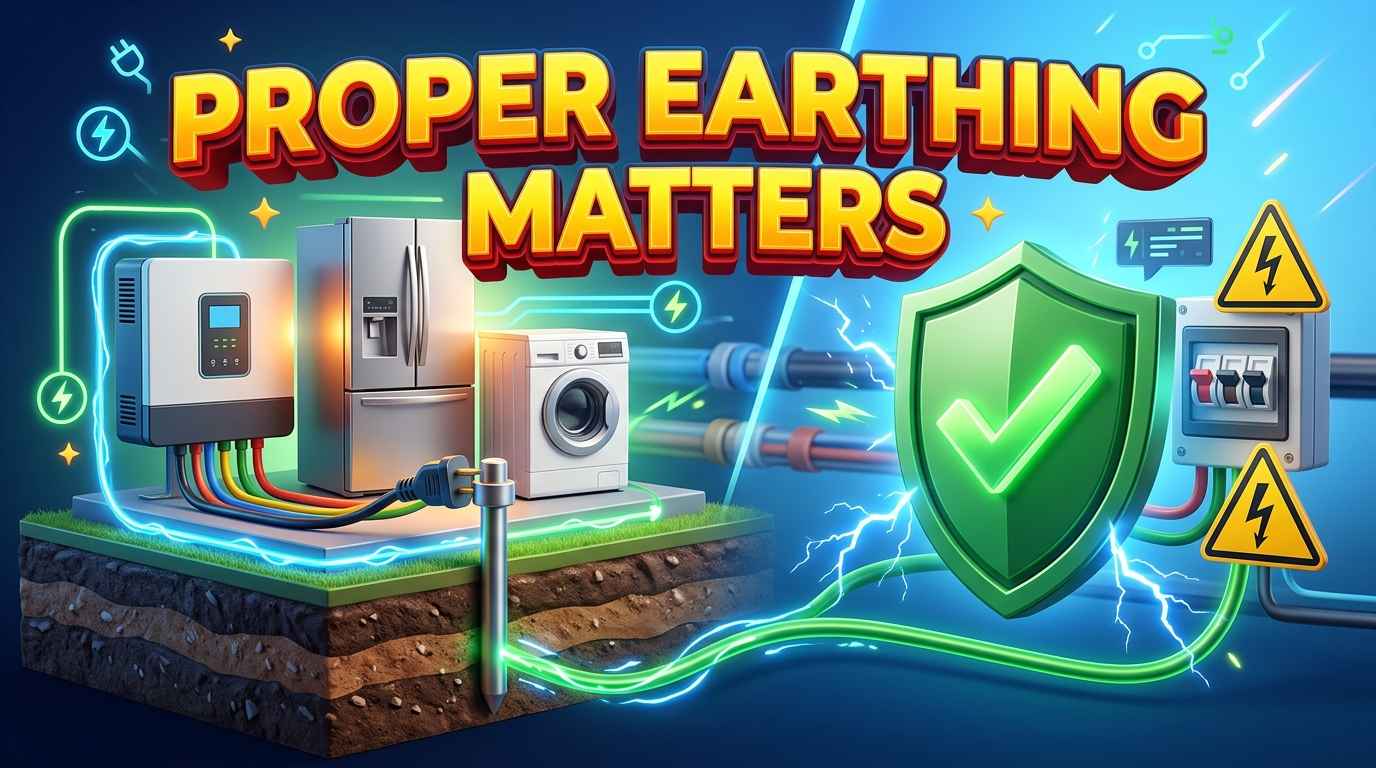
Earthing is one of the most important parts of a safe electrical system, but it is also one of the parts homeowners often ignore.
Many people spend money on a good solar inverter, batteries, appliances, MCBs, RCCBs and expensive wiring, but then pay little attention to the earthing system. This can create a serious weakness in an otherwise modern electrical installation.
A properly designed earthing system provides a path for fault current and helps keep exposed metal parts at a safer electrical potential. It works together with protective devices such as circuit breakers and residual-current protection to reduce the risk of electric shock, fire and equipment damage.
This becomes particularly important when a home has a solar inverter, lithium battery, refrigerator, washing machine, air conditioner, water pump, computer equipment or other modern appliances.
NEPRA’s Power Safety Code specifically calls for permanent earthing systems and explains that earthing can reduce the risk of electric shock, fire and equipment damage. NEPRA also recommends three-pin plugs for residential appliances and regular inspection and maintenance of electrical safety systems by qualified electricians.
In this guide, we explain what earthing is, why it matters, how it protects inverters and appliances, common earthing mistakes in Pakistan, how earthing relates to solar systems, and what homeowners should check before considering an electrical installation safe.
What Is Electrical Earthing?
Electrical earthing, sometimes called grounding, is a protective connection between an electrical installation and the earth.
In a typical electrical system, the earth conductor is connected to exposed conductive parts of equipment and to an earthing system designed for the installation.
The basic idea is simple:
If a fault causes electricity to reach a metal part that should not normally be energized, the earthing system provides a low-impedance path for fault current so that protective devices can operate and the dangerous voltage can be reduced or cleared.
For example, imagine a metal-bodied washing machine develops an internal insulation fault.
Without proper protective earthing, the metal body could become energized.
A person touching the washing machine while also providing a path to earth could then be exposed to electric shock.
With an appropriately designed protective-earth system, fault current has a deliberate path through the protective conductor, allowing the relevant protection to operate.
This is why earthing should never be considered just another wire.
It is part of the overall electrical safety system.
Why Is Earthing Important?
Proper earthing can help protect:
- People
- Solar inverters
- Batteries and battery systems
- Refrigerators
- Washing machines
- Air conditioners
- Water pumps
- TVs
- Computers
- Metal electrical enclosures
- Distribution boards
- Other electrical equipment
NEPRA’s current public safety guidance tells consumers to install earthing systems, have internal wiring inspected by trained electricians and use three-pin plugs and sockets for appliances such as washing machines, refrigerators and irons.
A properly designed system can help address several hazards.
1. Electric shock
Earthing helps provide a controlled path for fault current rather than leaving exposed metal parts at a dangerous potential.
2. Fire risk
Fault current and damaged insulation can create heating and arcing hazards. Proper protective coordination can help disconnect a faulty circuit.
3. Equipment damage
Electrical faults, surges and abnormal conditions can damage sensitive electronic equipment.
4. Inverter protection
Solar inverter manufacturers commonly require protective earthing as part of installation. The exact connection method depends on the inverter design and manufacturer instructions.
5. Protective-device operation
Earthing works together with devices such as MCBs and residual-current protection. It is not a replacement for them.
How Does Earthing Actually Work?
A simplified example makes the concept easier to understand.
Suppose an appliance has:
- Live conductor
- Neutral conductor
- Earth conductor
- Metal body
Under normal operation, electricity flows through the intended circuit.
The metal body should not carry operating current.
Now imagine the live conductor becomes damaged and touches the metal body.
Without proper earthing
The metal body may become energized.
The protective system may not disconnect the supply quickly enough, depending on the fault and installation.
With a properly designed protective-earth path
Fault current can flow through the protective path.
The protective device can then operate according to the system design.
The goal is to clear the dangerous fault rather than allowing the appliance body to remain at a hazardous voltage.
NEPRA’s Power Safety Code describes permanent earthing as a means of providing a path for fault current and reducing the risk of electric shock, fire and equipment damage.
Earthing vs Neutral – They Are Not the Same
One of the most common misconceptions is that neutral and earth are interchangeable.
They are not simply two names for the same wire.
Neutral
Neutral is part of the normal current-carrying circuit in a typical single-phase AC system.
Earth
The protective earth is primarily a safety conductor intended to help deal with faults and maintain exposed conductive parts at a safer potential.
A three-pin plug typically provides:
- Live
- Neutral
- Earth
NEPRA explicitly describes the three pins as serving different purposes and recommends three-pin plugs for residential appliances and equipment.
Never ask an electrician to “use neutral as earth” as a shortcut.
The installation needs to follow the applicable electrical design and protective requirements.
What Happens If a House Has No Proper Earthing?
A house may continue to operate even when its earthing is inadequate.
Lights can turn on.
Fans can run.
The refrigerator may work.
The solar inverter may appear normal.
This can create a false sense of security.
The problem may only become obvious when a fault occurs.
Possible consequences include:
- Electric shock
- Appliance body becoming energized
- Poor operation of protective systems
- Equipment damage
- Increased fire risk
- Unexpected inverter faults
- Leakage-current problems
- Greater vulnerability to certain surge events
The fact that an appliance is working does not prove that the electrical installation is safe.
Why Earthing Is Especially Important for Solar Inverters
Solar inverters contain electronic components that convert and control electrical energy.
Depending on the system, an inverter may be connected to:
- Solar panels
- DC isolators
- DC protection
- AC supply
- AC distribution board
- Batteries
- Communication equipment
- Monitoring equipment
- Metal mounting structures
This creates a more complex electrical system than a basic lighting circuit.
A properly designed protective and grounding system is therefore important.
However, an important point is often misunderstood:
Earthing does not mean an inverter can never be damaged.
Earthing is one part of a complete protection system.
Other protection may include:
- MCBs
- Fuses
- RCCBs/RCBOs
- DC protection
- AC surge protection
- DC surge protection
- Correct isolation
- Correct cable sizing
- Proper overcurrent protection
- Manufacturer-specified grounding
- Lightning/surge protection where appropriate
Does Earthing Protect a Solar Inverter From Lightning?
Earthing can be an important part of a properly designed lightning and surge-protection system, but simply driving an earth rod into the ground does not make a solar installation lightning-proof.
Lightning protection requires a coordinated system.
Depending on the installation, this may involve:
- Proper protective earthing
- Surge protective devices
- Correct bonding
- Appropriate DC protection
- AC surge protection
- Lightning protection system where required
- Correct cable routing
- Manufacturer requirements
NEPRA’s Power Safety Code discusses grounding of equipment and conductive structures and notes the role of grounding in reducing risks associated with faults and lightning-related energy.
For a solar installation in an area with significant lightning exposure, the design should be reviewed by a qualified professional rather than relying on an earth rod alone.
Solar Panel Earthing
Solar panels and their mounting structures can contain exposed conductive metal parts.
Depending on the system design and applicable standards, exposed conductive components may require bonding/earthing.
The exact arrangement depends on:
- Panel construction
- Mounting structure
- Inverter design
- System voltage
- DC architecture
- Surge protection
- Local requirements
- Manufacturer instructions
A solar installer should therefore follow the inverter and equipment manufacturer’s installation requirements rather than using the same earthing arrangement for every project.
Inverter Earthing
The inverter’s protective earth connection should be installed according to its manufacturer’s instructions.
This may involve the inverter chassis/enclosure and the protective-earth system of the building.
Some inverters have specific requirements concerning:
- PE connection
- Neutral-earth arrangement
- Backup output
- Generator input
- Battery system
- AC input
- AC output
- PV array
- Surge protection
This is particularly important with hybrid inverters because they can operate in different modes.
For example:
Grid mode → Solar + Grid
Battery mode → Battery + Inverter
Backup mode → Inverter → Essential loads
The protective arrangement must remain appropriate across the operating modes.
Why Earthing Matters for Lithium Batteries
Lithium batteries are increasingly used with solar systems in Pakistan.
A battery system can include:
- Battery modules
- BMS
- Metal cabinet
- DC cables
- DC protection
- Communication cables
- Inverter connection
The battery itself is not simply “made safe” by connecting one wire to an earth rod.
The installer needs to follow the battery manufacturer’s grounding, protection and installation instructions.
Where the battery enclosure or other exposed conductive parts require protective bonding, those connections should be correctly installed.
Earthing and Household Appliances
Earthing is not only for solar systems.
It matters for many everyday appliances.
Refrigerator
A refrigerator can have exposed metal components and electronic controls.
A proper protective-earth connection is important where required.
Washing Machine
Washing machines combine electricity, metal components and water, making correct electrical protection particularly important.
NEPRA specifically lists washing machines among appliances for which three-pin plugs and sockets should be used.
Air Conditioner
AC outdoor units contain metal enclosures and electrical components.
Proper protective earthing should be part of the installation.
Water Pump
A water pump can operate in wet environments, making electrical protection especially important.
Electric Geyser
A geyser combines electricity and water.
Correct earthing and residual-current protection are particularly important considerations.
Computer and TV
Electronic devices can be sensitive to electrical disturbances and surges.
Earthing is one part of a broader electrical protection strategy.
Earthing and MCBs
Many homeowners think:
“I have an MCB, so I don’t need earthing.”
This is incorrect.
An MCB primarily provides overcurrent protection.
For example, an MCB can respond to:
- Overload
- Short circuit
Earthing serves a different protective function.
The two systems work together.
A simplified protection chain is:
Fault → Earthing path → Fault current → Protective device operates → Fault disconnected
The exact behavior depends on the electrical system and protective-device design.
NEPRA states that protective mechanisms and permanent earthing should work together to protect people, equipment and property.
Earthing and RCCB/RCBO
Residual-current protection is another important part of electrical safety.
An RCCB detects an imbalance associated with residual/leakage current and can disconnect the circuit.
An RCBO can combine residual-current protection with overcurrent protection.
This means a modern residential installation may use several layers of protection:
Layer 1
Correct wiring
Layer 2
Protective earthing
Layer 3
MCB/fuse protection
Layer 4
RCCB/RCBO protection
Layer 5
Surge protection where appropriate
Layer 6
Proper inspection and testing
No single device replaces all the others.
What Is an Earth Rod?
An earth rod is one possible component of an earthing electrode system.
It is installed into the ground and connected to the electrical installation using an appropriate earthing conductor.
However, installing an earth rod does not automatically mean the house has a good earthing system.
The effectiveness of the complete system depends on factors such as:
- Soil conditions
- Electrode type
- Electrode arrangement
- Conductor size
- Connections
- Corrosion
- Installation quality
- Required grounding resistance
- System design
NEPRA states that fixed earthing/grounding resistance should be according to the design or manufacturer’s instructions.
Does More Than One Earth Rod Mean Better Earthing?
Not automatically.
You may hear claims such as:
“Install three rods and the earthing will be perfect.”
That is not a reliable universal rule.
The required electrode arrangement depends on the site and system design.
Two or more electrodes may sometimes be used where the design requires them, but simply adding rods without proper testing and bonding does not guarantee a safe installation.
The final system should be measured and verified appropriately.
What Is Earth Resistance?
Earth resistance is a measurement associated with how effectively an earthing electrode/system connects electrically to the surrounding earth.
A lower measured resistance can be desirable in many grounding applications, but there is no single number that should be blindly applied to every residential or solar installation.
The appropriate value depends on:
- System design
- Equipment manufacturer
- Applicable standards
- Protection requirements
- Soil conditions
- Type of installation
NEPRA’s safety code states that fixed earthing resistance should follow the design or manufacturer’s instructions.
Therefore, be careful when an installer claims:
“5 ohms is always perfect.”
or
“10 ohms is always enough.”
The correct requirement should come from the applicable design and equipment requirements.
How Is Earthing Tested?
Earthing should be tested using appropriate electrical test equipment by a qualified person.
A visual inspection alone cannot confirm the quality of an earthing system.
Testing may involve:
- Earth resistance measurement
- Continuity testing
- Protective conductor verification
- Polarity checks
- Insulation testing
- Residual-current protection testing
The exact tests depend on the installation.
NEPRA’s Power Safety Code calls for annual testing and maintenance of protective mechanisms by a qualified electrician.
Common Earthing Mistakes in Pakistan
1. No Earth Wire
Some older installations may have only live and neutral wiring.
This is a significant safety concern.
2. Fake Earth Connection
Sometimes an installer may connect an earth wire without establishing a proper protective-earth system.
A green/yellow wire alone does not prove that proper earthing exists.
3. Neutral Used as Earth
This is an unsafe shortcut.
Neutral and protective earth have different functions.
4. Poor Connections
Loose or corroded connections can increase resistance and reduce reliability.
5. No Earthing for Solar Structure
Solar mounting structures and other exposed conductive parts should be assessed according to the system design.
6. No Testing
Installing an earth electrode without measuring the completed system leaves an important question unanswered:
Does the system actually meet its intended requirements?
7. Earth Rod Installed but Not Properly Connected
An electrode is useless as a protective measure if the conductor connecting it to the installation is missing, damaged or improperly terminated.
8. Treating Earthing as a Solar-Only Requirement
Earthing is relevant to the entire electrical installation, not only the inverter.
9. Ignoring Manufacturer Instructions
Different inverters and battery systems can have different grounding arrangements.
Always check the installation manual.
Signs That Your Home May Have an Earthing Problem
Some warning signs include:
- Mild electric shock from appliance bodies
- Tingling sensation when touching metal appliances
- Sparks from equipment
- Repeated RCCB trips
- Strange inverter fault messages
- Damaged plugs
- Burn marks around sockets
- Old two-pin appliance connections
- No visible earth connection in the DB
- Very old wiring
- Unexplained electrical faults
However, the absence of these symptoms does not prove that earthing is correct.
The safest way to confirm an electrical installation is through proper inspection and testing.
Why You Should Not Test Earthing Yourself With a Multimeter
A multimeter can perform useful electrical measurements, but it is not a substitute for proper earth-testing equipment and professional inspection.
For example, seeing approximately normal voltage between live and earth does not prove that the complete earthing system will safely clear a fault.
A proper assessment may require specialized testing.
NEPRA advises consumers not to perform electrical repairs themselves and recommends trained/licensed electricians for electrical work and inspection.
Earthing During Solar Installation: A Practical Checklist
If you’re installing a solar system, ask the installer to explain:
Inverter
- Is the inverter protective earth connected?
- What does the manufacturer specify?
- How is the AC side earthed?
- How is the backup output handled?
Solar Panels
- Are exposed conductive mounting components bonded/grounded as required?
- Is the DC protection correctly designed?
- Are surge-protection requirements considered?
Battery
- Does the battery enclosure require protective bonding?
- What does the battery manufacturer specify?
- Is the battery cabinet properly connected?
AC Side
- Is the solar inverter connected to the appropriate DB?
- Is the protective earth continuous?
- Are MCB/RCCB/RCBO requirements addressed?
Surge Protection
- Are AC and DC surge-protection requirements considered?
- Is the arrangement appropriate for the site?
Testing
- Has the completed system been tested?
- Are the results documented?
- Has the installer followed the manufacturer’s instructions?
Earthing vs Lightning Protection
These terms are often confused.
Earthing
Primarily concerns the protective connection of electrical equipment and conductive parts to earth.
Lightning Protection
Deals with managing lightning currents and associated surge risks.
A lightning protection system can include:
- Air terminals
- Down conductors
- Earth electrodes
- Bonding
- Surge protective devices
A normal house earthing electrode should not automatically be described as a complete lightning-protection system.
For larger homes, commercial buildings or solar installations exposed to significant lightning risk, professional design may be appropriate.
Can Poor Earthing Damage an Inverter?
It can contribute to unsafe or abnormal electrical conditions, and it can reduce the effectiveness of the protection system.
However, it would be incorrect to say:
“Poor earthing always damages an inverter.”
Inverter failures can have many causes, including:
- Voltage problems
- Surges
- Overheating
- Incorrect wiring
- Overloading
- Component failure
- Installation errors
- Environmental conditions
Earthing is one part of the overall protection system.
Can Earthing Reduce Appliance Damage?
Proper earthing can help a protective system respond to certain fault conditions and can reduce the risk associated with exposed conductive parts.
But earthing is not a voltage stabilizer.
It does not automatically fix:
- Low voltage
- High voltage
- Voltage fluctuation
- Frequency problems
- Overload
- Poor-quality grid supply
For those problems, the appropriate protection may include:
- Voltage protection
- Surge protection
- Stabilization where required
- UPS/inverter systems
- Correct circuit design
Earthing vs Surge Protection
These are also different.
Earthing
Provides a protective path for fault currents and helps establish a reference/connection to earth as part of the electrical protection system.
Surge Protection
A surge protective device (SPD) is designed to limit transient overvoltage by diverting surge energy through an appropriate protective path.
A solar installation may require both.
A good electrical system therefore should not be described as:
“We installed earthing, so no surge protector is needed.”
The two perform different roles.
How to Improve Earthing in an Existing House
If you suspect an old house has poor earthing, don’t start by digging randomly around the property.
Instead:
Step 1: Have the DB inspected
Check whether protective-earth conductors are present.
Step 2: Inspect sockets
Confirm that appropriate three-pin outlets and protective-earth connections are installed.
Step 3: Check major appliances
Pay special attention to:
- Refrigerator
- Washing machine
- AC
- Pump
- Geyser
- Solar inverter
Step 4: Test the earthing system
Use appropriate professional testing equipment.
Step 5: Correct defects
Replace damaged wiring, incorrect connections or inadequate components.
Step 6: Check protection
Review MCBs, RCCBs/RCBOs and surge protection as appropriate.
Step 7: Document the system
Label the DB and keep records of the electrical work and test results.
How Much Does Earthing Cost in Pakistan?
There is no universal earthing price.
The cost can depend on:
- Soil conditions
- Electrode type
- Number of electrodes
- Copper/GI conductor
- Earth clamps
- Inspection chambers
- Labour
- Existing wiring
- Distance from DB to electrode
- Solar-system requirements
- Lightning-protection requirements
A basic residential earthing job can therefore cost much less than a complete solar or commercial grounding system.
Instead of asking only:
“How much is one earth rod?”
ask:
“What complete earthing system is being installed, what components are included, and how will it be tested?”
This gives you a much more meaningful comparison.
How to Choose an Electrician for Earthing Work
Don’t choose an electrician only because they offer the lowest price.
Ask:
- Do you test the completed earthing system?
- What testing equipment do you use?
- What conductor will you use?
- What electrode system are you proposing?
- How will the DB earth bar be connected?
- How will the solar inverter be connected?
- What does the inverter manufacturer require?
- Will you test protective devices?
- Will you provide test results?
- Are you qualified/licensed for the work?
NEPRA’s public guidance recommends qualified/licensed electricians for electrical work and regular inspection of internal wiring.
10 Important Earthing Tips for Homeowners
Tip 1: Never ignore a shock from an appliance
Even a small tingling sensation can indicate a serious electrical problem.
Tip 2: Don’t remove the earth pin
If an appliance has a three-pin plug, don’t remove or bypass the earth pin just to make it fit a two-pin socket.
Tip 3: Don’t connect earth to neutral as a shortcut
Use the correct protective-earth arrangement.
Tip 4: Test old electrical installations
Old houses should be professionally inspected.
Tip 5: Don’t rely on an earth rod alone
The complete protective system matters.
Tip 6: Follow inverter manuals
Different models can have different grounding requirements.
Tip 7: Consider surge protection
Especially for solar and sensitive electronic equipment.
Tip 8: Don’t overload sockets
NEPRA warns against overloaded sockets because of fire risk.
Tip 9: Keep electrical equipment away from water
Moisture significantly increases electrical safety risks.
Tip 10: Use qualified professionals
Electrical safety is not the place to experiment.
Frequently Asked Questions
What is the main purpose of earthing?
The main purpose of protective earthing is to provide an appropriate path for fault current and help reduce the risk of electric shock, fire and equipment damage.
Is earthing necessary for a solar inverter?
A solar inverter installation normally requires protective grounding/earthing according to the inverter manufacturer’s instructions and the applicable electrical requirements. The exact arrangement varies by inverter and system design.
Can an inverter work without earthing?
An inverter may appear to operate even when the installation’s earthing is inadequate. That does not mean the installation is safe or correctly installed.
Does earthing protect against high voltage?
Not by itself. Earthing is not a voltage stabilizer or voltage protector.
Does earthing protect appliances from lightning?
Earthing can be an important part of a properly designed lightning and surge-protection system, but an earth rod alone does not provide complete lightning protection.
Is neutral the same as earth?
No. Neutral and protective earth have different functions in an electrical installation.
How do I know whether my house has proper earthing?
A visual inspection can identify some obvious problems, but proper verification requires appropriate electrical testing by a qualified professional.
Is one earth rod enough?
Not necessarily. The appropriate earthing electrode arrangement depends on the electrical system, site conditions, design and applicable requirements.
Does every appliance need an earth wire?
The requirement depends on the appliance’s construction and protection class. Appliances with exposed conductive parts may require protective earthing, while some double-insulated equipment is designed differently. Follow the manufacturer’s instructions and applicable electrical requirements.
Can poor earthing cause inverter errors?
It can contribute to fault or protection-related issues in some installations, but inverter errors have many possible causes. The exact fault code and manufacturer documentation should be checked.
Should solar panels be earthed?
The exposed conductive parts and mounting system should be assessed according to the solar-system design, applicable requirements and manufacturer instructions.
Is earthing important in Pakistan?
Yes. NEPRA’s safety guidance specifically tells consumers to install earthing systems and recommends regular inspection of internal electrical wiring by qualified personnel.
Final Conclusion
Earthing is one of the most important safety foundations of a modern electrical system.
It is not simply a wire buried in the ground, and it is not something that matters only when installing solar.
A properly designed earthing system works together with:
- Correct wiring
- MCBs
- RCCBs/RCBOs
- Surge protection
- Proper isolation
- Correct cable sizing
- Appliance protection
- Solar inverter protection
- Regular inspection and testing
For homes with solar inverters, lithium batteries, air conditioners, refrigerators, washing machines, pumps and other electrical appliances, proper earthing becomes an especially important part of the overall electrical design.
The most important point is that earthing must be designed and tested as a complete system. Simply installing an earth rod or connecting a green wire does not prove that the installation is safe.
If you are constructing a new home, upgrading old wiring or installing a solar system, discuss earthing with the electrician or solar installer before the work begins. Ask what system is being installed, how it will be connected, what the inverter manufacturer requires and how the completed installation will be tested.
NEPRA’s current safety guidance emphasizes earthing, appropriate three-pin connections, inspection of internal wiring and qualified electrical work.
A good electrical system is not only about making electricity available—it is about making sure that electricity can be controlled safely when something goes wrong.