
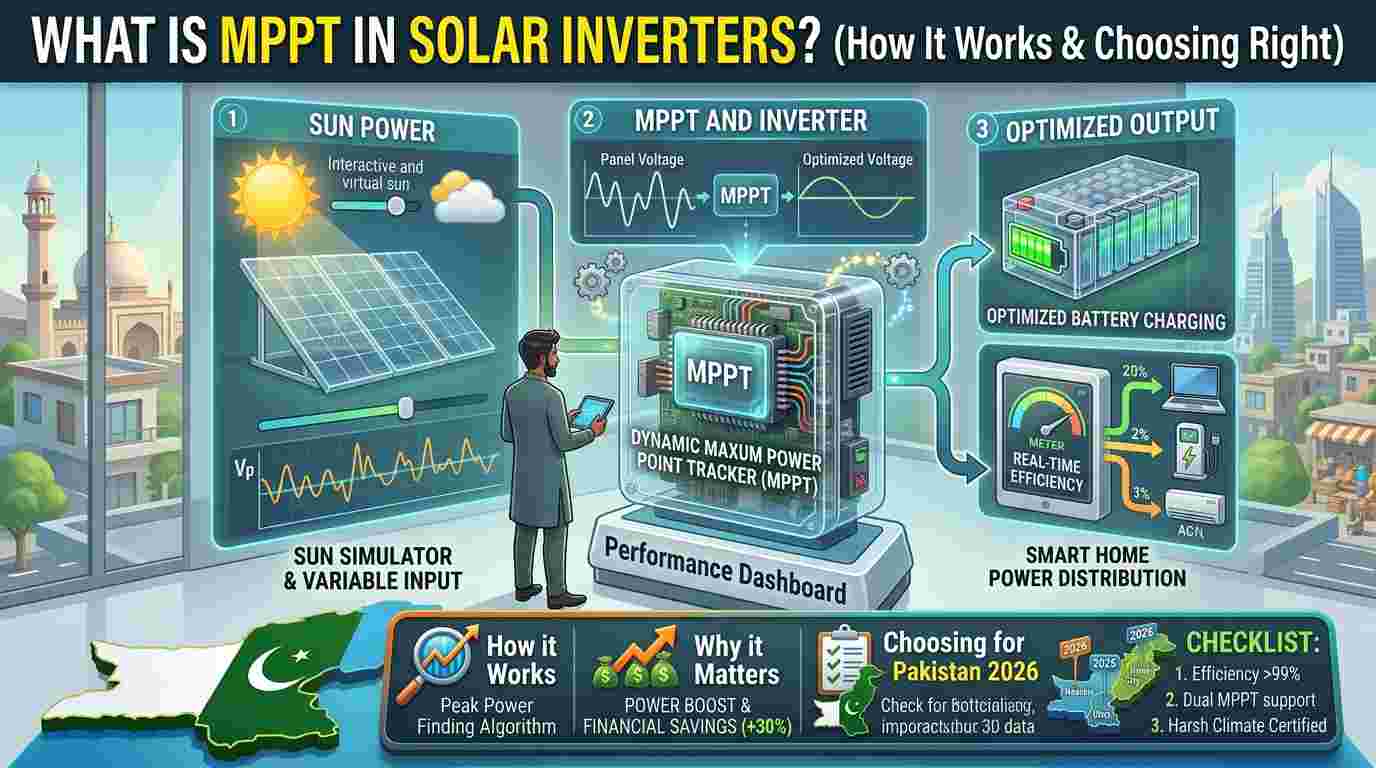
If you have recently compared solar inverters, you have probably seen the term MPPT mentioned in almost every modern solar inverter specification. You may see phrases such as 2 MPPTs, 3 MPPTs, MPPT voltage range, maximum PV voltage, maximum PV current, and sometimes separate MPPT inputs.
But what does MPPT actually mean, and why is it important?
MPPT stands for Maximum Power Point Tracking. It is a technology used in solar inverters and solar charge controllers to continuously adjust the operating point of a solar panel or solar array so the system can extract as much available power as possible under changing sunlight and temperature conditions.
This becomes especially important in Pakistan, where solar panels operate through very hot summers, changing sunlight intensity, dust, partial shading and different roof orientations.
For example, a 585W solar panel does not produce exactly 585 watts throughout the day. Its voltage and current change depending on sunlight, temperature, shading and other conditions. The MPPT system continuously looks for the point where the combination of voltage and current produces the highest available power.
Understanding MPPT can therefore help you choose a better inverter, design the correct solar panel string and avoid common installation mistakes.
What Does MPPT Mean in Solar?
MPPT means Maximum Power Point Tracking.
A solar panel has a particular operating point where its voltage and current produce its maximum electrical power.
The basic formula is:
Power = Voltage × Current
or:
P = V × I
Suppose a solar panel is operating at:
- Voltage = 40V
- Current = 14A
Its approximate power would be:
40 × 14 = 560W
However, the panel’s best voltage and current are not fixed throughout the day.
In the morning, the sunlight is weaker. Around midday, solar irradiance is normally stronger, but panel temperature can also become very high. Clouds can suddenly reduce irradiance. Dust and shading can also affect the operating point.
The MPPT circuit inside the inverter continuously adjusts the electrical operating point to find a useful maximum-power point.
Technical documentation from Victron Energy describes MPPT as a system that selects the optimum current-voltage point on the panel’s power curve, while NREL’s photovoltaic modeling documentation also treats inverter MPPT voltage limits as an important part of PV system design.
Why Does a Solar Panel Need MPPT?
A common misunderstanding is:
“If my panel is rated 585W, why can’t the inverter simply take 585W from it?”
The reason is that the panel’s voltage and current are constantly changing.
A solar panel does not behave like a fixed 585W electrical source.
Its output depends on factors such as:
- Sunlight intensity
- Cell temperature
- Panel orientation
- Shading
- Dust and soiling
- Panel characteristics
- Wiring
- System voltage
- Weather conditions
The inverter therefore needs to find an operating point that gives the best available power at that particular moment.
This is the job of MPPT.
Without suitable MPPT operation, the solar array may operate away from its maximum-power point and leave some available energy unused.
How Does MPPT Work?
The easiest way to understand MPPT is to imagine a solar panel connected to an intelligent electronic controller.
The controller continuously monitors the panel’s electrical output.
It looks at:
Voltage × Current = Power
It then changes the operating point and checks whether available power increases or decreases.
If the new operating point produces more power, the controller continues moving in that direction.
If power decreases, it adjusts in another direction.
Modern MPPT algorithms can respond very quickly to changing solar conditions.
This is particularly useful when clouds move across the sun or irradiance changes rapidly. Some modern MPPT systems also use more advanced algorithms to deal with partial shading, where more than one potential power peak can appear on the panel array’s power-voltage curve.
The important point is that MPPT does not “create” extra solar energy.
Instead, it helps the inverter use the available solar energy more effectively.
What Is the Maximum Power Point?
Every solar panel has an electrical curve describing the relationship between voltage, current and power.
The panel can operate at many combinations of voltage and current.
But one area of the curve provides the highest power.
This is called the:
Maximum Power Point (MPP)
Two important values are associated with it:
- Vmp = Voltage at maximum power
- Imp = Current at maximum power
The panel’s rated maximum power is approximately:
Pmax = Vmp × Imp
For example, imagine a hypothetical 585W panel with:
- Vmp = 42V
- Imp = 13.93A
Then:
42 × 13.93 ≈ 585W
These values are examples only. Always use the actual electrical specifications printed on the panel datasheet when designing a real system.
MPPT vs PWM – What Is the Difference?
MPPT is often compared with PWM, or Pulse Width Modulation.
The two technologies are not equivalent.
A traditional PWM controller essentially connects the solar array to the battery in a way that pulls the array voltage close to the battery-side voltage.
An MPPT controller, by contrast, can operate the solar array at a different voltage and convert the available power to the voltage required by the battery/load side.
Victron’s technical comparison explains that MPPT effectively decouples the solar-array voltage from the battery voltage, allowing a higher-voltage solar array to work with a lower-voltage battery system.
Simple comparison
| Feature | PWM | MPPT |
|---|---|---|
| Maximum Power Point Tracking | No | Yes |
| Solar-array voltage flexibility | Lower | Higher |
| Efficiency potential | Lower | Higher |
| Suitable for larger systems | Limited | Better |
| Series panel configuration | Limited by controller design | Common |
| Changing sunlight response | Basic | Advanced |
| Cost | Usually lower | Usually higher |
| Modern home solar inverter | Less common | Standard technology |
For a small, simple solar system, PWM can still have applications.
For modern residential solar systems, particularly higher-power systems, MPPT is generally the preferred technology.
Why MPPT Is Important in Pakistan
Pakistan’s solar environment presents some interesting challenges.
Solar panels can experience:
- Very high summer temperatures
- Dust accumulation
- Strong sunlight
- Changing weather
- Partial shading from nearby buildings
- Different roof directions
- Long DC cable runs
- Different panel orientations
Panel temperature is particularly important.
Solar modules generally lose electrical power as their cell temperature rises. Therefore, the panel’s output characteristics at a hot roof temperature can be quite different from the conditions used for its laboratory rating.
An MPPT system helps the inverter continuously operate the array within its available power region rather than assuming that one fixed voltage will always be ideal.
This is one reason inverter and string design should not be based only on the total panel wattage.
Does MPPT Increase Solar Panel Wattage?
No.
This is an important distinction.
If you install a 585W panel, MPPT does not turn it into a 700W panel.
Instead, MPPT helps the inverter operate the panel at an appropriate voltage/current combination so that available power is captured effectively.
Think of it this way:
Solar panel = produces available electrical energy
MPPT = finds a suitable operating point to harvest that energy
Inverter = converts/manages that electrical energy for the system
MPPT cannot compensate for:
- Severe shading
- Broken panels
- Incorrect wiring
- Excessive dust
- Poor installation
- Bad connectors
- An undersized or unsuitable inverter
What Is an MPPT Voltage Range?
When selecting a solar inverter, you will often see something like:
MPPT voltage range: 120V–550V
The exact figures vary by inverter.
This means the inverter’s MPPT system is designed to track the PV array within a specified operating-voltage region.
This is extremely important when deciding how many panels should be connected in series.
For example, if you connect several panels in series:
Panel 1 + Panel 2 + Panel 3 + Panel 4
their voltages approximately add together.
If one panel has a Vmp of around 42V, four panels may have an operating voltage around:
42 × 4 = 168V
Again, actual design must use the manufacturer’s Vmp, Voc and temperature coefficients.
The resulting string voltage must fit the inverter’s MPPT operating range.
NREL’s photovoltaic modeling documentation specifically identifies losses that can occur when array DC voltage falls outside an inverter’s rated MPPT voltage limits.
MPPT Voltage Range vs Maximum PV Voltage
These two specifications are often confused.
They are not the same thing.
MPPT operating voltage range
This tells you the voltage region where the inverter can actively track the maximum power point.
Maximum PV input voltage
This is the highest DC voltage the inverter is designed to accept.
For example, an inverter could have specifications conceptually like:
- MPPT operating range: 120–550V
- Maximum PV voltage: 600V
The solar string should be designed so that its operating voltage sits comfortably within the MPPT range while its maximum possible open-circuit voltage, particularly under cold conditions, does not exceed the inverter’s maximum PV voltage.
This is why simply saying:
“The panels are 10kW and the inverter is 10kW, so they are compatible.”
is not enough.
Voltage and current limits must also be checked.
Why Is Voc Important When Designing MPPT Strings?
Voc means Open-Circuit Voltage.
It is the voltage of a solar panel when it is not supplying current to a load.
Voc changes with temperature.
In general, PV open-circuit voltage increases as the module becomes colder.
Therefore, string design must consider the coldest expected operating condition, not just the hot summer condition.
SMA’s technical guidance states that the PV array’s open-circuit voltage on the coldest statistically expected day must not exceed the inverter’s maximum input voltage.
This is a critical safety and equipment-protection consideration.
For this reason, professional solar installers should calculate:
- Vmp
- Voc
- Imp
- Isc
- Temperature coefficients
- Number of panels in series
- Number of strings
- Inverter MPPT range
- Maximum PV voltage
- Maximum PV current
What Is a Multi-MPPT Inverter?
A modern inverter may have:
- 1 MPPT
- 2 MPPTs
- 3 MPPTs
- 4 or more MPPTs
The advantage of multiple MPPTs is that different groups of solar panels can be tracked separately.
This can be useful when panels are installed on different roof orientations.
For example:
MPPT 1: South-facing panels
MPPT 2: East-facing panels
Instead of forcing both groups to behave like one identical solar string, each MPPT can independently manage its connected PV input.
SMA describes multi-string inverters as having two or more string inputs, each with its own MPP tracker, making them particularly useful for differently oriented or partially shaded PV areas.
Why Multiple MPPTs Matter With Partial Shading
Imagine you have a house with:
- 6 panels facing south
- 6 panels facing west
The south-facing panels may receive strong sunlight during one part of the day while the west-facing panels perform better later.
If both groups are placed into an unsuitable common configuration, their different operating conditions can create unnecessary mismatch.
Separate MPPTs can make the system design more flexible.
The same concept applies to shading.
Suppose:
String A: receives full sunlight
String B: is shaded by a nearby building in the morning
Separating these groups using suitable MPPT inputs can help prevent one differently performing group from unnecessarily influencing the other.
SMA recommends grouping PV sections with similar irradiation and, where shading is significant, using separate MPP tracking for differently irradiated sections.
Is More MPPT Always Better?
Not necessarily.
An inverter with four MPPTs is not automatically better than an inverter with two MPPTs.
The correct question is:
How many independent PV orientations or strings does your solar system actually need?
For a simple roof where every panel:
- faces the same direction,
- has the same tilt,
- receives similar sunlight,
- and has no significant shading,
one or two properly designed MPPTs may be enough.
For a complicated roof with multiple orientations and shading, additional MPPT inputs can be very useful.
MPPT and Solar Panels in Series
When solar panels are connected in series:
Voltage increases
while the current remains approximately the same.
For example, if three panels each have an operating voltage around 42V:
3 × 42V = approximately 126V
This higher voltage can be useful because it may place the array comfortably within the inverter’s MPPT operating range.
Series connections can also reduce current for a given amount of power, which can help reduce resistive cable losses.
Victron explains that, for a given power, increasing array voltage reduces current, and cable losses are related to current squared.
However, the string must never exceed the inverter’s maximum voltage.
MPPT and Solar Panels in Parallel
When solar panels or strings are connected in parallel:
Voltage remains approximately the same
while current increases.
For example:
String 1 = 10A
String 2 = 10A
Parallel current is approximately:
10A + 10A = 20A
This can be useful when system design requires additional current rather than additional voltage.
However, the inverter’s maximum PV input current must be respected.
A Practical 585W Solar Panel Example
Let’s use a hypothetical 585W module to understand the concept.
Suppose the panel datasheet gives approximately:
- Power = 585W
- Vmp = 42V
- Imp = 13.93A
- Voc = 50V
These numbers are illustrative; actual panel specifications must be checked before installation.
If you connect four panels in series:
Approximate operating voltage
42 × 4 = 168V
Approximate string power
585 × 4 = 2,340W
Approximate operating current
Around 13.93A
Now imagine eight identical panels.
A possible configuration could be:
4S2P
That means:
- 4 panels in series
- 2 such strings in parallel
Approximate voltage:
168V
Approximate current:
13.93 × 2 = 27.86A
Approximate power:
585 × 8 = 4,680W
But this configuration should only be used if the selected inverter’s MPPT voltage and current limits support it.
The example demonstrates why panel wattage alone is not enough for inverter selection.
How Many MPPTs Do You Need?
There is no universal answer.
It depends on the roof and inverter.
One MPPT may be suitable when:
- All panels have the same orientation
- Tilt is similar
- Shading is minimal
- Strings are properly matched
Two MPPTs may be useful when:
- Roof has two major orientations
- East and west panels are installed
- Different sections experience different shading
- The inverter design requires separate strings
More MPPTs may be useful when:
- The roof has multiple orientations
- There are several independent PV sections
- Shading varies considerably
- The system has complex string requirements
The correct number should be determined from the actual roof layout and inverter specifications.
MPPT in On-Grid, Hybrid and Off-Grid Inverters
MPPT is not limited to one type of solar system.
MPPT in On-Grid Inverters
An on-grid inverter receives DC electricity from solar panels and converts it into AC electricity.
The MPPT section manages the PV input to find an appropriate maximum-power operating point.
Multiple MPPTs are common in modern string inverter designs.
MPPT in Hybrid Inverters
Hybrid inverters can combine:
- Solar panels
- Grid electricity
- Batteries
- Household loads
The PV side commonly uses MPPT technology to optimize the solar input.
This is particularly important because the inverter may need to decide how available solar energy should be used for loads, battery charging and other operating modes.
MPPT in Off-Grid Systems
Off-grid systems depend heavily on efficient solar energy harvesting because there may be no grid supply available.
An MPPT solar charge controller can operate the PV array at an appropriate voltage and convert that power into the voltage required by the battery system.
Does MPPT Work Better During Cloudy Weather?
MPPT can be particularly useful when sunlight changes quickly.
Clouds can cause solar irradiance to move up and down continuously.
A sophisticated MPPT algorithm can repeatedly search for the best available operating point instead of assuming that conditions remain constant.
Victron’s technical documentation specifically notes the benefit of fast MPPT tracking under rapidly changing light conditions and discusses advanced tracking under partial shading.
However, MPPT cannot recover energy that simply is not available.
If heavy clouds reduce the sunlight reaching the panels, solar production will still fall.
Does MPPT Improve Performance in Hot Weather?
MPPT does not eliminate the effect of heat.
Solar panels normally produce less power as cell temperature increases.
But because panel voltage changes with temperature, the inverter’s ability to track the array’s changing operating point remains important.
This is especially relevant in Pakistan, where roof-mounted panels can become very hot during summer.
A good solar system therefore requires both:
Good panel selection + correct MPPT/string design
rather than relying on MPPT alone.
Common MPPT Mistakes During Solar Installation
1. Choosing an inverter only by kW rating
A 10kW inverter is not automatically compatible with every 10kW panel array.
Always check:
- Maximum PV voltage
- MPPT voltage range
- Maximum PV current
- Number of MPPTs
- Maximum PV power
- String requirements
2. Ignoring Voc
This can be a serious design mistake.
The maximum string voltage must be checked against the inverter’s maximum DC input voltage, including temperature effects.
3. Putting differently shaded strings together
Strings with significantly different irradiation conditions may not perform optimally when incorrectly combined.
4. Mixing panels without checking specifications
Panels with different electrical characteristics can create mismatch problems.
SMA’s installation guidance recommends that PV modules connected within the relevant input configuration be appropriately matched in type, alignment and string arrangement.
5. Ignoring current limits
Even if the voltage is correct, the MPPT input current must remain within the inverter’s permitted limit.
6. Assuming two MPPT connectors always mean two independent MPPTs
Some inverter manufacturers provide multiple physical connectors associated with the same MPPT tracker.
Always read the actual inverter datasheet.
How to Choose the Right MPPT Inverter in Pakistan
Before purchasing an inverter, ask your installer to provide the following information.
1. Solar panel model
Know the exact panel model and its:
- Wattage
- Voc
- Vmp
- Isc
- Imp
- Temperature coefficients
2. Number of panels
Calculate the total number of modules.
3. String configuration
Determine:
- Panels per string
- Number of strings
- Series connection
- Parallel connection
4. Inverter MPPT range
Check whether the calculated string Vmp falls within the inverter’s operating range.
5. Maximum DC voltage
Check the calculated worst-case string Voc against the inverter’s maximum PV voltage.
6. Maximum MPPT current
Check the combined current of parallel strings against the inverter input specification.
7. Number of independent MPPTs
Choose an inverter with enough independent trackers for the roof’s actual layout.
Is a 2-MPPT Inverter Better Than a 1-MPPT Inverter?
It depends on your installation.
For example:
Simple roof
All 12 panels face the same direction with similar sunlight.
A single well-designed MPPT arrangement may be sufficient.
Two-direction roof
Six panels face east and six face west.
Two independent MPPTs can be more useful.
Shaded roof
Some panels are affected by a nearby building or water tank.
Separate MPPT tracking may provide a better design depending on the exact shading pattern.
Therefore, don’t buy an inverter simply because the box says “2 MPPT” or “3 MPPT.”
Look at how those MPPTs can actually be used.
MPPT and Battery Voltage
In battery-based systems, MPPT also allows the solar-array voltage to be different from the battery voltage.
For example, a battery system may be:
48V
while the PV array operates at a considerably higher voltage.
The MPPT controller converts the solar power into the voltage/current combination required for battery charging.
This is one of the major differences between MPPT and basic PWM operation.
This flexibility is particularly valuable for larger battery-based solar systems.
What Does “2 MPPT, 2 Strings” Mean?
These terms are sometimes confused.
An inverter may have:
2 MPPTs
and physically provide:
4 PV connectors
That does not necessarily mean four independent trackers.
For example, the design could effectively be:
- MPPT 1 → String A + String B
- MPPT 2 → String C + String D
The exact configuration depends on the inverter.
Therefore, always read the manufacturer’s wiring diagram.
Can MPPT Solve Shading Problems Completely?
No.
MPPT can help optimize the available power, but it cannot make a shaded panel produce the same energy as an unshaded panel.
If a panel is heavily shaded:
- Solar irradiance reaching the cells is reduced
- Available electrical power decreases
- String behavior can change
- Multiple local power peaks can potentially appear
Advanced inverter algorithms can help locate a better operating point, but proper system layout remains the best solution.
Where possible, avoid shading before relying on advanced electronics to manage it.
Why Professional Solar Design Matters
Solar installation is not simply:
Panel wattage + inverter wattage = system
A properly designed system considers:
Panels → strings → MPPTs → inverter → AC protection → distribution → loads
The DC side is particularly important because solar panels can produce dangerous DC voltage even when the grid is unavailable.
Incorrect string voltage, poor connectors, unsuitable cables or improper protection can create equipment and safety risks.
PV string design should therefore be carried out according to the manufacturer’s specifications and applicable electrical requirements.
For residential installations, qualified solar/electrical professionals should handle high-voltage DC connections and protection equipment.
2026 Solar Inverter Trend: Smarter MPPT Management
Modern solar inverters are becoming more intelligent than older basic designs.
Current systems increasingly combine:
- Multiple MPPT inputs
- Wider PV operating ranges
- Remote monitoring
- Advanced shade management
- Battery integration
- Smart energy management
- Faster tracking algorithms
- More detailed PV performance data
Some advanced MPPT systems are specifically designed to identify multiple power points that can occur under partial shading rather than simply stopping at the first local maximum.
This does not mean every homeowner needs the most expensive inverter.
The better approach is to choose technology that matches the actual solar array.
Quick MPPT Checklist Before Buying a Solar Inverter
Before purchasing an inverter for your home or business, check these points:
✔ What is the inverter’s MPPT voltage range?
✔ What is its maximum PV voltage?
✔ What is the maximum MPPT input current?
✔ How many independent MPPT trackers are available?
✔ How many strings can each MPPT support?
✔ What are the panel Voc and Vmp values?
✔ How many panels will be connected in each string?
✔ What happens to Voc during cold conditions?
✔ Are panels on different roof orientations?
✔ Is there partial shading?
✔ Are all panels properly matched?
✔ Does the inverter support your intended battery voltage if it is a hybrid/off-grid system?
If these questions are answered correctly, you are much less likely to face MPPT-related design problems later.
Frequently Asked Questions About MPPT
What is MPPT in a solar inverter?
MPPT means Maximum Power Point Tracking. It continuously adjusts the solar array’s operating point to help extract the maximum available electrical power under changing conditions.
Is MPPT necessary for solar panels?
For modern residential and higher-power solar systems, MPPT is highly important because panel voltage and current change with sunlight and temperature. It allows the inverter to operate the PV array at an appropriate power point.
Is MPPT better than PWM?
For many modern solar applications, especially larger systems and systems where panel voltage differs significantly from battery voltage, MPPT offers important advantages over PWM. PWM can still be suitable for some small and simple systems.
Does MPPT increase the wattage of a solar panel?
No. MPPT does not increase the panel’s rated wattage. It helps the system operate the panel at a point where the available solar power can be harvested effectively.
What is Vmp?
Vmp is the voltage at which a solar panel produces its maximum rated power under specified test conditions.
What is Voc?
Voc is the open-circuit voltage of a solar panel. It is important when calculating the maximum voltage of a series-connected PV string.
Why do some inverters have two MPPTs?
Two MPPTs allow different PV sections to be tracked independently. This can be useful when panels have different orientations or different shading conditions.
Can I connect panels with different wattages to the same MPPT?
It depends on the exact electrical characteristics and inverter design. Mixing panels with significantly different specifications in the same string or improperly combining them can cause mismatch and should be avoided unless the system is specifically designed for it.
Does MPPT work during cloudy weather?
Yes. MPPT continues tracking the available operating point as solar conditions change. However, cloudy weather reduces the energy available from the panels, so MPPT cannot compensate for a major reduction in sunlight.
Does MPPT work better in Pakistan’s hot weather?
MPPT remains important because panel voltage and power characteristics change with temperature. However, high temperature itself still reduces PV performance. Correct panel selection, ventilation, installation and system design are also important.
How many MPPTs does my solar system need?
There is no fixed number. It depends on panel orientation, shading, string design and the inverter’s specifications. A simple roof may require fewer independent trackers than a complex roof with multiple orientations.
Can MPPT reduce solar cable losses?
A higher-voltage PV string can carry lower current for the same power, which can reduce resistive cable losses when the system is correctly designed.
Final Thoughts: Is MPPT Important for Your Solar System?
Yes — MPPT is one of the most important technologies inside a modern solar inverter.
It allows the inverter to continuously work with the changing electrical characteristics of the solar panels instead of treating the PV array as a fixed electrical source.
For a homeowner in Pakistan, the real benefit is not simply seeing the word “MPPT” on an inverter specification sheet. The important thing is whether the MPPT system is correctly matched to the solar panels, string configuration, roof orientation, shading conditions and inverter voltage/current limits.
When planning a solar system, don’t choose an inverter only by its kW capacity.
Look at:
- MPPT voltage range
- Maximum PV voltage
- Maximum PV current
- Number of independent MPPTs
- Panel Vmp and Voc
- String configuration
- Temperature effects
- Roof orientation
- Shading
- Battery requirements for hybrid systems
A properly designed MPPT configuration can help your solar array operate efficiently across changing sunlight and temperature conditions throughout the day.
If you are planning a new solar system in Bahawalpur or anywhere in Pakistan, Punjab Solar Bahawalpur can help you evaluate your panel configuration, inverter requirements, system capacity and installation needs based on your actual electricity load and roof conditions.
The goal should not simply be to install more solar panels. The goal is to build a properly matched solar system where the panels, strings, MPPTs, inverter, protection equipment and loads work together efficiently and safely.