
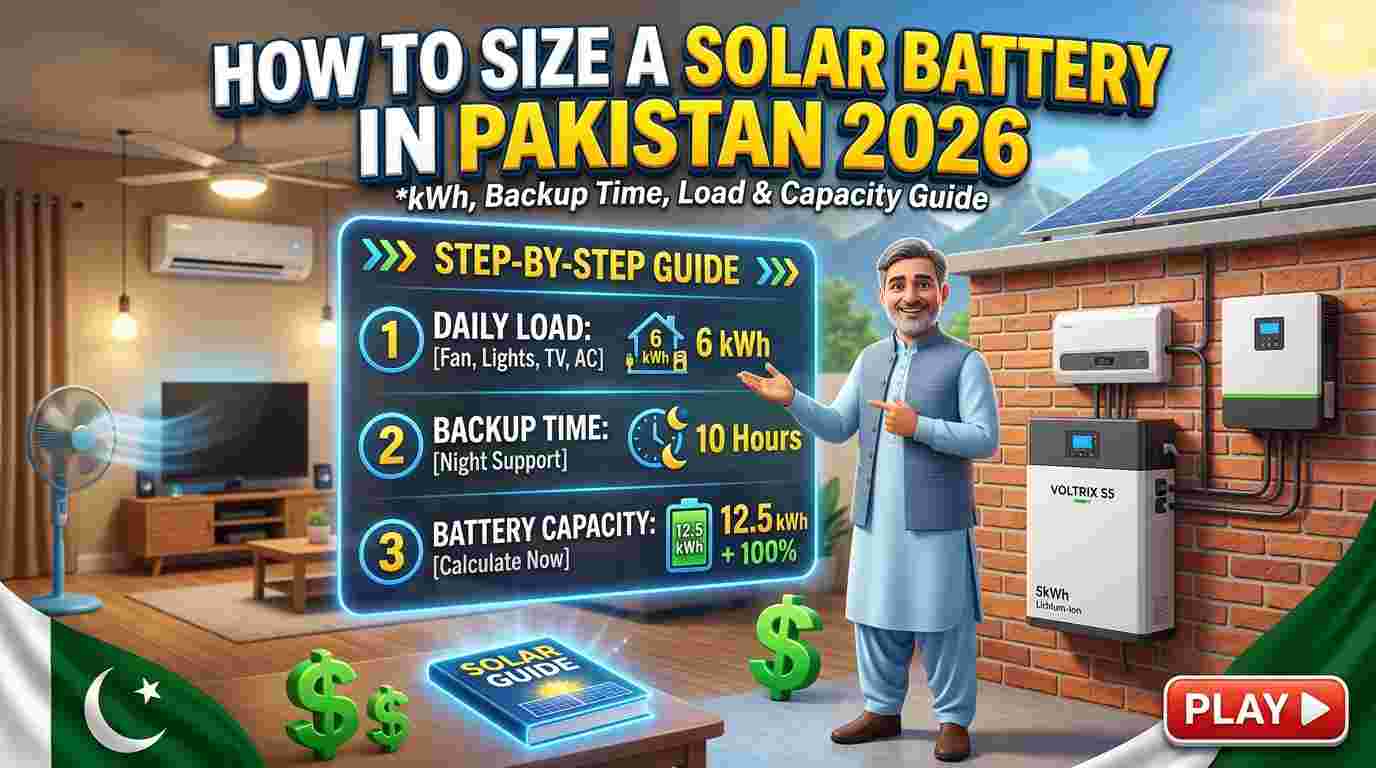
Solar panels generate electricity during the day, but what happens when the sun goes down?
This is where a solar battery becomes important.
For homes and businesses in Pakistan, battery storage is becoming an increasingly important part of solar system planning. A battery can store surplus solar energy during the day and make that energy available later for fans, lights, refrigerators, TVs, internet equipment, water pumps and other selected loads.
But one of the biggest mistakes people make when buying a battery is choosing it only by its advertised capacity.
Someone may ask:
“Is a 5kWh battery enough for my home?”
The correct answer depends on how much power your appliances consume, how long you want backup, how much of the battery’s capacity is usable, what inverter you have, and whether the battery is being charged by solar during the day.
A 5kWh battery can be sufficient for one household’s essential loads but completely inadequate for another household running multiple air conditioners.
This guide explains how to calculate the right solar battery size for a home or business in Pakistan in 2026.
What Is Solar Battery Capacity?
Battery capacity is commonly expressed in:
- Wh = Watt-hours
- kWh = Kilowatt-hours
- Ah = Ampere-hours
For household solar systems, kWh is usually the easiest way to understand stored energy.
For example:
1 kWh = 1,000 Wh
A battery rated at 5.12kWh theoretically stores around:
5,120Wh
of energy under its specified conditions.
However, the entire rated capacity may not always be available to your appliances.
This is because battery systems have:
- Depth of Discharge (DoD) limits
- Conversion losses
- Inverter losses
- Battery management limits
- Temperature effects
- Age-related capacity reduction
Therefore:
Rated battery capacity ≠ guaranteed usable AC energy
This distinction is extremely important when sizing a solar battery.
Why Do You Need a Solar Battery?
A battery can provide several benefits.
1. Night-time solar usage
Your solar panels generate electricity during daylight hours, but household consumption continues after sunset.
A battery allows excess daytime solar generation to be stored for later use.
2. Backup during load shedding
If the grid goes off, a properly configured hybrid/off-grid system can use stored energy to supply selected loads.
3. Better solar self-consumption
Instead of exporting or wasting surplus solar energy, the system can store some of it and use it later.
4. Essential-load backup
You can configure a backup circuit for important appliances such as:
- Fans
- Lights
- Refrigerator
- Wi-Fi router
- Computers
- Security cameras
- Television
- Selected water pumps
5. Reduced dependence on grid electricity
Depending on the system design, battery storage can reduce the amount of electricity purchased from the grid during certain periods.
The Most Important Question: What Do You Want the Battery to Run?
Before buying a battery, don’t start with:
“How many kWh should I buy?”
Start with:
“Which appliances do I want to run, and for how many hours?”
This simple change can prevent a lot of unnecessary expense.
For example, you may want the battery to run only:
- 4 fans
- 6 LED lights
- 1 refrigerator
- Wi-Fi router
- 1 television
You may not need to include:
- Electric geyser
- Electric heater
- Iron
- Large water pump
- Multiple air conditioners
- Electric cooking appliances
unless your battery and inverter are specifically sized for those loads.
Step 1: Make a Load List
Create a simple table of the appliances you want to operate from the battery.
For example:
| Appliance | Quantity | Approx. Power | Total |
|---|---|---|---|
| LED lights | 6 | 10W | 60W |
| Ceiling fans | 4 | 70W | 280W |
| Refrigerator | 1 | 150W average* | 150W |
| TV | 1 | 100W | 100W |
| Wi-Fi router | 1 | 15W | 15W |
| Laptop | 1 | 60W | 60W |
| Approx. total | 665W |
*A refrigerator’s actual consumption changes because its compressor cycles on and off.
This example gives an estimated running load of around:
665W
That does not mean the refrigerator will continuously consume exactly 150W.
Real-world appliance consumption varies.
For accurate sizing, actual measured consumption is better than relying only on the label.
Step 2: Calculate Energy Consumption
Once you know the approximate load, calculate how many hours you want it to run.
The basic formula is:
Energy = Power × Time
If your load is approximately:
665W
and you want to operate it for:
6 hours
then:
665 × 6 = 3,990Wh
or approximately:
3.99kWh
So you would need around 4kWh of usable energy before considering system losses and battery reserve.
This is why a 5kWh battery might work for this particular example, while the same battery may be completely unsuitable for a home running several high-power appliances.
Step 3: Understand Usable Battery Capacity
This is one of the most important concepts in battery sizing.
Suppose you purchase a:
5.12kWh lithium battery
You should not automatically assume that 5.12kWh will always reach your appliances as usable AC energy.
Battery manufacturers specify operating limits, and the inverter also has conversion losses.
Depth of Discharge, commonly called DoD, describes how much of the battery’s stored energy is used.
For example, an 80% DoD means approximately 80% of the rated capacity is being used.
A simple calculation would be:
5.12kWh × 80% = 4.096kWh
So approximately 4.1kWh would be considered usable at that assumed DoD before considering other system losses.
Actual usable capacity should always be based on the manufacturer’s specifications.
Victron’s current battery-sizing guidance similarly distinguishes between rated and usable capacity and notes that lithium batteries can generally provide a larger usable fraction of their rated capacity than lead-acid batteries.
What Is Depth of Discharge (DoD)?
Depth of Discharge tells you how deeply a battery has been discharged.
For example:
20% DoD
Only 20% of the battery’s capacity has been used.
50% DoD
Half of the battery’s capacity has been used.
80% DoD
Approximately 80% has been used.
100% DoD
The battery has been discharged to its specified full-discharge limit.
A battery’s recommended DoD depends on its chemistry, manufacturer and system design.
Repeatedly operating a battery at maximum possible discharge can increase stress.
Battery University notes that discharge depth, temperature and load all influence battery aging and cycle life.
For this reason, battery sizing should leave a sensible reserve rather than intentionally running the battery to its absolute limit every night.
How to Calculate Solar Battery Size
A useful basic formula is:
Required Battery Capacity = Required Energy ÷ Usable Fraction
If your appliances require:
4kWh
and you plan around an 80% usable fraction:
4 ÷ 0.80 = 5kWh
Then you should also consider inverter losses, operating conditions and some additional design margin.
So a practical design might move toward a battery somewhat larger than the simple 5kWh mathematical result.
This is why professional battery sizing should not stop at one calculator formula.
Practical Example: 5.12kWh Battery
Let’s assume you have a:
5.12kWh lithium battery
and approximately:
4.1kWh usable energy
under an illustrative 80% usable-capacity assumption.
Suppose your average backup load is:
500W
The theoretical runtime would be:
4.1kWh ÷ 0.5kW = 8.2 hours
But real-world runtime can be lower because of:
- Inverter efficiency
- Battery voltage variation
- Appliance startup loads
- Battery temperature
- Battery protection limits
- Wiring losses
- Battery aging
So don’t advertise an exact 8.2-hour backup time to a customer simply from the rated capacity.
A more realistic calculation should include system losses and an appropriate reserve.
How Long Will a 5kWh Battery Last?
There is no single answer.
Here are simplified examples using a hypothetical 5kWh usable energy figure:
| Average Load | Approx. Theoretical Runtime |
|---|---|
| 250W | 20 hours |
| 500W | 10 hours |
| 750W | 6.7 hours |
| 1,000W | 5 hours |
| 1,500W | 3.3 hours |
| 2,000W | 2.5 hours |
| 3,000W | 1.7 hours |
| 4,000W | 1.25 hours |
These are theoretical calculations, not guaranteed real-world runtimes.
Actual runtime will be lower or different depending on the battery’s usable capacity, inverter efficiency, appliance behavior and battery condition.
The table demonstrates an important point:
Battery capacity determines energy duration, while inverter power capability determines how much load can be supplied at one time.
These are two different things.
Battery kWh vs Inverter kW
Many people confuse these measurements.
Battery capacity = kWh
This tells you approximately how much energy the battery stores.
Inverter capacity = kW
This tells you how much power the inverter can supply at a given moment, subject to its specifications.
For example:
Battery: 10kWh
Inverter: 5kW
The battery may contain enough energy to operate a 1kW load for several hours, but the inverter’s output limit is still around 5kW.
Likewise:
Battery: 5kWh
Inverter: 10kW
does not mean the battery can provide 10kW for a long period.
The battery may have enough power capability for a high instantaneous load depending on its specifications, but its energy reserve is still only around 5kWh rated.
Battery Capacity in Ah and kWh
Some batteries are advertised in:
Ah
while others are advertised in:
kWh
You can convert between them using:
Energy (Wh) = Voltage × Amp-hours
For example, a nominal:
51.2V, 100Ah
battery gives:
51.2 × 100 = 5,120Wh
or:
5.12kWh
This is why many modern 48V-class lithium batteries are described as approximately 5.12kWh.
However, the nominal voltage and actual operating voltage are not always identical, so the manufacturer’s stated energy rating should be used for final system design.
Why 48V Batteries Are Common in Solar Systems
For larger residential solar systems, 48V-class battery systems are common.
Compared with very low-voltage battery systems, a higher battery voltage can reduce the current required for the same power.
For example, ignoring losses:
At 48V:
5,000W ÷ 48V ≈ 104A
At 24V:
5,000W ÷ 24V ≈ 208A
At 12V:
5,000W ÷ 12V ≈ 417A
Higher current requires appropriately sized cables, connectors, fuses and protection equipment.
Therefore, higher-voltage battery architectures can be more practical for larger loads, provided the inverter and battery are designed to work together.
How Much Battery Do You Need for a 5kW Solar System?
This is another question with no universal answer.
A 5kW solar system does not automatically require a 5kWh battery.
Your battery should be sized according to:
- Night-time consumption
- Desired backup duration
- Essential loads
- Load-shedding schedule
- Solar generation
- Battery charging opportunity
- Inverter specifications
- Budget
For example:
Light night-time usage
You may only need:
5kWh battery
Moderate night-time usage
You may prefer:
10kWh battery
Heavy night-time usage
You may require:
15kWh or more
The solar array also needs to be large enough to recharge the battery while simultaneously serving daytime loads.
Example: 5kW Solar System With 5.12kWh Battery
Imagine a home has:
5kW solar panels
and:
5.12kWh lithium battery
During the day:
- Solar panels generate electricity.
- Household loads consume some of it.
- Excess solar can charge the battery.
- Once the battery reaches its charging target, excess energy can be handled according to the inverter/system configuration.
At night:
- Solar generation falls to zero.
- The battery supplies selected loads.
- The inverter converts battery DC energy into AC electricity.
- The system stops battery discharge according to configured limits.
The actual result depends on solar production, daytime consumption and the battery’s state of charge.
How Much Battery Do You Need for a 10kW Solar System?
Again, don’t automatically match:
10kW solar = 10kWh battery
You may have a 10kW solar array but only need 5kWh of battery storage for essential night-time loads.
Alternatively, a large home may want:
15–20kWh or more
if it expects significant evening and night-time consumption.
The correct battery size comes from the energy requirement, not simply the solar panel capacity.
How Much Battery Do You Need for Air Conditioning?
Air conditioners change battery sizing dramatically.
A small fan might consume tens of watts.
An air conditioner can consume hundreds or thousands of watts depending on its capacity, efficiency, operating mode and conditions.
Inverter ACs also vary their power consumption instead of always operating at one fixed wattage.
Suppose an AC averages:
1,200W
for 5 hours.
Energy requirement:
1.2 × 5 = 6kWh
That is already more than the useful energy available from many small residential batteries.
Now add:
- Fans
- Refrigerator
- Lights
- TV
- Internet
- Other appliances
and the required battery capacity can become significantly larger.
Therefore, if you want overnight AC backup, battery sizing should be based on actual AC consumption rather than its nominal tonnage alone.
Can a 5.12kWh Battery Run an AC?
It depends.
If the battery has around 5.12kWh rated capacity, the actual usable AC energy will be lower than the nameplate value after considering usable DoD and conversion losses.
A small efficient inverter AC running for a limited period might be possible.
But running a high-power AC continuously for many hours can consume a large portion of the battery.
The correct calculation is:
AC average power × desired operating hours
Then add the other loads you want to run.
Don’t Forget Starting Loads
Some appliances have startup or surge requirements.
Examples include:
- Refrigerators
- Water pumps
- Motors
- Some compressors
- Certain power tools
The inverter must be capable of handling these loads.
A battery may have enough kWh capacity but still fail to operate an appliance if:
- Inverter surge rating is insufficient
- Battery discharge current is insufficient
- BMS limits are reached
- Wiring is undersized
This is another reason why energy capacity and power capability must be checked separately.
Lithium Battery Sizing for Solar
Lithium batteries have become popular for residential solar because they can offer:
- High usable capacity
- Compact design
- Good cycle performance
- Lower maintenance than traditional flooded lead-acid systems
- High energy density
- Communication with compatible hybrid inverters on many systems
However, “lithium battery” is not a complete specification.
You should also check:
- Battery chemistry
- Nominal voltage
- Rated capacity
- Usable capacity
- Recommended DoD
- Maximum continuous charge current
- Maximum continuous discharge current
- Peak discharge current
- Cycle-life specification
- Operating temperature
- Communication protocol
- BMS
- Warranty
- Compatible inverter list
What Is BMS and Why Does It Matter?
BMS means Battery Management System.
A BMS monitors and protects battery cells.
Depending on the battery design, it can manage or protect against conditions such as:
- Overcharge
- Over-discharge
- Excessive current
- High temperature
- Low temperature
- Cell imbalance
- Other abnormal operating conditions
A good battery/inverter combination should be properly configured so that the inverter understands the battery’s operating requirements when communication is supported.
Battery Temperature Matters in Pakistan
Pakistan’s summer temperatures make battery placement especially important.
Lithium batteries should not simply be installed in an extremely hot, enclosed space and forgotten.
Prolonged elevated temperatures can accelerate battery aging.
Battery University notes that elevated temperature can shorten lithium-ion battery life and that high temperature combined with high state of charge can increase stress.
Therefore:
Better battery location
- Cool
- Dry
- Ventilated
- Protected from direct sunlight
- Away from unnecessary heat sources
- Accessible for inspection
Do not place a battery where the enclosure can become excessively hot simply because it is close to the solar inverter.
Always follow the battery manufacturer’s installation temperature and clearance requirements.
Should You Oversize Your Battery?
Sometimes.
Oversizing can be useful because it can provide:
- More backup
- Lower average depth of discharge
- More reserve capacity
- Better flexibility for future loads
- Less stress during heavy usage
But oversizing also increases cost.
If you purchase a 20kWh battery but normally use only 2kWh overnight, much of that investment may remain unused.
The goal is not to buy the largest battery possible.
The goal is to find the right balance between:
Capacity + backup requirement + budget + solar charging capability
What Happens If the Battery Is Too Small?
An undersized battery can cause:
- Short backup time
- Frequent deep discharges
- Battery reaching low state of charge quickly
- Loads switching back to grid
- More frequent cycling
- Poor user experience during load shedding
If your household repeatedly needs more energy than the battery can provide, increasing battery capacity may be more practical than repeatedly changing operating settings.
What Happens If the Battery Is Too Large?
An oversized battery is not necessarily harmful, but it can be financially inefficient.
Potential disadvantages include:
- Higher initial cost
- More installation space
- More weight
- More battery modules
- Longer charging time if solar capacity is insufficient
- More expensive replacement later
A large battery should therefore be supported by an adequate solar charging source.
Battery Size for Common Home Loads
The following are illustrative examples rather than fixed appliance specifications.
Small essential-load backup
Loads:
- Fans
- Lights
- Router
- Refrigerator
- TV
Possible storage range:
5–10kWh
Medium home backup
Loads:
- Multiple fans
- Lights
- Refrigerator
- TV
- Computers
- Small appliances
- Selected pump
Possible storage range:
10–15kWh
Large backup requirement
Loads:
- Multiple ACs
- Pumps
- Refrigerator/freezer
- Full lighting
- Kitchen appliances
- Other heavy loads
Possible requirement:
15kWh+
These are starting points only. Actual sizing should use measured or calculated consumption.
Battery Sizing Example for a Pakistani Home
Suppose a family wants backup for these essential loads:
- 4 fans = approximately 280W
- 6 lights = approximately 60W
- Refrigerator = approximately 150W average
- TV = 100W
- Router = 15W
- Laptop = 60W
Approximate total:
665W
They want:
7 hours
of backup.
Energy requirement:
665 × 7 = 4,655Wh
or:
4.655kWh
If the battery design uses approximately 80% usable capacity:
4.655 ÷ 0.80 = 5.82kWh
Then inverter losses and a practical reserve should also be considered.
Therefore, a battery around 6kWh or larger could be a reasonable starting point for investigation.
A 5.12kWh battery may be close to the requirement but could provide less than the desired runtime once real-world losses and reserve are included.
This example shows why selecting a battery only because “5kWh sounds enough” can produce disappointing results.
Should You Buy One Large Battery or Multiple Smaller Batteries?
This depends on the battery system.
For example, a homeowner might compare:
1 × 10kWh battery
against:
2 × 5kWh batteries
Multiple battery modules can provide:
- Expandability
- Redundancy in some system designs
- Easier staged investment
- Higher combined power capability in compatible systems
But they also require:
- Compatible parallel operation
- Correct communication
- Proper cabling
- Appropriate protection
- Manufacturer approval for the configuration
Never assume that any two batteries can simply be connected together.
Battery and Hybrid Inverter Compatibility
This is one of the most important buying considerations.
Before buying a battery, check:
Does the hybrid inverter support this battery?
Compatibility may involve:
- Battery voltage range
- BMS communication
- CAN/RS485 protocol
- Firmware
- Charge/discharge current
- Battery type settings
- Number of battery modules
- Parallel operation
A battery that has the correct kWh rating but is not properly compatible with the inverter can create configuration and performance problems.
How to Calculate Battery Size Quickly
For a simple first estimate:
Step 1
Calculate the total average load in watts.
Step 2
Decide how many hours you want backup.
Step 3
Multiply:
Watts × Hours = Wh
Step 4
Convert Wh to kWh:
Wh ÷ 1,000 = kWh
Step 5
Adjust for usable battery capacity.
Step 6
Allow for inverter/system losses and practical reserve.
Step 7
Check the battery’s maximum discharge power.
Step 8
Check inverter compatibility.
This gives you a much better starting point than choosing a battery based only on its marketing capacity.
Common Solar Battery Sizing Mistakes
Mistake 1: Matching battery kWh to solar kW
A 10kW solar system does not automatically need a 10kWh battery.
Mistake 2: Ignoring actual load
A household running two ACs needs very different storage from a household running fans and lights.
Mistake 3: Using rated capacity as usable capacity
A 5.12kWh battery should not automatically be treated as 5.12kWh of delivered AC energy.
Mistake 4: Ignoring inverter losses
Battery DC energy must pass through the inverter before reaching AC appliances.
Mistake 5: Ignoring surge power
Pumps and compressors can require higher starting power.
Mistake 6: Ignoring battery temperature
Hot installation conditions can affect battery life and performance.
Mistake 7: Buying a battery without checking compatibility
Always check the inverter manufacturer’s supported battery list and communication requirements.
Mistake 8: Installing too little solar capacity to recharge the battery
A large battery is not very useful if the available solar generation cannot recharge it adequately.
Mistake 9: Running the battery at maximum depth every night
Deeper cycling can increase battery stress depending on chemistry and design.
How to Get More Backup From the Same Battery
You don’t always need to immediately buy a larger battery.
You can also reduce unnecessary consumption.
During a power outage:
- Turn off unnecessary lights
- Use energy-efficient fans
- Avoid running electric heaters
- Avoid unnecessary water pumping
- Limit high-power kitchen appliances
- Use efficient inverter AC settings
- Turn off unused electronics
- Prioritize essential circuits
Reducing the load from:
1,500W → 750W
can potentially double the theoretical runtime for the same stored energy.
Energy efficiency is therefore effectively another form of battery capacity.
Solar Battery Charging Strategy
A battery should ideally be charged using surplus solar energy when available.
For example:
Morning
Solar generation starts increasing.
Midday
Solar generation is high and household loads are supplied.
Surplus energy can charge the battery.
Afternoon
Battery approaches its target state of charge.
Evening
Solar generation decreases.
Battery begins supplying selected loads.
Night
Battery continues supplying essential loads until the configured low state-of-charge limit is reached or grid supply becomes available.
The exact behavior depends on the hybrid inverter’s operating mode and settings.
Should the Battery Be Fully Charged Every Day?
The answer depends on the battery manufacturer’s operating recommendations and your system’s purpose.
A battery used for backup may be kept at a high state of charge so it is ready for an outage.
A battery used primarily for energy arbitrage or daily cycling may follow different settings.
The important point is to use the battery manufacturer’s recommended:
- Maximum charge voltage
- Charge current
- Minimum state of charge
- Maximum DoD
- Temperature limits
- Operating modes
Don’t manually change advanced lithium battery parameters without understanding the battery manufacturer’s requirements.
Battery Capacity Decreases With Age
No rechargeable battery maintains exactly the same capacity forever.
Over time, capacity can decline because of:
- Cycling
- Temperature
- Time
- High charging stress
- Deep discharge
- High discharge rates
- Cell aging
Therefore, a battery designed exactly at the minimum capacity requirement on day one may provide less backup after years of use.
A reasonable design margin can help maintain useful backup as the battery ages.
Battery University also notes that capacity fades with use and time and that system designers commonly account for reserve capacity.
2026 Battery Buying Checklist for Pakistan
Before purchasing a solar battery, check all of the following:
✔ Rated capacity in kWh
✔ Usable capacity
✔ Battery chemistry
✔ Nominal voltage
✔ Recommended DoD
✔ Maximum continuous discharge power
✔ Maximum charge current
✔ Maximum discharge current
✔ BMS protection
✔ Operating temperature
✔ Warranty period and conditions
✔ Cycle-life specification
✔ Compatible hybrid inverters
✔ Communication protocol
✔ Expandability
✔ Installation requirements
✔ Manufacturer support
Don’t compare batteries only by:
“This one is 5.12kWh and that one is 5kWh.”
Two batteries with similar headline capacities can have different usable energy, power capability, warranty terms and operating characteristics.
Frequently Asked Questions
How many kWh battery do I need for a home?
It depends on your required loads and backup duration. A small essential-load system may work with around 5kWh, while homes requiring longer backup or multiple heavy appliances may need 10kWh, 15kWh or more.
Is a 5.12kWh battery enough for a home?
It can be enough for selected essential loads, but it may not be enough for a full house with air conditioners and other heavy appliances. Calculate your actual load and required backup time first.
How long will a 5kWh battery last?
Runtime depends on load. At a theoretical 500W average load, 5kWh would equal approximately 10 hours before accounting for usable-capacity limits and system losses. At 2kW, the theoretical time is around 2.5 hours.
Is 10kWh battery enough for two ACs?
It depends on the actual average power consumption and operating hours of the ACs. Two ACs running for several hours can consume a significant amount of energy, so the actual AC consumption should be measured or estimated before sizing the battery.
What does 5.12kWh mean?
It means the battery’s rated energy capacity is approximately 5.12 kilowatt-hours under its specified conditions. It does not necessarily mean 5.12kWh of AC energy will be delivered to your appliances.
What is DoD in a lithium battery?
DoD means Depth of Discharge. It describes how much of the battery’s available capacity has been discharged.
Is a higher DoD always better?
Not necessarily. A higher usable DoD gives you more energy from the same battery, but battery life and manufacturer specifications must also be considered.
What is the difference between kW and kWh?
kW measures power—the rate at which electricity is being used or supplied.
kWh measures energy—the amount of electricity stored or consumed over time.
Can I add another battery later?
Some battery systems are designed for expansion, but additional modules must be compatible with the existing battery, BMS, inverter and manufacturer-approved configuration.
Does hot weather affect solar batteries?
Yes. Prolonged high temperatures can accelerate aging and affect battery performance. Battery installation should follow the manufacturer’s temperature, ventilation and clearance requirements.
Is lithium better than lead-acid for solar backup?
Lithium can provide a larger usable fraction of its rated capacity and can offer other advantages, but the best choice depends on budget, usage, system requirements, installation conditions and the specific battery. Victron’s battery-sizing guidance illustrates the difference in usable capacity assumptions between lithium and lead-acid systems.
Can a battery run my entire house during load shedding?
It can if the battery, inverter, wiring and protection system are properly sized for the total load and required duration. However, running the entire house—including multiple ACs, pumps and electric heating appliances—can require a very large battery system.
Final Thoughts: Choose Battery Size From Your Load, Not From a Marketing Number
Choosing a solar battery should not start with:
“Which battery has the biggest kWh?”
It should start with:
“How much energy do I actually need, and for how long?”
A proper battery-sizing process considers:
- Your essential appliances
- Average power consumption
- Backup duration
- Battery rated capacity
- Usable capacity
- Depth of Discharge
- Inverter efficiency
- Surge requirements
- Battery discharge capability
- Solar charging capacity
- Battery temperature
- Future load requirements
- Battery aging
- Budget
For example, a 5.12kWh lithium battery can be a practical option for essential household backup when the loads are controlled and properly calculated. But if you expect to operate multiple ACs, pumps and other high-power appliances throughout the night, a significantly larger storage system may be required.
The most important thing is to avoid both under-sizing and unnecessary over-sizing.
A properly designed solar system should balance:
Solar Panels + Hybrid Inverter + Battery + Loads + Protection
When these components are correctly matched, battery storage can make a solar system much more useful after sunset and during grid outages.
If you are planning a solar battery system in Bahawalpur or anywhere in Pakistan, Punjab Solar Bahawalpur can help assess your electricity load, backup requirements, solar capacity and battery options so the system is designed around your actual needs rather than simply choosing a battery based on its advertised kWh rating.